
Puerto Vallarta Airport Guide: Mexico’s Pacific Sun Gateway
Puerto Vallarta Airport is the gateway to Banderas Bay and Riviera Nayarit. Read about its single runway, two halls, North American routes and spotting spots.
 By The Aviation Hub
7 min read
Updated October 20, 2026
Licenciado Gustavo Diaz Ordaz International serves Puerto Vallarta on Mexico’s Pacific coast and the resort strip of Riviera Nayarit to its north. Everyone calls it Puerto Vallarta Airport, and it exists almost entirely to move holidaymakers between North America and Banderas Bay. Around seven million passengers pass through each year, with a sharp peak between December and April when Canadians and Americans flee the winter. A single long runway, a tired original terminal and a second terminal nearing completion tell the story of an airport trying to keep pace with demand.
Puerto Vallarta Airport at a Glance
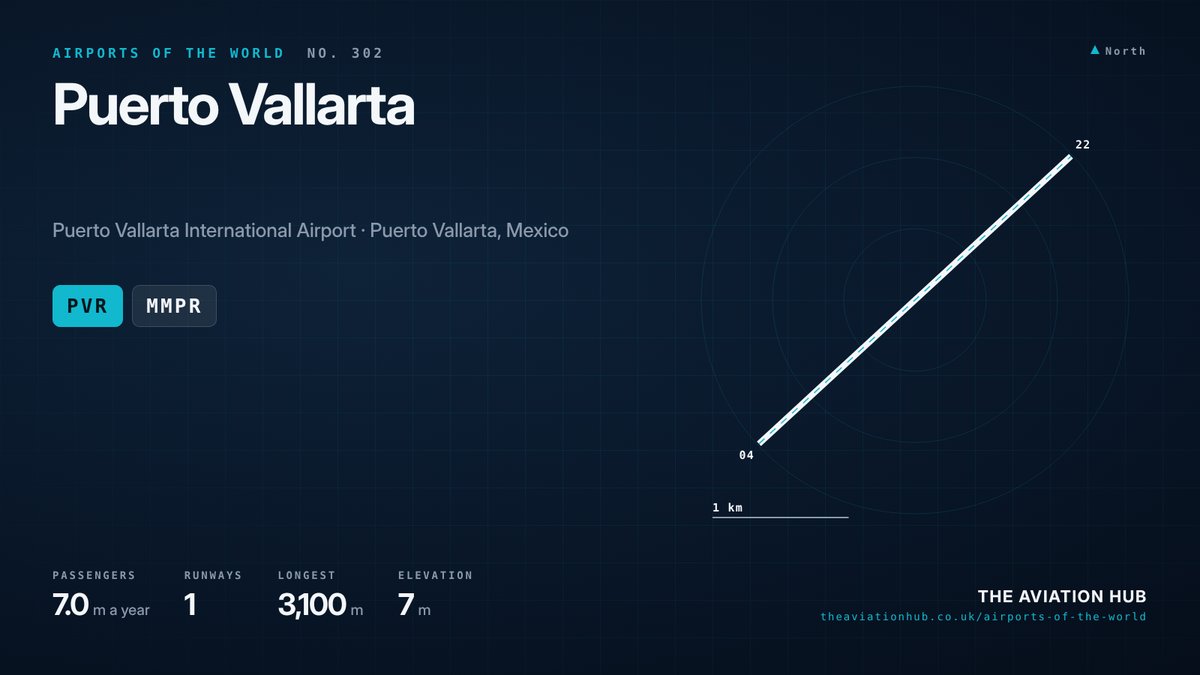
The IATA code is PVR and the ICAO code is MMPR. The airport sits about 5 miles (8 km) north of the old town and the Malecon, on flat land beside the Ameca river that marks the border between Jalisco and Nayarit. Elevation is just 23 feet (7 m). There is one asphalt runway and one passenger terminal, with a second terminal under construction.
Grupo Aeroportuario del Pacifico, usually shortened to GAP, has operated Puerto Vallarta Airport since Mexico privatised its regional airports in the late 1990s. GAP also runs Guadalajara, Tijuana and Los Cabos. Traffic has climbed from roughly 3.6 million in 2015 to about seven million in recent years. No airline bases a large fleet here, but Volaris, VivaAerobus, Aeromexico, WestJet, Air Canada, Alaska, American, United, Delta and Southwest all maintain a heavy presence. Live arrivals and parking information are on the airport’s official website.
How Puerto Vallarta’s Airport Came to Be
Puerto Vallarta was a fishing village until Hollywood arrived. The filming of The Night of the Iguana in 1963, and the attendant publicity around Richard Burton and Elizabeth Taylor, turned the town into a destination almost overnight. The federal government responded with new roads, a port and an airport capable of taking jets. The airport took the name of Gustavo Diaz Ordaz, the president in office from 1964 to 1970.
Traffic built steadily through the 1970s and 1980s as Mexicana and Aeromexico added flights from Mexico City and the United States carriers discovered the beaches. The terminal was rebuilt and extended more than once, eventually splitting into Hall A for domestic flights and Hall B for international arrivals and departures. Privatisation in 1998 handed the concession to GAP, which invested in the apron, the runway and the commercial areas.
The most recent turning point came in the 2020s. The pandemic emptied the airport for a few months, then North American demand came roaring back faster than almost anywhere else in Mexico. GAP responded with a second terminal, begun in 2022, which is the largest project in the airport’s history.
Runways at Puerto Vallarta Airport
Puerto Vallarta Airport has a single asphalt runway, 04/22, measuring 3,100 m (10,171 ft) with a width of 45 m. That length comfortably handles the Boeing 737 MAX 8 and Airbus A321neo fleets that dominate the schedule, and it has taken wide bodies such as TUI Boeing 787s from the UK and Air Transat Airbus A330s from Canada. The low elevation and sea level air help performance even on hot afternoons.
Prevailing winds off the bay mean runway 22 handles most arrivals and departures, with aircraft approaching from the northeast over the Ameca valley and departing out over the Pacific. On the occasions when runway 04 is in use, approaches come in low over the water and the hotel zone. The single runway sets a practical ceiling on movements, and on peak winter Saturdays the taxiways fill with aircraft waiting for their departure slot.
Terminals and Airlines
The original terminal is organised into two halls that share one roof. Hall A handles domestic traffic and is home to Volaris, VivaAerobus, Aeromexico and Aeromexico Connect, with flights to Mexico City, Guadalajara, Monterrey, Tijuana and a growing list of regional cities. Hall B deals with international carriers, which in practice means almost every airline from Canada and the United States. Air Canada, WestJet, Air Transat, Flair and Porter cover the Canadian market. American, United, Delta, Alaska, Southwest, Frontier and Sun Country fly from the United States.
GAP’s new Terminal 2 is still being built and is designed to roughly double the airport’s capacity. The first six contact gates are due by December 2026, with full opening expected in early 2027. It brings more boarding bridges, a new bus terminal, better parking and the sort of retail that the original terminal never had room for, which should relieve the chronic queues during the winter peak. Lounges are modest; the main pay in option is the VIP lounge in Hall B.
Routes and Destinations
Mexico City is by far the busiest domestic route, carried by Aeromexico, Volaris and VivaAerobus with several daily departures. Guadalajara and Monterrey follow. The low cost carriers keep adding regional cities, with Volaris starting Puebla, Aguascalientes and San Luis Potosi in 2026.
Internationally, Los Angeles, San Francisco, Dallas Fort Worth, Houston, Phoenix, Denver and Chicago are the heavy hitters, with Vancouver, Calgary and Toronto leading the Canadian side. The Canadian market is remarkable for its depth: WestJet alone serves more international destinations from Puerto Vallarta Airport than any other airline, and Air Transat serves Montreal. At about 2,470 miles (3,980 km), Montreal is among the longest regular routes, well beyond Toronto at about 2,170 miles (3,490 km).
The schedule swings dramatically with the seasons. December to April sees seasonal flights from secondary North American cities such as Edmonton, Winnipeg, Minneapolis and Salt Lake City, most of which vanish by June. Summer brings the rains and a quieter airport serving mostly domestic leisure passengers. Cargo is minimal beyond belly freight.
Getting to and from Puerto Vallarta Airport
Puerto Vallarta Airport sits directly on Highway 200, the coastal road that links the hotel zone with Nuevo Vallarta and Riviera Nayarit. Taxis from the terminal are run by a regulated airport concession with fixed zone prices, and a ride to the Zona Romantica costs roughly 400 to 500 pesos (around £17 to £21). Crossing the pedestrian bridge over the highway lets you hail a cheaper city taxi or an Uber, which the airport taxi union has long resisted.
Local buses are the cheapest option by a wide margin. City buses stop on Highway 200 outside the airport and run south to the centre for a low fare, taking 30 to 40 minutes. Buses north to Nuevo Vallarta, Bucerias and Sayulita leave from the same road. Pre booked resort transfers and shared shuttles are popular with package tourists. There is no rail link and none is planned. Car hire desks fill the arrivals hall, and the drive to the Marina district takes about ten minutes.
Spotting and Photography
The approach to runway 22 comes in from the north east across the Ameca river, and roads on the Nayarit side give views of aircraft on final with the Sierra Madre behind them. The beach at Boca de Tomates, west of the airport, offers a seaside view of departures climbing out over the bay.
Inside Puerto Vallarta Airport, the departure gates in Hall B look out across the apron to the runway. Winter weekends are the time to visit, when the ramp holds WestJet 737 MAX 8s, Air Transat Airbus jets, Volaris A321neos and the occasional wide body. Security staff are relaxed about cameras in public areas but not about anyone lingering near the perimeter fence or the cargo gate. Respect the taxi marshals, carry water, and do not stand on the highway shoulder.
What Comes Next
Terminal 2 is the project that defines the airport’s next decade. GAP has framed it as a step towards handling well over ten million passengers a year, and it aims to make Puerto Vallarta the first airport in Latin America certified as net zero. Space for a second runway is limited, since the site is hemmed in by the river, the highway and the sea.
The constraint is more likely to be the city than the airport. Puerto Vallarta’s hotel inventory is growing but so is local pushback on water and congestion. For the next few years, though, this field will remain the only serious gateway to the bay. Puerto Vallarta Airport is heading for growth, and the new terminal gives it the room to absorb it. Compare it with other Mexican gateways on our Airports of the World map.
Continue to follow The Aviation Hub for more analysis and insight.
Advertise with us Your brand, in front of an aviation audience Home page and in-article placements, sold directly, one advertiser per slot. From £250 a year. See the rates

