
Pune Airport Guide: A Civil Enclave on a Fighter Base
Pune Airport shares its runway with an Indian Air Force fighter base. Read about the new terminal, busiest routes, transport links and what comes next.
 By The Aviation Hub
6 min read
Updated October 20, 2026
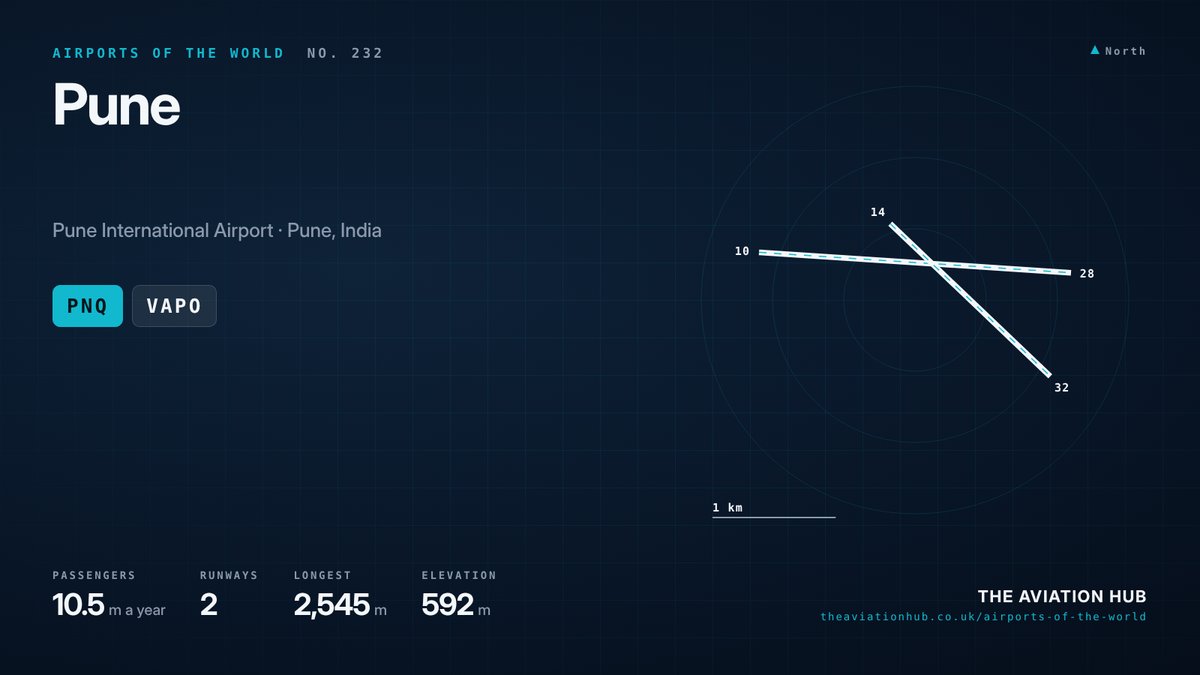
Pune’s airport sits at Lohegaon, about 7 miles (11 km) north east of the city centre, inside an active Indian Air Force station. Airliners share the runway with Sukhoi fighters, and the military controls the sky. Pune Airport handled about 11 million passengers in the year to March 2026, serving a city of IT parks, car factories and universities in western Maharashtra. A new terminal opened in 2024, but the military setting still shapes almost everything about how the airport works.
Pune Airport at a Glance
The IATA code is PNQ and the ICAO code is VAPO. The field lies 1,942 feet (592 m) above sea level on the Deccan plateau. There are two runways in the published data, though only one serves airliners, and two passenger terminals. Traffic reached 11,005,988 passengers in the 2025 to 2026 financial year, up 5.2 per cent.
The Airports Authority of India runs the civil enclave, while the Indian Air Force owns the airfield and handles air traffic control. No airline treats Pune Airport as a formal hub. IndiGo serves the most destinations by a wide margin, followed by Air India Express, SpiceJet, Akasa Air and Star Air. Flight information and terminal guidance are available on the airport’s official website.
How Pune’s Airport Came to Be
The airfield opened in 1939 as RAF Poona, built to provide air defence for Bombay, now Mumbai. During the Second World War it hosted squadrons flying the de Havilland Mosquito, Vickers Wellington and Supermarine Spitfire. The Royal Indian Air Force took charge in May 1947, and the base has remained in military hands since.
Civil flights grew up around the base rather than replacing it. Pune became a customs airport in 1997, mainly so that farmers could export perishable produce. In 2008 the old terminal gained international departure and arrival wings. That same year Lufthansa began flying to Frankfurt with an Airbus A319 configured entirely in business class, operated by PrivatAir, because the runway could not support a larger jet on such a long sector.
The Lufthansa link survived for a decade. After the PrivatAir lease ended in 2018, Lufthansa briefly flew its own aircraft with a technical stop in Baku, and the last flight left in January 2019. The biggest change at Pune Airport came on 14 July 2024, when a new terminal of about 52,000 square metres opened after long delays over permissions and security staffing. Air India and Air India Express operated its first flights, to Delhi and Bhubaneswar.
Runways at Pune Airport
Runway 10/28 is asphalt, 2,545 metres (8,350 feet) long and 46 metres wide, a modest length which explains why wide body services and long range flights have never taken hold. A second asphalt strip, 14/32, measures 1,796 metres (5,893 feet) by 46 metres, but the Air Force now uses it mainly as a taxiway.
The Airports Authority built a parallel civil taxiway, 2,200 metres long, to ease congestion. Navigation aids include a DVOR/DME and an NDB, and the runway has night landing facilities. Military control is the real constraint. The Air Force sets the hours, blocks time for training sorties and has clashed with civil authorities over night slots, and the runway closed for 14 days for repairs in October 2021.
Terminals and Airlines
The 2024 terminal now carries most departing passengers. It was designed for more than 9 million passengers a year, with larger check in halls, more aerobridges and far more space for security queues. The original building of about 6,500 square metres, with its 2008 international wings, remains in use alongside it.
The fleet mix is almost entirely narrow body. IndiGo flies Airbus A320neo and A321neo jets to dozens of cities, and Air India Express and Akasa Air operate Boeing 737 MAX 8 aircraft. Air India and SpiceJet complete the picture. There are no foreign airlines on the schedule, so every international passenger at Pune Airport flies with an Indian carrier.
The terminal has earned praise. In the 2025 ACI Airport Service Quality survey it ranked first among Indian airports handling 5 to 15 million passengers.
Routes and Destinations
Delhi is the dominant route, with about 1.4 million departing passengers in 2023 to 2024. Bengaluru followed with almost 900,000, ahead of Chennai, Hyderabad and Ahmedabad. Pune Airport links the city’s IT and manufacturing workforce with India’s other business centres, so weekday mornings and evenings are the peak.
International flying is thin. Dubai and Singapore were the busiest foreign routes in 2023 to 2024, with roughly 60,000 and 31,000 departing passengers respectively. Singapore has since dropped off the schedule, so Bangkok, about 1,800 miles (2,900 km) away, is now the longest route. Flights to the Netherlands and Germany have been proposed, which would restore a direct European link for the first time since 2019.
Cargo is modest but useful, with grapes, flowers and other perishables shipped out through the customs facility. A dedicated international cargo terminal has been proposed.
Getting to and from Pune Airport
There is no rail link to the terminal. Ramwadi station on Pune Metro lies about 2 miles (3 km) away, and PMPML feeder buses connect the two. That combination is the cheapest sensible route into the city. PMPML also runs an airport shuttle to several districts.
Most passengers take a taxi or app cab. Prepaid taxi counters and auto rickshaw ranks serve the terminals, and the journey to Pune Junction or Shivajinagar takes 30 to 45 minutes depending on traffic. The roads around Viman Nagar and Lohegaon are congested at peak hours, so allow plenty of time. Coaches run to Mumbai and other cities, and car rental firms operate at Pune Airport.
Spotting and Photography
Spotting at Pune Airport is not recommended outside the terminal. This is a frontline Air Force station, and photographing military aircraft, installations or the perimeter can lead to arrest. Do not point cameras at the base from surrounding roads, rooftops or hotels.
The safe option is the departure lounge of the new terminal, where large windows overlook the civil apron and the runway. From there passengers can watch IndiGo, Akasa and Air India Express movements, and Su-30MKI fighters often roar past on take off. Morning light is soft and the monsoon months from June to September bring dramatic skies.
Respect the rules without exception. Keep photography to the civil apron from inside the building, and stop immediately if security staff object.
What Comes Next
The 2024 terminal has eased the worst crowding, and a proposed international cargo facility would help exporters. The deeper problem is the runway. As long as the Air Force controls it, civil growth will be capped by military priorities.
The long term answer is a greenfield airport at Purandar, south east of the city, on about 2,832 hectares. Opposition to land acquisition has slowed the project, and a state approved proposal to rename the existing field after the saint Tukaram also awaits central approval. Pune Airport will keep growing in the meantime, but the city needs Purandar to become a true international gateway. See where both sites sit on the Airports of the World map.
Continue to follow The Aviation Hub for more analysis and insight.
Advertise with us Your brand, in front of an aviation audience Home page and in-article placements, sold directly, one advertiser per slot. From £250 a year. See the rates

