Punta Cana Airport Guide: The Caribbean’s Private Gateway
Punta Cana Airport is a privately built resort gateway with two runways and palm thatched terminals. Its airlines, busiest routes and transfers explained.
 By The Aviation Hub
7 min read
Updated October 20, 2026
Punta Cana International Airport serves the resort coast at the eastern tip of the Dominican Republic, a few miles inland from the beaches of Bavaro and Cap Cana. It was built by a private developer rather than a government, which was unusual in 1983 and remains unusual today. Punta Cana Airport handled around 11 million passengers in 2025, making it the busiest airport in the Dominican Republic and the second busiest in the Caribbean. Almost every passenger is a holidaymaker, and the terminals are designed to feel like part of the resort.
Punta Cana Airport at a Glance
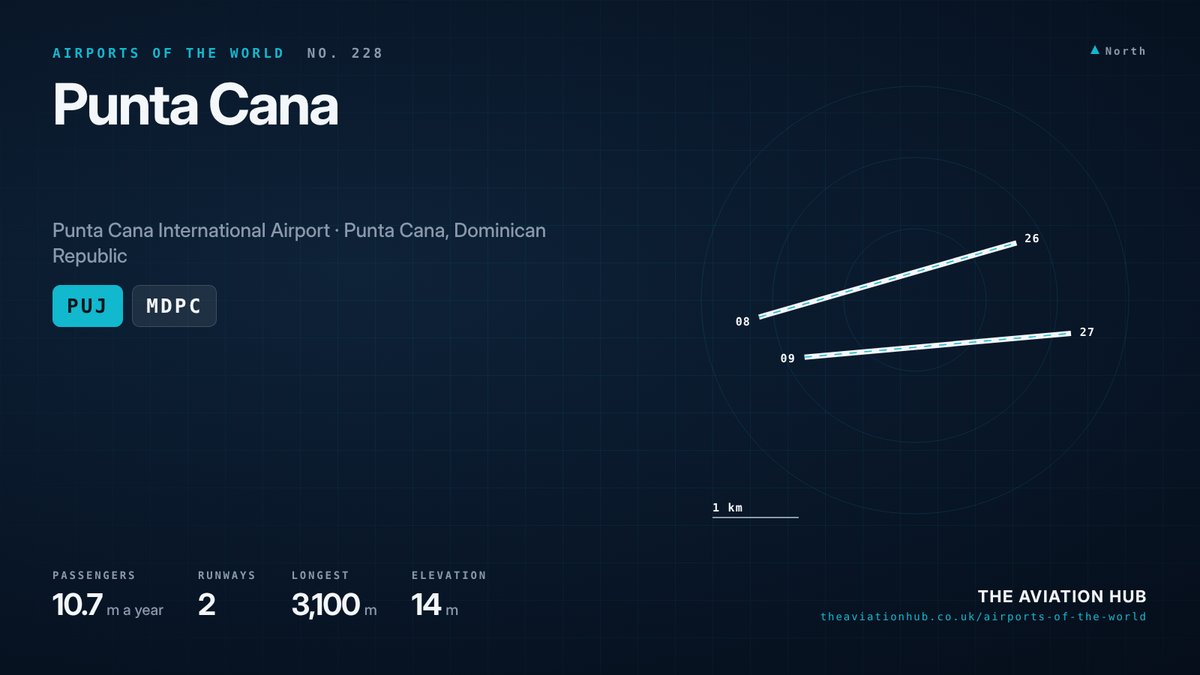
The IATA code is PUJ and the ICAO code is MDPC. The field sits at 47 feet (14 m) above sea level on flat coastal scrub in La Altagracia province, roughly 10 miles (16 km) from the main Bavaro hotel zone, with the provincial capital Higuey further inland to the west. There are two runways and two international terminals, plus separate buildings for domestic, executive and VIP traffic. In 2025 the airport recorded just over 11 million passengers and 61,500 aircraft movements.
Arajet, the Dominican low cost carrier, and Air Century both base aircraft here. Grupo Puntacana, the resort developer founded by Frank Rainieri and the late Ted Kheel, owns and operates the airport outright. Flight information, terminal details and lounge bookings sit on the airport’s official website.
How Punta Cana’s Airport Came to Be
In 1969 Grupo Puntacana bought a stretch of undeveloped coastline with no road, no electricity and no town. The partners built a small hotel and realised that guests would never come in numbers while the only access was a rough track from Higuey. A road arrived in the late 1970s. The developers then decided to build their own airport, and the Dominican government granted the concession.
The airport opened in December 1983 to a design by the architect Oscar Imbert. The original terminals were open to the air, with roofs of palm fronds supported by timber, and that style still defines the buildings. It is widely described as the first privately owned international airport in the world. Charter flights from Europe and Canada soon followed, and the resort strip grew around it.
The turning points have been physical. A second runway opened in 2011, Terminal B with its first jet bridges arrived in 2014, and a new VIP lounge with a pool followed in 2017. Terminal B doubled from seven to 14 gates in 2023. Punta Cana Airport has grown with the hotels, financed by the same company that owns them.
Runways at Punta Cana Airport
There are two runways. The main runway is 08/26, an asphalt strip of 3,100 metres (10,171 feet) and 45 metres wide. The second, 09/27, is also 3,100 metres (10,171 feet) long and 45 metres wide and acts as the backup, used when the main runway is closed for maintenance or when traffic peaks. Both are long enough for the Boeing 777-300ER and Airbus A350 flown by European and Latin American carriers.
The runways lie almost parallel and close together, so simultaneous operations are limited. Trade winds blow from the east for most of the year, which makes runways 08 and 09 the standard configuration with arrivals approaching from inland to the west. Hurricane season from June to November brings the main disruption. The airport has handled several landing incidents, including a Skyservice Boeing 767 in 2005 that fractured its upper fuselage and an overweight Orenair Boeing 777 in 2016 whose brakes caught fire after an engine failure. Nobody died in either event.
Terminals and Airlines
Terminal A is the older building at Punta Cana Airport and keeps the open air thatched character. Terminal B opened in 2014 with jet bridges and air conditioning and now has 14 contact gates plus three remote stands. Airlines are spread between the two by agreement rather than alliance, and the allocation changes. The National Terminal handles domestic charters and light aircraft, the FBO serves business jets and the VIP terminal offers a private apron and lounge for the resort’s wealthier guests.
North American carriers dominate. American Airlines, Delta, JetBlue, United, Frontier, Southwest and Breeze fly from the United States, while Air Canada, WestJet, Air Transat and Flair serve Canada. Copa connects Panama City. From Europe, TUI, British Airways, Condor, Discover, Edelweiss, Air France, Air Europa and Iberojet bring charter and scheduled wide bodies, and LATAM, Avianca and Arajet link South America.
Arajet, the Boeing 737 MAX 8 operator launched in 2022, uses the airport as its second base after Santo Domingo. Air Century flies regional turboprops and small jets across the Caribbean.
Routes and Destinations
Toronto Pearson was the busiest international route in 2025 with about 914,000 passengers, ahead of Panama City with 797,000 and New York JFK with 686,000. Montreal and Lima complete the top five. Miami, Boston, Philadelphia, Charlotte, Newark and Fort Lauderdale fill out the American market, which supplies the single largest share of visitors.
Europe is served by Madrid, Paris, Frankfurt, Zurich, London Gatwick and Manchester, and seasonal LOT flights to Katowice are the longest regular route at roughly 5,100 miles (8,200 km). Punta Cana Airport serves around 90 airports in 26 countries. The peak season runs from December to April, when Canadians and Americans flee winter, with a second summer peak driven by European families. Cargo is minor, consisting mostly of belly freight and hotel supplies.
Getting to and from Punta Cana Airport
There is no rail or metro service anywhere in the region. Most visitors arrive on a hotel transfer arranged with their package, and resort minibuses crowd the arrivals kerb. The journey to Bavaro takes 20 to 30 minutes, and to Cap Cana about 15 minutes. Punta Cana Airport sits beside the Boulevard Turistico del Este, the main coastal highway, and the Autopista del Coral toll road reaches Santo Domingo in about two and a half hours.
Taxis operate from a rank outside each terminal at fixed fares, typically around 30 to 40 US dollars to Bavaro. Ride hailing is restricted at the airport. Car hire desks sit in both terminals, and the roads to the resorts are good, though driving standards are not. Public buses run from Higuey and Veron but do not enter the airport, and are not practical with luggage. The pre booked transfer is the cheapest sensible option for most travellers.
Spotting and Photography
Spotting at Punta Cana Airport is possible but not encouraged. The best public vantage is the road along the southern boundary near the threshold of runway 26, where arrivals pass low over the scrub and the afternoon sun is behind the camera. Morning light suits the western end, under the approaches to runways 08 and 09.
The variety is excellent for the Caribbean. Wide bodies from Condor, Edelweiss, Air France, British Airways, Air Europa and TUI mix with the full spread of North American narrow bodies and the Arajet MAX fleet. Winter weekends bring the heaviest traffic, with aircraft arriving in waves through the middle of the day. The open air terminals give passengers decent views from the gates.
Private ownership means private security. Do not approach fences, do not photograph the VIP apron and move on if asked. Carry identification and keep tripods in the car.
What Comes Next
Grupo Puntacana continues to expand in step with hotel construction. The 2023 extension of Terminal B added capacity for the next surge, and further apron and terminal work is planned as passenger numbers climb towards 12 million. A United States Customs and Border Protection preclearance facility has been discussed for years but has yet to open.
Arajet is the new variable. Its network from the airport grows each season, with a Montevideo route scheduled for March 2027, and it brings a point to point model to a field built for charters. Punta Cana Airport is heading for continued growth, limited only by hurricane risk and the pace of resort building along the coast. Compare it with other Caribbean gateways on the Airports of the World map.
Continue to follow The Aviation Hub for more analysis and insight.
Advertise with us Your brand, in front of an aviation audience Home page and in-article placements, sold directly, one advertiser per slot. From £250 a year. See the rates