
Quanzhou Airport Guide: Fujian’s Shared Military Field
Quanzhou Airport serves the Fujian coast from a single runway shared with the air force. Here is its history, airlines, routes, access and spotting advice.
 By The Aviation Hub
6 min read
Updated October 20, 2026
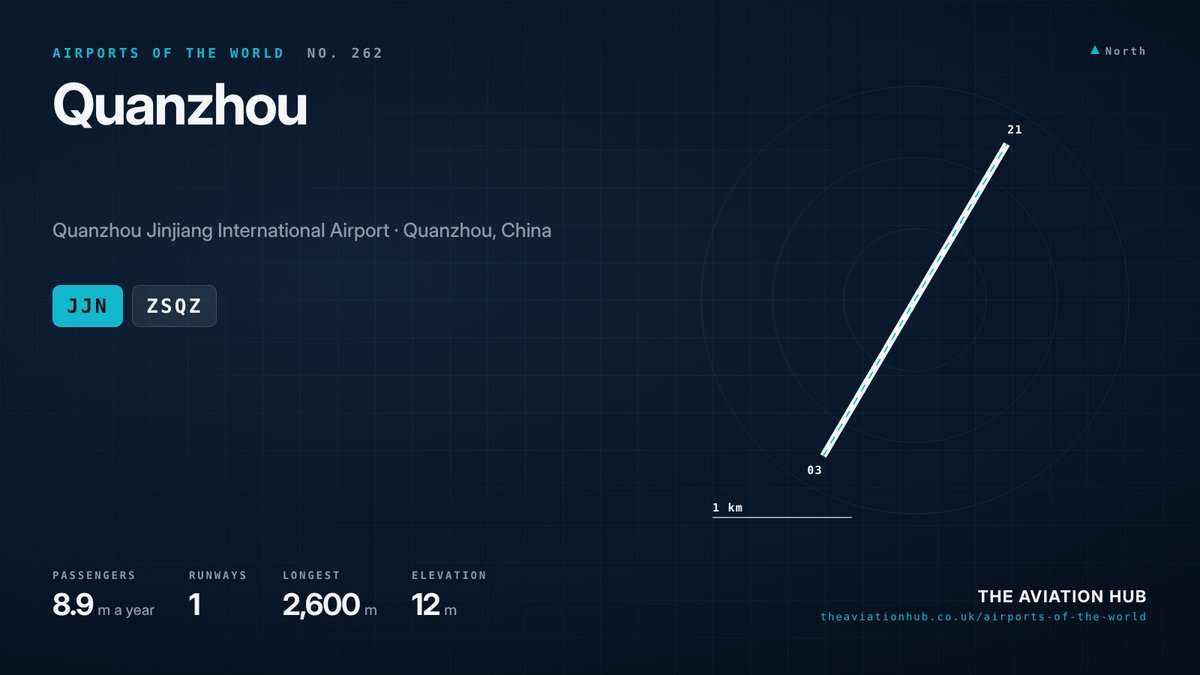
Quanzhou Jinjiang International Airport serves one of the richest manufacturing regions on the Chinese coast, the cluster of shoe and textile towns south of Quanzhou in Fujian Province. The field sits in Jinjiang, a county level city within Quanzhou, and handles close to nine million passengers a year on a single runway it shares with the Chinese air force. Quanzhou Airport is a focus city for XiamenAir and a gateway for the large overseas Chinese communities of the Philippines and Southeast Asia that trace their roots to this coast.
Quanzhou Airport at a Glance
The IATA code is JJN, taken from Jinjiang, and the ICAO code is ZSQZ. The airport lies about 7 miles (12 km) south of the Quanzhou city centre and only a short drive from the centre of Jinjiang. Elevation is 12 metres (39 feet). There is one runway, and the terminal handles both domestic and international flights.
Traffic reached roughly 8.85 million passengers in 2025, almost flat on 2024, with around 63,000 aircraft movements and about 74,000 tonnes of freight. XiamenAir is the largest operator and treats the field as a focus city alongside its main hub at Xiamen. China Eastern, Shenzhen Airlines, Air China, China Southern, Sichuan Airlines and Shanghai Airlines all serve it. Quanzhou Airport is a civil and military field, so the runway and much of the land belong to the air force while the civil side is run by a local airport company. Flight information is published on the airport’s official website.
A Short History of Jinjiang Airfield
The airfield dates from August 1955, when it opened as a military field on the coast facing Taiwan across the strait. For four decades it was purely military, and the Quanzhou region had no airline service of its own. Passengers used Xiamen or Fuzhou.
Civil flights began on 12 December 1996, once a passenger terminal and apron had been added to the base. The private economy of Jinjiang, built on footwear, clothing and ceramics, drove the demand. Domestic routes to Beijing, Shanghai and Guangzhou filled quickly with business travellers.
The turning point came in November 2012 when the field gained international status and its present name. International flights to Manila followed, serving the Hokkien speaking diaspora. A larger terminal and apron expansion arrived in the following years as traffic climbed past five million and then eight million passengers.
Runways at Quanzhou Airport
Quanzhou Airport has one asphalt runway, 03/21, measuring 2,600 metres (8,530 feet) long and 50 metres wide. That is modest by Chinese standards. The field is rated for aircraft up to the size of a Boeing 767, and Airbus A320 family and Boeing 737 aircraft form almost all of the traffic.
Because the air force owns the runway, civil operations fit around military flying. The shared runway is one of the limits on the field’s growth. Aircraft take off and land into wind, so the northeast monsoon of winter puts most operations on runway 03. Summer brings southwesterly winds and more use of runway 21. Typhoons between July and September cause periodic closures.
Terminals and Airlines
Domestic flights take the great majority of passengers, and a small international and regional operation serves Macau, the Philippines and Malaysia. XiamenAir dominates both. It is a SkyTeam member, and China Eastern adds further SkyTeam capacity here. Air China and Shenzhen Airlines represent Star Alliance, while Sichuan Airlines, Spring Airlines and other independents add trunk capacity.
XiamenAir has the widest network by far, and Shenzhen Airlines runs the second largest. Around two dozen other Chinese airlines add a handful of routes each. Philippine Airlines and Central Airlines are the only foreign based carriers.
Routes and Destinations
The main routes from Quanzhou Airport are the domestic trunks to Beijing, Shanghai Hongqiao and Pudong, Guangzhou, Chengdu, Chongqing and Kunming. Several of these are served by more than one airline. Flights to Xi’an, Wuhan, Changsha, Nanjing and Hangzhou connect the Fujian factories to their customers. Secondary routes reach Harbin, Shenyang and Urumqi.
International flying is small but distinctive. Manila is the most important foreign destination because of the Filipino Chinese community, served by XiamenAir, Philippine Airlines and Central Airlines. XiamenAir also flies to Cebu and Kuala Lumpur. Macau carries steady regional traffic. Freight is significant for an airport of this size because of the footwear and clothing exporters nearby, and bellyhold cargo of around 74,000 tonnes a year leaves mostly on domestic flights.
Getting to and from Quanzhou Airport
There is no rail station at the terminal. The nearest high speed stations are Jinjiang, roughly 20 minutes away by taxi, and Quanzhou railway station on the Fuzhou to Xiamen line, about 40 minutes. From Quanzhou station the fast trains reach Xiamen in half an hour and Fuzhou in just over an hour. Airport buses link the terminal with the Quanzhou city centre, Jinjiang, Shishi and Nan’an, with fares of around 10 to 20 yuan (roughly £1 to £2).
Taxis from Quanzhou Airport to the city centre cost about 50 yuan and take 30 minutes outside the rush hour. Ride hailing through Didi is cheaper and more reliable than the taxi rank. By car the airport sits beside the G15 Shenyang to Haikou expressway, which gives a 90 minute run to Xiamen. Parking is in surface lots in front of the terminal, with the first few hours costing a few yuan.
Spotting and Photography
Quanzhou Airport is a military base and photography is a sensitive matter. Chinese law treats the air force side as a restricted zone, and anyone pointing a long lens at the runway from outside the fence can expect a visit from the police. Enthusiasts should keep their cameras inside the terminal, where the departure gates give acceptable views across the civil apron and of aircraft taxiing to runway 21.
The light is best in the afternoon from the pier windows. The traffic is mostly XiamenAir 737-800s and 737 MAX 8s, China Eastern A320neos and Shenzhen Airlines A320s. Do not photograph military aircraft, do not linger on roads around the base and respect any instruction from security staff. The fence lines here are not places for a casual visit.
What Comes Next
The constraints are obvious. A shared runway, a 2,600 metre strip and a compact site cap the airport’s growth, and traffic barely moved in 2025. Fujian’s provincial plan favours the new Xiamen Xiang’an airport, under construction on Dadeng Island to the south and expected to open in late 2026, as the region’s main international gateway. When it opens, Quanzhou passengers will have a large new airport within an hour by road and rail.
The likely future for Quanzhou Airport is as a busy domestic point and a niche gateway to the Philippines, with growth tied to the factory economy that built it. For comparisons across China’s coastal airports see our Airports of the World map.
Continue to follow The Aviation Hub for more analysis and insight.
Advertise with us Your brand, in front of an aviation audience Home page and in-article placements, sold directly, one advertiser per slot. From £250 a year. See the rates

