
Quito Airport, officially Mariscal Sucre International Airport, is the main gateway to Ecuador’s capital and its Andean highlands. It opened in 2013 on the Tababela plateau east of the city, replacing a cramped and dangerous predecessor in the middle of Quito. At 2,411 m above sea level it is one of the highest major airports in South America. It is the hub for LATAM Ecuador and Avianca Ecuador and a big exporter of cut flowers.
Quito Airport at a Glance
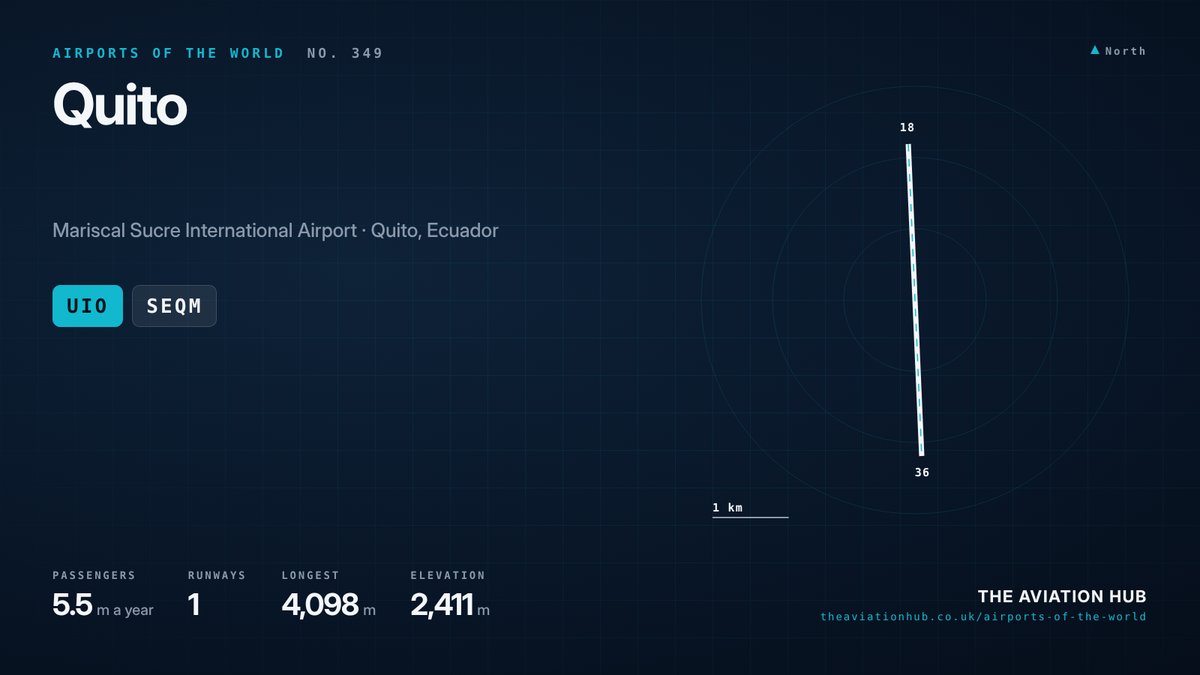
The airport carries the IATA code UIO and the ICAO code SEQM. It lies about 11 miles (18 km) east of Quito in a straight line, though the road journey to the city centre is considerably longer. Its elevation is 2,411 m (7,910 ft), and a single concrete runway, 18/36, serves a single passenger terminal.
Quito Airport has handled roughly 5 million passengers a year in recent years, recovering from about 4.3 million in 2022 towards its earlier peak. LATAM Ecuador and Avianca Ecuador both use it as a hub, and it was the main base of the state airline TAME until that carrier was liquidated in 2020. The concessionaire Quiport runs the airport for the city. Schedules and transport details are on the airport’s official website.
How Quito’s Airport Came to Be
The original Mariscal Sucre airport opened in 1960 in what was then the northern edge of the city. Quito grew around it, and by the 2000s the runway was boxed in by apartment blocks, with mountains close by and strong winds a constant problem. It had a string of incidents and overruns in its later years, and it could not be extended.
Construction of a replacement began in 2006 at Tababela. The financing contract was renegotiated in 2010, and an inaugural proving flight on 2 July 2012 carried the mayor and around 100 guests on an American Airlines Boeing 757 for a nine minute hop. The official opening slipped from October 2012, and the new airport finally began operations on 20 February 2013, the day after the old one closed.
The new field kept the name of Antonio Jose de Sucre, the independence hero, though many locals call it Tababela. The old site was turned into the Parque Bicentenario, a large public park.
Runways at Quito Airport
Runway 18/36 is 4,098 m (13,445 ft) long and 45 m wide with a concrete surface. The length is essential. At this altitude the air is thin, engines produce less thrust and aircraft need far more distance to take off, especially when fully loaded for long flights to Europe or the United States.
The extra length transformed operations. Wide body aircraft such as the Boeing 787 and Airbus A330 can operate with far fewer payload restrictions than at the old city airport. The surrounding terrain is gentler on the plateau, but the Andes are never far away and approach procedures are designed around them. Wind and weather decide whether 18 or 36 is in use. Morning fog and afternoon storms are common in the rainy months.
Terminals and Airlines
Quito Airport has one modern passenger terminal handling both domestic and international flights, with jet bridges and remote stands on a broad apron. Skytrax made it the first five star rated airport in the Western Hemisphere, a reflection of its clean, efficient design. Cargo has its own extensive facilities beside the passenger area.
LATAM Ecuador operates a large domestic network, with Airbus A320 family jets to Guayaquil, Cuenca and the Galapagos. Avianca Ecuador provides the main domestic competition and feeds Avianca’s Bogota hub. Among foreign carriers, American, Delta and United link the United States, and Avianca Ecuador adds New York JFK. Iberia and Air Europa fly to Madrid and KLM to Amsterdam. Copa connects Panama City and Aeromexico serves Mexico City, giving travellers options across all three global alliances.
Routes and Destinations
Guayaquil is the busiest domestic route from Quito Airport, linking the capital with the country’s largest city and port. Cuenca comes second, ahead of Baltra in the Galapagos. The island flights to Baltra and San Cristobal carry a steady stream of tourists, many stopping in Guayaquil on the way. Internationally, Panama City, Bogota, Madrid, Miami and Lima have been the top destinations.
Madrid and Amsterdam are the longest routes and the main links with Europe. New services are on the way. Air Canada plans seasonal flights to Toronto and Montreal from December 2026, and LATAM is due to restore Santiago de Chile in December 2026.
Cargo is a major strength. Around 365,000 tonnes moved through in 2024, and about 92 per cent of exports were flowers. Roses from the Andean farms fill freighters bound for Miami, Amsterdam and beyond, with peaks before Valentine’s Day and Mother’s Day.
Getting to and from Quito Airport
There is no rail link, and the Quito Metro does not reach the airport. Quito Airport is reached by the Ruta Viva expressway through Cumbaya and by the Collas road from the north. Journey times to the city centre range from about 45 minutes to well over an hour, depending heavily on traffic.
The express bus to the Parque Bicentenario on the old airport site stopped in 2024. Cooperative buses now run to the Rio Coca station, the Quitumbe terminal and El Labrador, which connects with the Quito Metro, for about US$2.45, though evening and weekend services are thin. Official taxis charge fixed fares by zone, typically from around US$25 (about £19) to the main hotel districts. Car hire and parking are available at the terminal, and hotels in nearby Tababela and Puembo suit early departures.
Spotting and Photography
The setting is the big attraction for photographers at Quito Airport. On clear mornings snow capped volcanoes stand on the horizon, and the dry plateau air gives sharp detail. The terminal’s public areas give views over the apron, where LATAM and Avianca A320s mix with American and Delta jets and wide body flower freighters.
The roads around Tababela and Puembo pass close to the field and give approach views, depending on the runway in use. Mornings are usually clearer before cloud builds in the afternoon. Ecuadorian police and airport security patrol the perimeter, so keep to public roads, carry identification and avoid photographing security installations. Altitude also affects visitors, so take water and do not overexert yourself.
What Comes Next
The terminal and runway were built with growth in mind, leaving spare capacity for years to come. The priority now is recovering and growing long haul links, with the new Canadian routes a sign of airline confidence. Cargo capacity is just as important, since the flower trade depends on reliable freighter slots and cold storage.
Ecuador’s economy and politics will shape the pace of growth, as they did when TAME collapsed. Yet the long runway, modern terminal and strong export base leave Quito Airport well placed for the next decade. Expect gradual gains in passengers and continued strength in cargo. Compare it with other South American hubs on our Airports of the World map.
Continue to follow The Aviation Hub for more analysis and insight.
Advertise with us Your brand, in front of an aviation audience Home page and in-article placements, sold directly, one advertiser per slot. From £250 a year. See the rates

