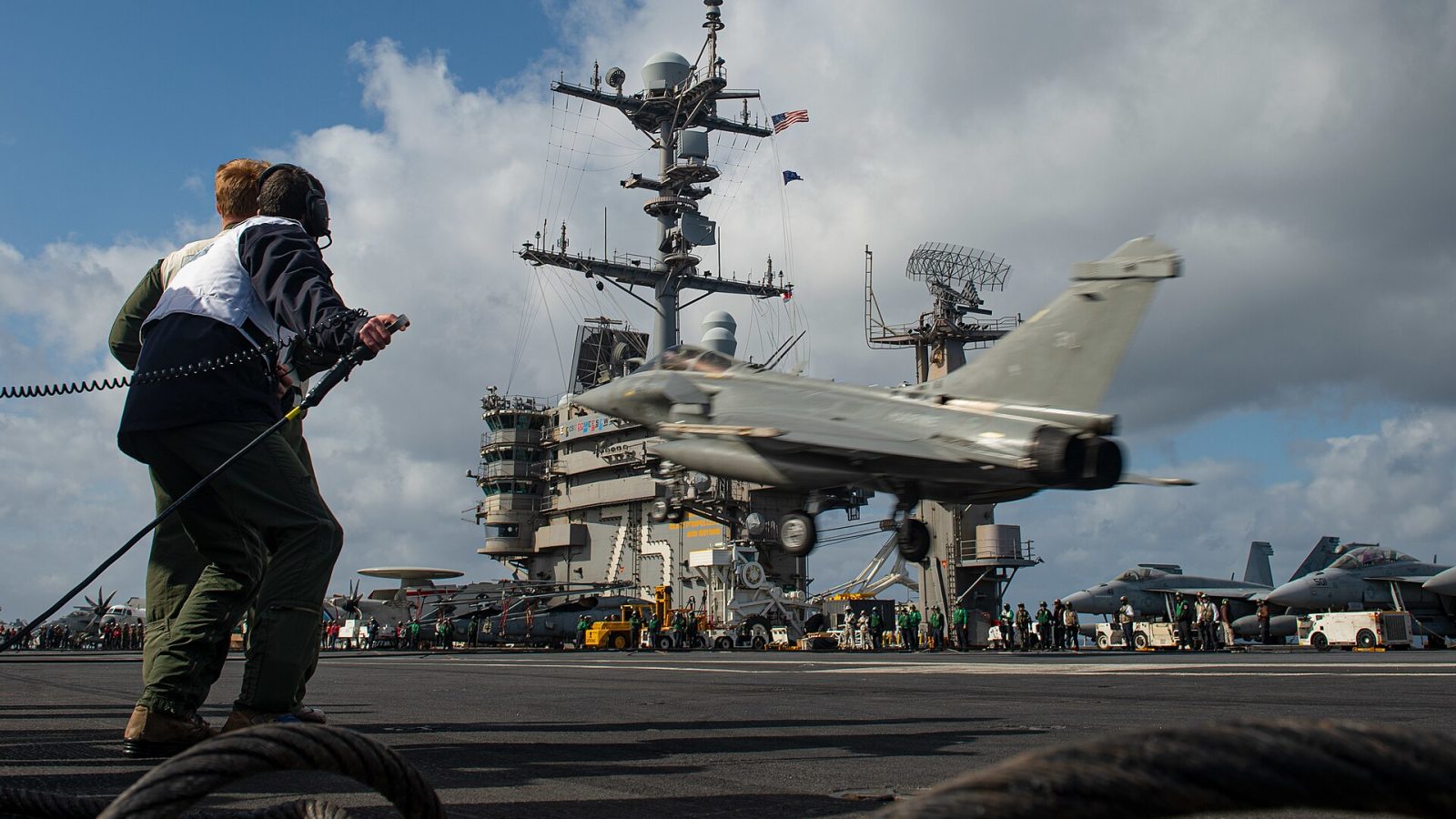
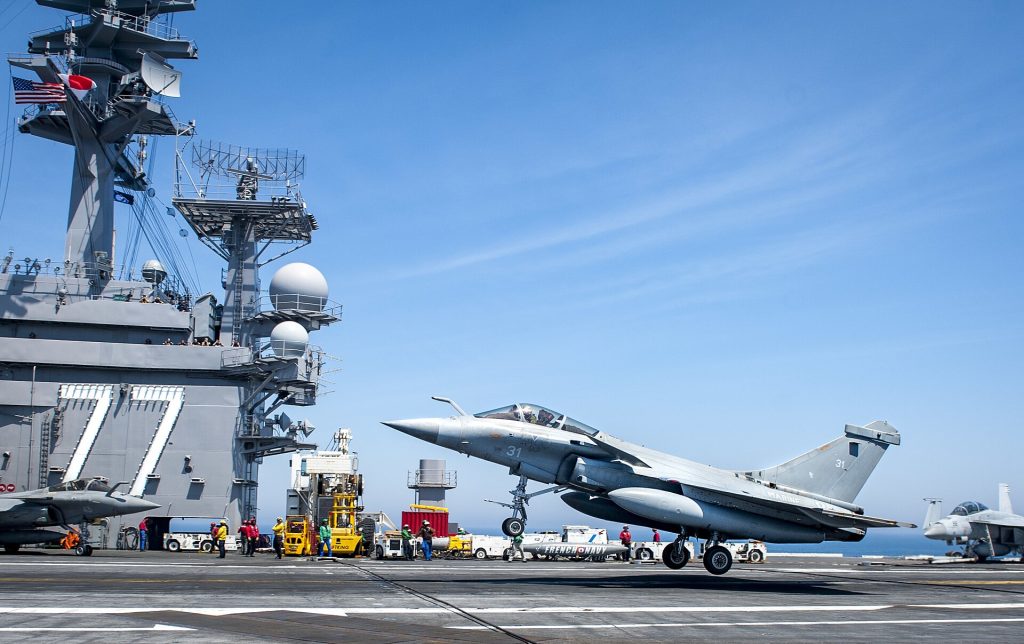
A French Navy Rafale M completed its first-ever arrested landing and ski-jump takeoff from INS Vikrant on 29 October 2026, a milestone the Indian Navy announced the following day. The achievement places India's new carrier one step closer to fielding its future fixed-wing strike force.
What Happened Aboard INS Vikrant
The Rafale M landed on INS Vikrant on the first attempt, according to both Air Data News and The Aviationist. The aircraft then departed using the carrier's ski-jump, completing both elements of the STOBAR cycle, ski-jump takeoff and arrested-wire recovery, that defines how INS Vikrant operates its fixed-wing aircraft.
The Indian Navy described the significance plainly. "The ongoing trials mark the first steps towards operationalisation of the aircraft in the Indian Navy," the service said.
Prior to the shipboard trials, carrier-compatibility testing took place at Goa's Shore-Based Test Facility (SBTF), as The Aviationist reported. Photographs from those shore-based evaluations circulated on social media on 22 October 2026, with The Aviationist again the first to cover them. One week later, on 30 October 2026, the Indian Navy issued its formal announcement.
A Long Road to the Flight Deck
The path to a Rafale M operating from an Indian carrier stretches back several years. A request for information covering 57 Multi-Role Carrier Borne Fighters was issued by India in 2017, a programme that was subsequently reduced to 26 aircraft, Air Data News reported. To demonstrate their aircraft's suitability, Boeing deployed two F/A-18E/F Super Hornets to Goa, where they used the ski-jump facility to show carrier compatibility, according to Air Data News. The competition concluded in July 2023 when India chose the Rafale M over the Super Hornet, as Air Data News and The Aviationist both reported.
An intergovernmental agreement for all 26 aircraft was signed by India and France in April 2025, according to both outlets. Valued at approximately Rs 630 billion, or roughly $7.4 to $7.5 billion, the deal encompasses 22 single-seat Rafale M fighters and four twin-seat trainers, the latter intended solely for land-based operations. Carrier operations for the twin-seat variants are not possible, given that no twin-seat carrier-capable version of the Rafale M has been produced, as both Air Data News and The Aviationist confirmed.
The Rafale M first demonstrated ski-jump capability at INS Hansa, Goa, in January 2022, according to both outlets, giving Dassault and the French Navy an early indication that the aircraft could adapt to STOBAR operations. Air Data News noted that the Rafale M was originally designed for catapult carriers and that the French Navy operates it from the Charles de Gaulle using steam catapults, making this adaptation to a ski-jump environment a notable engineering and operational step.
You can explore the full specifications of the Rafale M and other carrier aircraft through our Aircraft Search tool.
What the Rafale M Replaces
Across both INS Vikrant and INS Vikramaditya, the Indian Navy's MiG-29K fleet is expected to be replaced by the 22 single-seat Rafale M fighters in due course, according to Air Data News and The Aviationist. The MiG-29K's own milestone aboard INS Vikrant came on 6 February 2023, a date that also saw the Naval LCA Tejas complete its inaugural arrested landing and ski-jump departure from the carrier, as both outlets reported.
The Rafale M order therefore represents a generational shift in Indian carrier aviation, consolidating the fixed-wing strike force onto a single Western platform rather than continuing to operate a mixed fleet built around Soviet-era design lineage.
Deliveries and the Path to Operationalisation
First deliveries of the Rafale M to the Indian Navy are expected by the end of 2028 or in early 2029, with the full order scheduled for completion by 2030, according to Air Data News and The Aviationist. The October 2026 shipboard trials arrive well ahead of that delivery window, which suggests the two navies are using this period to refine deck procedures and identify any further integration work before production aircraft arrive.
The trials are described by the Indian Navy as the first steps towards operationalisation, and the service's language makes clear that further work lies ahead before the Rafale M is declared ready for operational carrier deployment.
The Bottom Line
The first arrested landing and ski-jump takeoff by a Rafale M from INS Vikrant closes a chapter that opened with a request for information nearly a decade ago. For the Indian Navy, it is confirmation that the aircraft selected in 2023 can perform the full STOBAR cycle its carriers demand. For Dassault, it extends the Rafale M's operational footprint beyond its sole current operator, the French Navy, and demonstrates flexibility that was not part of the aircraft's original design specification.
With deliveries not due until late 2028 at the earliest, the operationalisation timeline stretches several years ahead. The progress of those deliveries and any further shipboard trial phases will be the next indicators of whether the programme stays on schedule.
This article draws on reporting by Air Data News and The Aviationist.
Continue to follow The Aviation Hub for more analysis and insight.
Advertise with us Your brand, in front of an aviation audience Home page and in-article placements, sold directly, one advertiser per slot. From £250 a year. See the rates