
Raleigh Durham Airport Guide: Research Triangle Gateway
Raleigh Durham Airport links North Carolina's Research Triangle to around 90 destinations. Terminals, runways, routes, access and the new runway explained.
 By The Aviation Hub
6 min read
Updated October 20, 2026
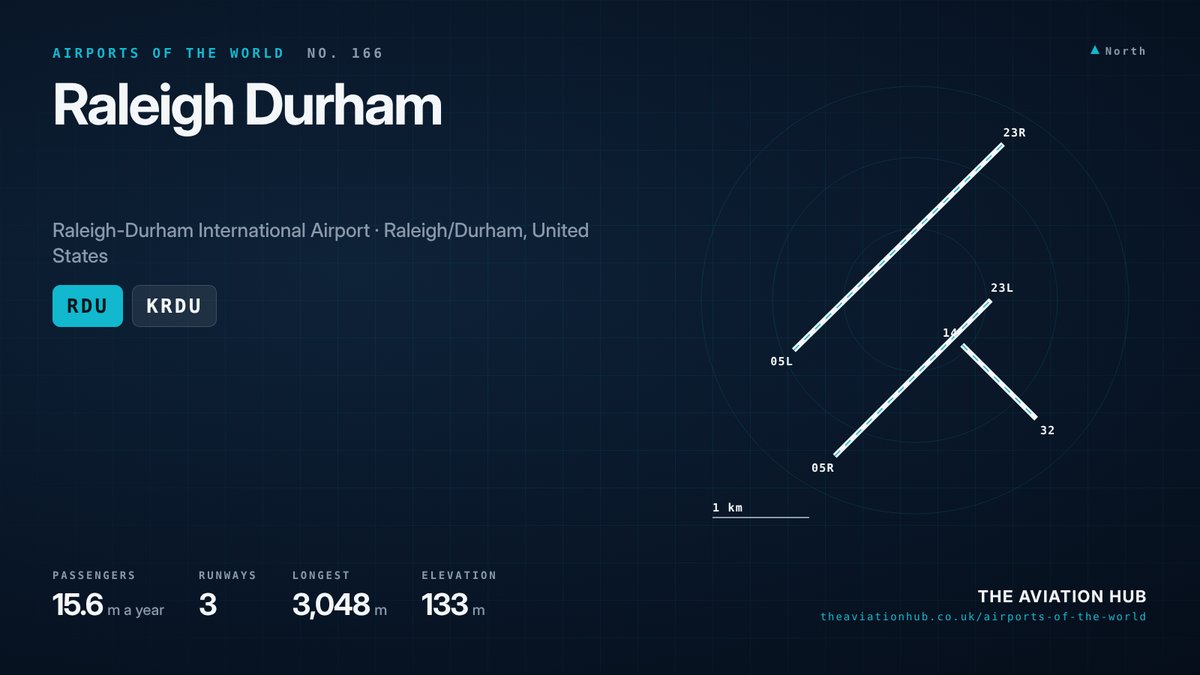
Raleigh Durham Airport sits in the pine woods of Wake County, North Carolina, roughly halfway between the state capital Raleigh and the university city of Durham and a few minutes from Research Triangle Park. It is about 12 miles (19 km) northwest of downtown Raleigh and a similar distance southeast of Durham. A record 15.6 million passengers used the field in 2025, driven by the technology, pharmaceutical and university economy around it. Delta leads the market, Breeze has a base, and a growing set of transatlantic routes gives the region direct links to London, Paris, Frankfurt, Reykjavik and Dublin.
Raleigh Durham Airport at a Glance
The codes are RDU and KRDU. The airport lies 133 m (435 ft) above sea level on around 5,000 acres of rolling, wooded land beside Umstead State Park. There are three runways, two of them parallel, and two terminals that are not connected airside. Just over 15.6 million passengers passed through in 2025, a fraction above the 2024 figure and the third record in a row.
No major carrier calls Raleigh Durham Airport a hub today, although Delta runs it as a focus city and Endeavor Air, the Delta regional subsidiary, keeps a crew base. Breeze Airways has a base here and serves more destinations from the field than anyone else. The Raleigh Durham Airport Authority, a body appointed by the two cities and two counties, owns and operates the airport. Parking rates and flight status are on the airport’s official website.
How the Triangle Got Its Airport
Raleigh’s first airport opened in 1929 on the south side of the city and was quickly outgrown. In 1939 the state created the Raleigh Durham Aeronautical Authority to build a joint field between the two cities, a plan pushed hard by Eastern Air Lines, which wanted a stop on its north to south routes. The new airport opened on 1 May 1943, and its first terminal was built partly from materials left over from Army Air Forces barracks.
The field stayed modest until American Airlines chose it for a hub in 1987 and built a new terminal for it on the site now occupied by Terminal 2. The hub lasted eight years. American pulled out in 1995, Midway Airlines moved in and used the terminal until it collapsed after the 2001 attacks, and the airport spent the 2000s rebuilding its traffic as an origin and destination market.
The current Terminal 2, a sweeping Fentress design with a curved timber roof meant to echo the Piedmont hills, opened in two phases in 2008 and 2011 on the site of the old American hub. The original building was refurbished and reopened as Terminal 1 in 2014. Raleigh Durham Airport has grown almost every year since.
Runways at Raleigh Durham Airport
Runway 05L/23R is the main runway, a concrete strip of 3,048 m (10,000 ft) by 46 m that takes the transatlantic wide bodies and the bulk of the airline traffic. Runway 05R/23L, at 2,286 m (7,500 ft) with an asphalt surface, runs parallel on the south east side, beyond the terminals, and handles narrow body arrivals and departures when the airport is busy. The third runway, 14/32, is a 1,088 m (3,570 ft) asphalt strip used by light aircraft.
Operations normally run to the southwest on the 23s in warm months and to the northeast on the 05s when cold fronts pass through, and the parallel pair allows simultaneous arrivals and departures. The main runway is being replaced. The FAA approved a new 05L/23R of 3,243 m (10,639 ft) in September 2023, construction started that October, paving is due in 2027 and completion in 2029. The present runway is more than 30 years old and past its design life.
Raleigh Durham Airport has seen several accidents, including an AVAir Fairchild Metroliner that crashed after takeoff in 1988 with the loss of 12 lives and an American Eagle Jetstream that crashed on approach in 1994, killing 15.
Terminals and Airlines
Terminal 2 is the main building, with 36 gates on Concourses C and D and the only international arrivals facility. American, Delta, United, JetBlue and Frontier fly from here alongside the foreign carriers: Air Canada, Air France, Lufthansa, Icelandair, Aer Lingus, Aeromexico and Copa. The long central hall with its curved ceiling and the views across the apron make it one of the more pleasant mid sized terminals in the United States. American’s Admirals Club and the Delta Sky Club are the main lounges.
Terminal 1 is the smaller 1980s building with nine gates on Concourse A. Southwest is the big tenant, joined by Alaska, Breeze, Sun Country and Avelo. The terminals are not linked airside, so a transfer means a shuttle bus or the moving walkways through the parking decks. A separate general aviation terminal serves the business jets.
Routes and Destinations
As of 2026 the airport serves around 90 destinations, 14 of them international in 11 countries. Atlanta is the busiest single route, flown by Delta many times a day, while the New York airports together carry the most passengers. Charlotte, Orlando, Dallas Fort Worth, Chicago O’Hare, Boston and Miami fill the rest of the top tier. Breeze spreads its Airbus A220 fleet across 41 mostly smaller destinations.
The transatlantic network is unusual for a market this size. American flies London Heathrow, Air France Paris Charles de Gaulle, Lufthansa Frankfurt, Icelandair Reykjavik and, from spring 2026, Aer Lingus Dublin. The Frankfurt service at roughly 4,300 miles (6,900 km) is the longest route from Raleigh Durham Airport. Air Canada links Toronto and Montreal, with Vancouver due in 2027, Aeromexico serves Mexico City and Copa connects Panama City. Caribbean and Mexican beach routes peak in winter and spring break. Cargo is modest, with FedEx and UPS feeders and the belly holds of the wide bodies.
Getting to and from Raleigh Durham Airport
There is no rail link. GoTriangle bus route 100 runs from both terminals to downtown Raleigh and the Regional Transit Center at Research Triangle Park, where connections reach Durham and Chapel Hill, which is the cheapest sensible option but slow. The ride to downtown Raleigh takes around 40 minutes.
Most people drive. Interstate 40 passes the southern edge of the field and the I-540 Northern Wake Expressway runs close by, putting downtown Raleigh 20 minutes away and Durham or Chapel Hill 25 to 30 minutes in normal traffic. A taxi or rideshare to downtown Raleigh costs around $30 to $40 (£23 to £31). Parking spans several decks and economy lots served by shuttles, and a consolidated rental car centre sits between the terminals.
Spotting and Photography
Raleigh Durham Airport runs one of the better observation parks in the eastern United States. The RDU Observation Park off West International Drive, near the control tower, has a raised deck with a direct view of the main runway, speakers carrying tower radio, picnic tables and free parking. It opens daily from 9am until sunset and is popular with families as well as photographers. The Terminal 2 windows give good apron shots of the Delta and American fleets.
Southwesterly operations on the 23s in afternoon light are the best combination at the park. The highlights are the morning wave of transatlantic Boeing 777 and 787 and Airbus A330 and A350 arrivals and the Breeze A220s. The park is the sanctioned spot, so use it rather than the perimeter roads, and keep clear of the fence line elsewhere.
What Comes Next
The Vision 2040 master plan maps out a much larger airport. Terminal 1 is to grow from nine gates to 24, Terminal 2 from 36 to 53, with completion pencilled in for 2032, and the customs facility is being enlarged for more international arrivals. The new main runway is due to open in 2029 and more parking is already under construction. Traffic is expected to keep climbing as the region grows.
Raleigh Durham Airport is heading for a decade of steady expansion as the Triangle’s economy keeps growing. Compare it with the other airports of the American South on the Airports of the World map.
Continue to follow The Aviation Hub for more analysis and insight.
Advertise with us Your brand, in front of an aviation audience Home page and in-article placements, sold directly, one advertiser per slot. From £250 a year. See the rates

