
Recife Airport Guide: Azul’s Hub in Brazil’s Northeast
Recife Airport is the Azul hub and main gateway to northeastern Brazil, with flights to Lisbon and Madrid. Runway, terminal, routes and access explained.
 By The Aviation Hub
6 min read
Updated October 20, 2026
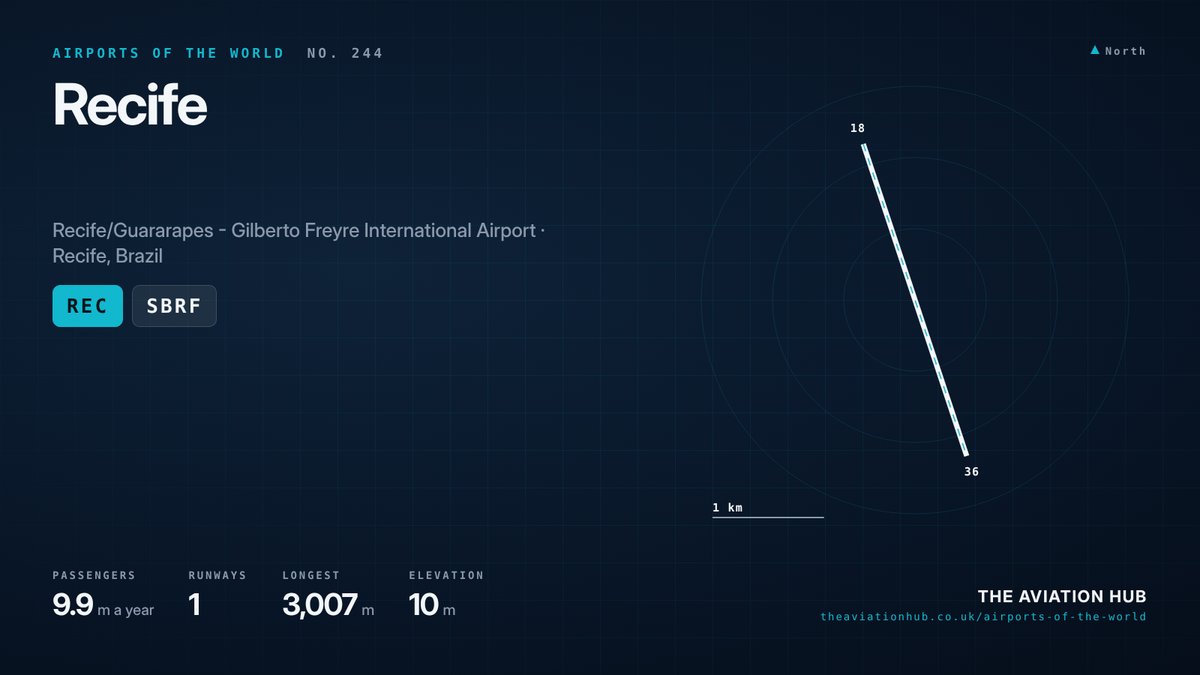
Recife Guararapes Gilberto Freyre International Airport is the principal gateway to northeastern Brazil and one of the country’s busiest airports outside the Rio and Sao Paulo region. Recife Airport sits in the Boa Viagem beach district of the Pernambuco state capital, with a metro station outside the terminal and a single long runway parallel to the coast. Azul uses it as a hub, Gol treats it as a focus city and around 10 million passengers pass through each year. The airport is run by the Spanish operator Aena under a 30 year concession.
Recife Airport at a Glance
The IATA code is REC and the ICAO code is SBRF. The airport lies about 9 miles (14 km) south of downtown Recife, close to the beach at Boa Viagem, at an elevation of just 10 metres (33 feet). There is one runway and one passenger terminal, with the Recife Air Force Base sharing part of the airfield and the Cindacta III air traffic control centre nearby.
Passenger numbers reached roughly 9.9 million in 2025, up about 4 per cent on the previous year, which puts the airport among the top ten in Brazil. Azul operates its northeastern hub here, and Gol and LATAM both fly dense domestic schedules. Aena Brasil has operated the airport since 2019 and is investing in the terminal. Flight information and parking details are on the airport’s official website.
How Recife’s Airport Came to Be
Recife’s first airfield was the Parque do Encanta Moca, which served early commercial flights in the 1920s and 1930s. The Second World War changed everything. The city’s position on the easternmost bulge of South America made it a strategic staging post for the South Atlantic air route, and a new airfield, first called Ibura, was built with American support. After the war it became a technical and refuelling stop for airliners crossing between Europe and South America.
The airport took the name Guararapes in 1948, after the nearby hills where Portuguese and Brazilian forces defeated the Dutch in the seventeenth century. Runway extensions in 1958 kept pace with the jet age. In December 2001 the sociologist Gilberto Freyre, Recife’s most famous intellectual, was added to the name.
A new terminal and concourse in 2004 lifted capacity from 1.5 million to around 9 million passengers a year, transforming the airport from a regional stop into a modern hub. Upgrades for the 2014 FIFA World Cup added eight jet bridges and completed the terminal renovation. In 2019 the Brazilian government handed the airport to Aena as part of a package of northeastern airports.
Runways at Recife Airport
Recife Airport operates a single runway, 18/36, which is 3,007 metres (9,865 feet) long and 45 metres wide with an asphalt surface. It runs north to south along the coast, and the length is sufficient for the jets operated on routes to Europe. A former secondary runway, 14/32, is no longer in use for scheduled traffic.
Runway 18 arrivals come in over the city from the north, crossing the built up districts between the centre and Boa Viagem at low altitude, which gives residents a close view of every landing. Runway 36 approaches come in over the beaches and the sea to the south. The prevailing trade winds from the southeast mean runway 18 is the more common configuration.
The runway sits within a few kilometres of the Atlantic, and heavy tropical rain can reduce braking performance, though closures are rare. The air force shares the field, and military movements mix with civil traffic under the control of the Recife tower. Two fatal accidents involving small regional aircraft, a Nordeste Bandeirante in 1991 and a Noar Let L-410 in 2011, both happened shortly after take off from here.
Terminals and Airlines
The single terminal at Recife Airport dates from 2004 and has a shopping concourse at its heart, with departures and arrivals on separate levels and a long pier of gates with jet bridges. Aena has refreshed the building since taking over, adding capacity to the security area and improving the retail offer. The layout is simple and the walking distances are short.
Azul is the largest carrier, with Embraer E195-E2 and Airbus A320neo aircraft radiating across the northeast and down to its main hub at Campinas. Gol flies Boeing 737-800 and 737 MAX 8 services to Sao Paulo, Rio and Brasilia, and LATAM operates Airbus A320 family jets on similar trunk routes. TAP Air Portugal flies to Lisbon and Iberia to Madrid, giving the city direct links to Europe. LATAM and Gol also fly to Argentina, and LATAM serves Santiago de Chile.
Routes and Destinations
Sao Paulo Guarulhos and Campinas are among the busiest routes, carrying passengers to the country’s economic centre and feeding Azul’s main hub. Rio de Janeiro, Brasilia, Salvador and Fortaleza are also busy, with frequent domestic services. Azul’s regional network reaches many smaller cities across Pernambuco, Paraiba, Alagoas and the interior.
Lisbon is a key international route, operated by TAP with flights year round. Madrid with Iberia is the longest sector from Recife Airport. JetSmart now flies to Buenos Aires, and Cabo Verde Airlines resumed its short hop across the Atlantic to Praia in May 2026. Summer in the southern hemisphere, from December to February, brings the peak of domestic leisure traffic to the beaches of Porto de Galinhas and the surrounding coast.
Getting to and from Recife Airport
A covered walkway links the terminal with Aeroporto station on Line South of the Recife Metro. Trains run to Recife Central in around 30 minutes for a flat fare of a few reais, and the metro is the cheapest sensible option for anyone heading downtown. It does not serve the Boa Viagem hotel strip directly, but that lies only a short taxi ride away.
Taxis and app cars with Uber and 99 wait outside arrivals. The ride to Boa Viagem takes 10 to 15 minutes and to the city centre around 30 minutes, with fares of roughly BRL 30 to 60 (about £5 to £9) depending on the time of day. City buses connect the airport with Boa Viagem, Piedade and the university district.
A multi storey car park and surface parking stand beside the terminal, with both short stay and long stay rates. Drivers heading to Porto de Galinhas or the southern beaches face a journey of about an hour.
Spotting and Photography
The approach to runway 18 over the city gives Recife Airport some of the best low altitude views in Brazil. Aircraft pass low over the neighbourhood of Imbiribeira on short final, and public streets under the approach offer clear photographs of arrivals. Afternoon light, with the sun in the west, favours aircraft on this approach.
For runway 36 arrivals, the beaches south of the field let spotters watch aircraft crossing the shoreline. The terminal has large windows but no formal viewing area. The mix of Azul’s Embraer fleet, TAP wide bodies and air force transports keeps things interesting.
The military presence means caution is needed. Do not photograph the air force side of the field, keep to public roads and avoid standing against the perimeter fence. Recife has areas where personal safety matters, so spot in daylight and in busier places.
What Comes Next
Aena’s concession includes a programme of terminal improvements, with more gates, expanded security and upgraded baggage systems planned over the coming years. The runway is adequate for current needs, and the constraint is the terminal rather than the airfield.
The airport’s position as Azul’s northeastern hub gives it a secure future, and the return of international routes after the pandemic shows demand to Europe is solid. Recife Airport is growing steadily rather than dramatically, which suits a city that is already the region’s business capital. Compare it with Brazil’s other gateways on the Airports of the World map.
Continue to follow The Aviation Hub for more analysis and insight.
Advertise with us Your brand, in front of an aviation audience Home page and in-article placements, sold directly, one advertiser per slot. From £250 a year. See the rates

