
Richmond Airport Guide: Virginia’s Capital Gateway
Richmond Airport is the main gateway to central Virginia. Discover its history as Byrd Field, its runways, airlines, busiest routes and how to get there.
 By The Aviation Hub
5 min read
Updated October 20, 2026
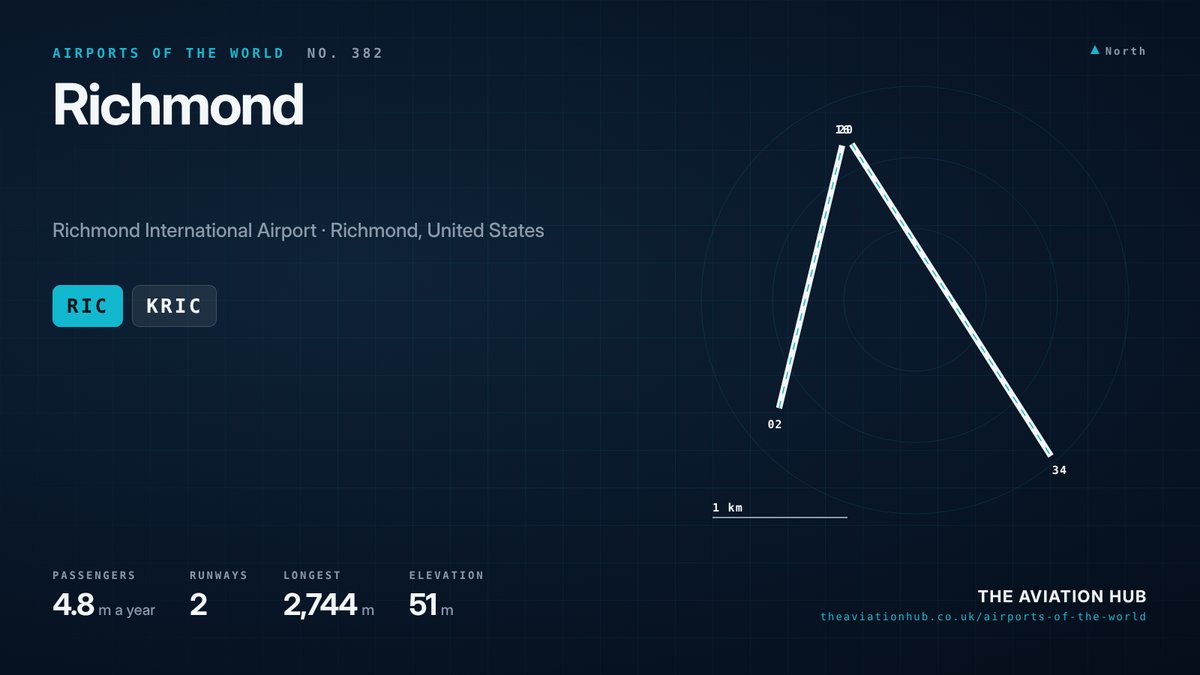
Richmond International Airport sits in Henrico County, a short drive east of the Virginia state capital. Known locally as RIC and widely called Richmond Airport, it serves central Virginia and handled more than 4.9 million passengers in 2025. It is a classic American spoke airport. Nearly every flight heads to a major hub, yet the field also carries a deep aviation history, a busy cargo operation and a military presence that dates back decades.
Richmond Airport at a Glance
The IATA code is RIC and the ICAO code is KRIC. The airport lies about 7 miles (11 km) southeast of downtown Richmond, beside the community of Sandston, at an elevation of 51 m (167 ft). It has two active runways and a single terminal split into Concourse A and Concourse B. Richmond Airport recorded 4,922,994 passengers in 2025, up 0.8 per cent on the year before. No airline uses it as a hub, though American and Delta carry the largest shares. The Capital Region Airport Commission runs the site.
How Richmond’s Airport Came to Be
The field was dedicated in 1927 as Richard Evelyn Byrd Flying Field. Richmond mayor John Fulmer Bright drove the project, and the city owned the land even though it sat in neighbouring Henrico County. The name honoured the polar aviator Richard E. Byrd, whose brother Harry was then governor of Virginia.
A new terminal building was completed in 1950, and the field became Richard E. Byrd Airport that year. In the mid 1970s a United Douglas DC-8-61 to Los Angeles via Washington Dulles was probably the largest airliner ever scheduled here. The darkest day came in 1961, when Imperial Airlines Flight 201/8 crashed during an attempted emergency landing, killing 77 of the 79 people aboard.
The current name arrived in 1984. Regional carriers Air Virginia and Wheeler Airlines once ran small hubs at Richmond Airport, but both faded long ago. The field also hosted an Air National Guard F-16 wing until 2007, when the unit moved to Langley to fly alongside the F-22 Raptor.
Runways at Richmond Airport
Two asphalt runways serve the field today. The main one, 16/34, measures 2,744 m (9,003 ft) and handles nearly all airline traffic. Its north to south alignment suits the prevailing winds, and it is the primary instrument runway in poor weather.
Runway 02/20 is shorter at 2,014 m (6,607 ft). It acts as the crosswind option and sees regional jets, cargo feeders and general aviation when winds swing round. A third strip, 07/25, closed in 2021 and was converted into Taxiway H. The Virginia Army National Guard keeps an aviation support facility on the field, so helicopters and a military transport add variety to the traffic mix.
Terminals and Airlines
The two level terminal feeds Concourse A and Concourse B, and gate B15 is equipped to handle international arrivals. Concourse A was expanded between 2018 and 2021, adding at least six gates to the previous 22. A widened checkpoint for Concourse B opened in 2019.
All three major network carriers fly here. American holds the largest share at around 19 per cent, followed by Delta at about 17 per cent. United serves its hubs, while Southwest, JetBlue, Breeze, Allegiant, Frontier and Sun Country cover leisure and point to point markets. Nine airlines serve almost 40 nonstop destinations from Richmond Airport, counting seasonal routes, a respectable spread for a metro area of this size.
Routes and Destinations
Atlanta is the busiest route by a wide margin, with around 410,000 passengers in the year to April 2026. Charlotte follows at about 300,000, reflecting American’s strength in the Carolinas. Orlando, Dallas Fort Worth, Chicago O’Hare and New York LaGuardia complete the top six.
Boston, Fort Lauderdale, Denver and Philadelphia also feature strongly. Denver provides the main link to the West, and connections there or in Dallas open the rest of the network. Florida routes expand in winter, when Breeze, Allegiant and Frontier add capacity to the sun. There are no scheduled transatlantic flights, though the airport has made clear it wants service to Europe. Cargo matters too. Richmond Airport handled roughly 223 million lb of freight and mail in 2025, with integrator aircraft arriving overnight.
Getting to and from Richmond Airport
Road is the main way in. Interstate 64 passes just north of the terminal, and the drive to downtown usually takes 15 to 20 minutes outside the rush hour. Taxis and ride hailing pick up outside baggage claim, and a city centre fare typically runs to around 30 dollars (about 23 pounds).
The cheapest option is the GRTC local bus, which links the terminal with downtown Richmond for a small fare, though the journey is slower. There is no rail link. Amtrak passengers use Main Street Station downtown or Staples Mill Road station north of the city, both a taxi ride away. Williamsburg and the coast lie about an hour east along Interstate 64. Parking includes garages beside the terminal and cheaper economy lots served by shuttle. Live parking rates and flight times are on the airport’s official website.
Spotting and Photography
Richmond is a relaxed field for enthusiasts. Roads around the perimeter offer glimpses of the action, particularly near the southern end when aircraft land on Runway 34. Late afternoon light suits the western side of the airfield.
Traffic is mainly regional jets, Airbus A320 family types and Boeing 737s, with FedEx and UPS freighters adding interest. National Guard helicopters break up the airline flow. The Virginia Aviation Museum once stood beside Richmond Airport, but it closed in 2016. Stay on public land, do not park on verges or block access roads, and move on politely if police or airport staff ask.
What Comes Next
The next major project is a single consolidated security checkpoint, estimated at about 253 million dollars, which will merge the separate Concourse A and B checkpoints. Enabling works were scheduled to start in late 2026. The airport is also studying a move of rental car counters into an expanded north baggage claim, with a covered walkway to a larger garage.
The ambition for European flights remains the biggest unknown. Richmond Airport has steady demand, room on its main runway and a growing region behind it. Expect gradual growth rather than dramatic change. To compare it with other airports, open the Airports of the World map.
Continue to follow The Aviation Hub for more analysis and insight.
Advertise with us Your brand, in front of an aviation audience Home page and in-article placements, sold directly, one advertiser per slot. From £250 a year. See the rates

