
Riga Airport Guide: airBaltic’s Home on the Baltic
Riga Airport is the main hub of the Baltic states and home of airBaltic. Codes, runway, piers, airlines, routes, transport and spotting tips.
 By The Aviation Hub
5 min read
Updated October 20, 2026
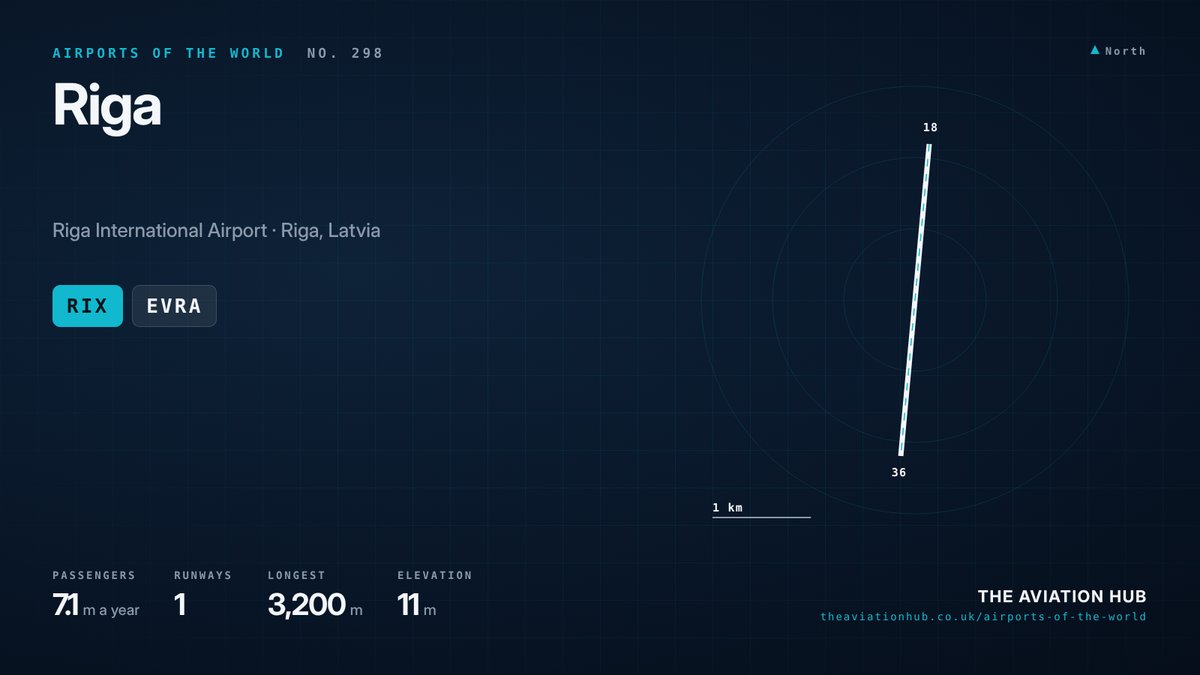
Latvia’s capital sits roughly midway between Tallinn and Vilnius, and its airport has become the main connecting point for the whole Baltic region. Riga Airport handled about 7.1 million passengers in 2024 and is the hub of airBaltic, whose Airbus A220 fleet links the city with more than 80 destinations. It sits on flat land south west of the city, an easy bus or taxi ride from the Old Town. Ryanair and Norwegian base aircraft here too, giving the field a strong mix of hub and low cost flying.
Riga Airport at a Glance
The IATA code is RIX and the ICAO code is EVRA. The airport lies in Marupe municipality, about 6 miles (10 km) south west of central Riga, at an elevation of 11 metres (36 ft). It has one runway and a single two storey passenger terminal with two main piers, B and C, plus an older area A used for some arrivals. A separate business aviation terminal opened in 2010.
Traffic in 2024 was roughly 7.1 million passengers, up about 7 per cent, with around 63,000 aircraft movements and almost 19,000 tonnes of cargo. airBaltic carried 57 per cent of passengers in 2025, Ryanair 23 per cent and Norwegian 5 per cent. The airport is a state owned joint stock company, with the Ministry of Transport holding the shares on behalf of the government. Timetables and parking details are on the airport’s official website.
How Riga’s Airport Came to Be
Before the current site, the city relied on Spilve, an older airfield north west of the centre. By the 1970s Spilve could not handle the jets of the Soviet era, so a new airport was built south west of the city and opened in 1973. It served Aeroflot routes across the Soviet Union through the 1970s and 1980s.
Independence in 1991 changed everything. airBaltic was founded in 1995, and the opening of the skies after Latvia joined the European Union in 2004 brought low cost carriers in large numbers. New northern terminal extensions opened in 2006 and 2016, creating the pier layout in use today. For a period the field even hosted an Uzbekistan Airways service between Tashkent and New York, which stopped in Riga until 2017.
Runways at Riga Airport
Riga Airport has a single runway, 18/36, which is 3,200 metres (10,499 ft) long and 45 metres wide with an asphalt and concrete surface. It has a Category II instrument landing system, useful in the fog and low cloud common in Baltic winters. The length handles any narrow body with ease and allows wide body charters and freighters.
Winter operations at Riga Airport are a constant challenge, and slippery conditions have caught out several crews. An airBaltic Airbus A220 slid off the runway in heavy snow in December 2021, and another airBaltic jet left the runway on landing in March 2023 without injuries. In September 2016 an airBaltic Dash 8 Q400 landed with its nose gear retracted, closing the runway for more than five hours.
Terminals and Airlines
The terminal at Riga Airport has a 36 desk check in hall feeding two piers. Pier B handles Schengen flights only, while Pier C handles both Schengen and non Schengen services, including flights to the UK. Each pier has eight jet bridge stands and four walk out stands. The layout is compact, and connections between airBaltic flights are usually quick.
airBaltic operates an all Airbus A220-300 fleet and runs bases in Tallinn and Vilnius as well. Lufthansa took a minority stake in the airline in 2025, bringing closer ties with the German group. Ryanair and Norwegian fly Boeing 737s from their Riga bases. SmartLynx, a Latvian charter and leasing airline long based here, ceased operations in November 2025. Lufthansa, LOT, Finnair and Turkish Airlines provide hub links.
Routes and Destinations
London is the busiest market, with 6.7 per cent of traffic in 2025, served by airBaltic, Ryanair and others. Helsinki follows at 5.3 per cent and has the most frequent service, around 56 weekly flights in summer 2025. Oslo, Stockholm and Tallinn complete the top five.
The network reached 107 destinations in September 2024. airBaltic serves most European capitals, Scandinavia, the Mediterranean and the Middle East, with Dubai and Tenerife among its longest routes. Ryanair and Norwegian focus on the UK, Scandinavia and southern European sun spots. Summer adds a large charter programme to Turkey, Egypt, Greece and Spain.
Getting to and from Riga Airport
Bus 22, run by the city transport company Rigas Satiksme, links the terminal with the city centre in around 30 minutes and is the cheapest option. Tickets cost a couple of euros. Long distance coaches from the airport serve Estonia, Lithuania, Poland and Germany.
Taxis take about 20 minutes to the Old Town. Since April 2024 a fixed price voucher system has curbed the overcharging that once gave airport taxis a poor reputation. Ride hailing apps such as Bolt also operate. Riga Airport has around 1,500 parking spaces across three car parks, reached from the P133 road off the E22. A station on Rail Baltica, the new standard gauge line to Tallinn, Kaunas and Warsaw, is planned at the terminal.
Spotting and Photography
Riga Airport is a rewarding stop for enthusiasts. Open fields and minor roads near both runway ends give clear views of arrivals and departures, and the flat landscape keeps backgrounds simple. airBaltic A220s dominate, but Ryanair and Norwegian 737s, charter jets and visiting freighters add variety.
Summer evenings bring long hours of light, while winter offers striking shots of aircraft in snow. Stay on public land, avoid blocking farm tracks and follow instructions from the airport police. Drones are banned near the field.
What Comes Next
The master plan includes a new south pier and a new air traffic control tower, which would add stands and gates as airBaltic grows. The Rail Baltica station is the bigger prize, putting the airport on a high speed line linking the three Baltic capitals with Poland. The design contract was signed in 2018, but construction of the wider line has faced delays and cost overruns.
Riga Airport looks set to remain the main hub of the Baltic states, with airBaltic at its centre and low cost growth around it. Its future depends heavily on the health of its home airline. Explore other Baltic gateways on the Airports of the World map.
Continue to follow The Aviation Hub for more analysis and insight.
Advertise with us Your brand, in front of an aviation audience Home page and in-article placements, sold directly, one advertiser per slot. From £250 a year. See the rates

