
Rio de Janeiro Airport Guide: Galeao’s Long Road Back
Rio de Janeiro Airport, known as Galeao, is the city's international gateway on Governador Island. Runways, terminals, routes and access explained.
 By The Aviation Hub
6 min read
Updated October 20, 2026
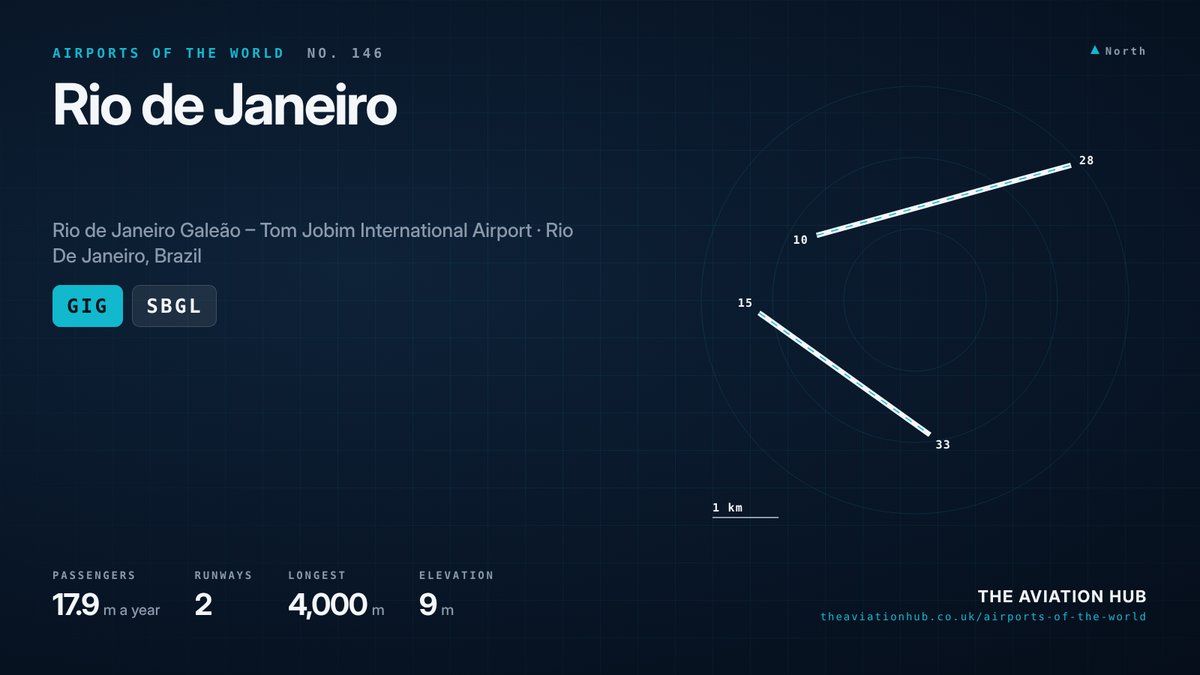
Rio de Janeiro Galeao International Airport is the long haul gateway to one of the world’s most photographed cities. Officially named after the composer Antonio Carlos Jobim, it occupies much of Ilha do Governador in Guanabara Bay, well away from the beaches of Copacabana and Ipanema. Rio de Janeiro Airport has had a turbulent decade, losing traffic to the downtown Santos Dumont airport and seeing its concession holder walk away, but 2025 brought a sharp recovery to almost 18 million passengers.
Rio de Janeiro Airport at a Glance
The IATA code is GIG and the ICAO code is SBGL. The airport lies about 12 miles (20 km) north of the city centre, at an elevation of just 9 m (28 ft) on reclaimed bay shore. There are two runways and two elliptical terminals, though only Terminal 2 processes passengers, with Terminal 1’s check in and baggage halls closed since November 2016. Gol operates a hub and LATAM Brasil treats it as a focus city.
Rio de Janeiro Airport handled roughly 17.9 million passengers in 2025, up about 24 per cent on the previous year, with around 129,000 aircraft movements. RIOgaleao, a consortium that came to be led by Changi Airports and Vinci, ran the site from 2014. In March 2026 the Spanish operator Aena won a new concession, and it took control in October 2026. Operational details are on the airport’s official website.
How Rio’s Airport Came to Be
The name comes from Praia do Galeao, the beach where the galleon Padre Eterno was built in 1663. A naval aviation school opened on the site in 1923, and the field became Galeao Air Force Base in 1941. Allied aircraft used it during the Second World War, and international flights moved here from Santos Dumont afterwards. The first civilian passenger terminal opened on 1 February 1952.
The vast elliptical Terminal 1 opened in 1977, built when Brazil’s military government wanted a showpiece. Air France flew Concorde here on scheduled services between 1976 and 1982, and the James Bond film Moonraker shows the aircraft landing. Terminal 2 followed in 1999, the same year the airport took Jobim’s name, and his song Samba do Aviao became its unofficial anthem.
Infraero handed the airport to the private RIOgaleao consortium in 2014 ahead of the World Cup and the 2016 Olympics. The years after the Games were hard. International airlines left, Terminal 1 was mothballed and the concession holder tried to return the airport to the government. The 2026 re concession to Aena marks the next chapter.
Runways at Rio de Janeiro Airport
Rio de Janeiro Airport has two runways set at an angle to each other. The longer runway, 10/28, is 4,000 m (13,123 ft) of concrete and 45 m wide, long enough for any aircraft at full weight in the heat of a Rio summer. It handles the long haul departures to Europe and the Gulf, and Emirates Boeing 777-300ER and Air France Boeing 777 services use it routinely.
The second runway, 15/33, is asphalt and measures 3,180 m (10,433 ft) by 47 m. It lies closer to the terminals and is the busier of the two, with most landings on runway 15. Approaches to runway 15 cross the bay with Sugarloaf and the Christ statue visible to the south on a clear day. In 2022 part of runway 10/28 was turned into a temporary motor racing circuit named after the driver Caca Bueno, a reflection of how much spare pavement the airport had at the time.
Terminals and Airlines
Terminal 2 is the working heart of Rio de Janeiro Airport. Everyone checks in here, and the two terminals are connected airside so gates in the older building can still be used at peak times. Gol, the home carrier, runs its Boeing 737-800 and 737 MAX 8 fleet through the domestic piers. LATAM Brasil adds Airbus A320 family and A321neo services across Brazil and to Buenos Aires, Santiago and Lima. Azul flies Embraer E195-E2 and Airbus aircraft to its hubs.
The foreign long haul operators include TAP Air Portugal, Air France, KLM, Lufthansa, British Airways, Iberia, Emirates, American, United and Delta, with Aerolineas Argentinas and LATAM covering South America. Alliance wise, LATAM has left Oneworld and now partners with Delta, Gol partners with American, and Azul works with United and TAP. Lounges in Terminal 2 serve the premium cabins.
Routes and Destinations
Sao Paulo is the dominant domestic market, both Guarulhos and Congonhas, with Brasilia, Belo Horizonte, Salvador and Recife close behind. Much of the Rio to Sao Paulo shuttle traffic uses Santos Dumont instead, which is why Galeao’s domestic figures lag its size. Buenos Aires, Santiago and Montevideo lead the regional international routes, with Aerolineas Argentinas and LATAM running multiple daily services.
Long haul routes connect Lisbon, Madrid, Paris, Amsterdam, Frankfurt, London Heathrow, Miami, New York, Houston, Atlanta and Dubai. The Dubai service with Emirates is the longest at around 7,400 miles (11,900 km). Carnival in February and the New Year celebrations on Copacabana are the peaks, and the Brazilian summer from December to March drives tourist traffic. Cargo is handled in a dedicated terminal, with Atlas Air, Cargolux and LATAM Cargo among the freighter operators.
Getting to and from Rio de Janeiro Airport
There is no train or metro at Rio de Janeiro Airport. The cheapest sensible option is the TransCarioca bus rapid transit line, which runs 24 hours a day from the terminal to Madureira, with a connection to the suburban rail network, and a nonstop service to the Gentileza intermodal terminal for the light rail into the centre. Journey times are 60 to 90 minutes to the Zona Sul beaches. Coaches also run to Niteroi and Buzios.
Taxis are the usual choice for visitors. Book at the booths in the arrivals hall, where the blue executive cabs and yellow city cabs quote fixed fares. A run to Copacabana takes 40 to 70 minutes depending on the Linha Vermelha traffic and costs roughly R$120 to R$180 (about £17 to £26). Ride hailing apps are cheaper and widely used. Parking is in multi storey garages beside Terminal 2.
Spotting and Photography
Galeao is a spectacular setting but a difficult one for spotters. The terminal windows in Terminal 2 give the best and safest views of the apron and the wide body stands, and a glass ramp in the disused Terminal 1 is open to the public. Outside the fence, the Corredor Esportivo boardwalk in Portuguesa lets you photograph arrivals on runway 28 coming in low over the bay, with the best light before 11:00.
Most landings use runway 15, and the lawn by the support companies on Avenida 20 de Janeiro covers them, although trees and lamp posts get in the way. Many arrivals from Europe land in the early morning. Rio’s suburbs are not places to wander with expensive equipment, so travel by taxi, stay in populated areas, keep gear discreet and do not loiter at the perimeter fence near the air force base.
What Comes Next
Aena’s new concession is the story to watch. The Spanish operator already runs Recife and a group of airports in the north east, and it inherits a site with a mothballed terminal and plenty of spare capacity. RIOgaleao had planned a new pier, apron and parking, plans that were revised after 2016, and the government has pushed to move traffic back from the slot restricted Santos Dumont.
Rio de Janeiro Airport has the runways and the buildings; what it needs is airlines, and 24 per cent growth in 2025 suggests they are returning. Compare it with the other South American hubs on our Airports of the World map.
Continue to follow The Aviation Hub for more analysis and insight.
Advertise with us Your brand, in front of an aviation audience Home page and in-article placements, sold directly, one advertiser per slot. From £250 a year. See the rates

