
Rome Fiumicino Airport Guide: Italy’s Main Hub Explained
Rome Fiumicino Airport explained: three runways, Terminals 1 and 3, the ITA Airways hub, the Leonardo Express to Termini and the plans for a fourth runway.
 By The Aviation Hub
7 min read
Updated October 20, 2026
Rome Fiumicino Airport, named for Leonardo da Vinci, is the busiest airport in Italy and the home of the flag carrier ITA Airways. It sits on the flat coastal plain beside the Tyrrhenian Sea, about 19 miles (30 km) from the centre of Rome, and passed 51 million passengers in 2025. After decades as a byword for chaos, the airport has rebuilt its terminals, added a new pier and collected a run of European service awards. Three long runways and a mix of flag carrier, low cost and long haul traffic make it one of the most varied fields in southern Europe.
Rome Fiumicino Airport at a Glance
Rome Fiumicino Airport uses the IATA code FCO and the ICAO code LIRF. It lies on the coast west of the city, next to the town of Fiumicino at the mouth of the Tiber, at an elevation of just 13 ft (4 m). Three runways serve two passenger terminals, numbered 1 and 3, after Terminals 2 and 5 closed in 2017. ITA Airways runs its hub here, and Ryanair, Vueling, easyJet, Wizz Air, Aeroitalia and Neos all base aircraft at the airport.
Traffic reached around 49.2 million passengers in 2024 and more than 51 million in 2025, which ranks it eighth in Europe. Aeroporti di Roma, part of the infrastructure group Mundys, manages the airport under a long concession from the Italian state. Flight information, parking and the terminal maps are on the airport’s official website.
How Rome’s Main Airport Came to Be
Ciampino, the pre war airfield on the south eastern edge of Rome, could not cope with the jet age or with the crowds expected for the 1960 Olympics. The new airport at Fiumicino took its first flights on 20 August 1960 to relieve the pressure, and it opened officially on 15 January 1961. Alitalia invested heavily through the 1960s and made it the centre of its network. Reproductions of Leonardo’s machines and drawings are dotted around the terminals.
The airport’s history has dark chapters. Palestinian militants killed 34 people in an attack on a Pan Am aircraft in 1973, and in 1985 gunmen linked to the Abu Nidal group killed 19 people in the departure hall of the building that is now Terminal 3. Satellite C and its SkyBridge people mover opened in 1999, and a Category IIIB landing system arrived in 2005 to deal with the autumn fog.
A fire in May 2015 destroyed part of Terminal 3 and crippled operations for months, which proved the catalyst for a complete rebuild. Terminal 5 closed in January 2017 and Terminal 2 followed that December to make way for the expansion of Terminal 1. ITA Airways replaced Alitalia as the hub carrier in October 2021, and the new Pier A and the enlarged Terminal 1 opened in the years after.
Runways at Rome Fiumicino Airport
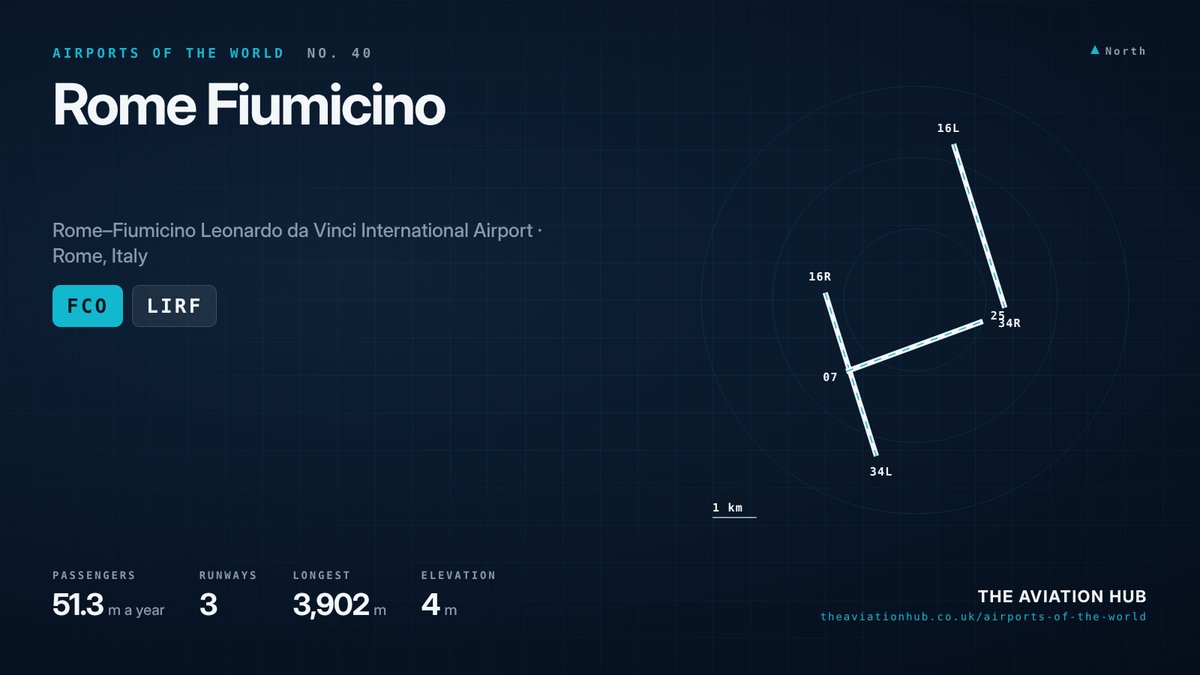
Three asphalt runways serve the field. The main pair, 16L/34R and 16R/34L, are each 3,902 m (12,801 ft) long and 60 m wide. They lie about 4 km apart, far enough for fully independent parallel operations, with the terminals and the old centre runway between them. That former runway, 16C/34C, now serves as Taxiway D. The third runway, 07/25, is 3,300 m (10,826 ft) long and 45 m wide and crosses the site on an east to west line.
The prevailing winds come off the sea, so 07/25 is used almost exclusively for departures towards the west on runway 25. Arrivals use the parallels, and the southerly direction on the 16s is the norm, with aircraft descending over the coast. Since the 2007 upgrade to the low visibility procedures, Rome Fiumicino Airport can handle about 30 movements an hour in thick fog, up from 10 before. The runways can take any aircraft in service, including the Airbus A380.
Terminals and Airlines
Terminal 1 is the ITA Airways building, which it shares with the other Lufthansa Group airlines. ITA left SkyTeam in 2025 and joined Star Alliance in April 2026. Its hall was redesigned during the pandemic closure and reopened in August 2021. Pier A, which opened in 2022, added 13 contact gates and ten remote stands on the north west side. Gates carry the letter A throughout.
Terminal 3 is the larger building at Rome Fiumicino Airport and handles everything else. The former Terminal 5 and the non Schengen satellite have been folded into it, with a new central airside hall and the SkyBridge train running out to gates E31 to E44 for long haul departures. Ryanair, Vueling, easyJet, Wizz Air, British Airways, Emirates, Qatar Airways and the American carriers all use it. ITA’s long haul flights also leave from the E gates, so a transfer from a domestic flight in T1 involves a walk between the buildings.
Routes and Destinations
Domestic routes to the islands dominate the short haul schedule. Catania was the busiest in 2023 with about 1.56 million passengers, Palermo followed with 1.39 million, and Milan Linate carried around 871,000 as the business shuttle. ITA, Ryanair, Wizz Air and Aeroitalia fight over Sicily and Sardinia, and fares are low as a result.
Madrid is the largest European market with about 1.75 million passengers, then Barcelona and Paris Orly. New York JFK leads the intercontinental routes with close to a million passengers a year, flown by ITA, Delta and American, ahead of Tel Aviv and Dubai. The longest service is Qantas’s seasonal nonstop to Perth at about 8,300 miles (13,400 km), and ITA’s flights to Buenos Aires, Los Angeles and Tokyo Haneda each top 6,000 miles (9,700 km). Summer swells the schedule with Greek islands and American tourists, and winter is noticeably quieter. Cargo passed 270,000 tonnes in 2024, with Poste Air Cargo and MSC Air Cargo based here.
Getting to and from Rome Fiumicino Airport
The Leonardo Express is the simplest option. Trenitalia runs it nonstop from the airport station to Termini every 15 minutes, with a journey of about 30 minutes for a fare of 14 euros. The FL1 regional line is cheaper and stops at Trastevere, Ostiense and Tiburtina, where it connects with the metro, though it does not reach Termini. Frecciarossa high speed trains run direct to Naples and Venice several times a day.
By road, the airport connects to the Grande Raccordo Anulare ring road by the Rome to Fiumicino motorway, and the historic centre is about 35 km and 40 to 60 minutes away depending on traffic. Taxis charge a fixed fare of around 55 euros (roughly 47 pounds) to anywhere inside the Aurelian walls. Terravision, SIT and COTRAL coaches run to Termini for a few euros and take about an hour, and Flixbus and Itabus serve other Italian cities. Multi storey car parks sit opposite the terminals with cheaper long stay lots on the shuttle.
Spotting and Photography
Rome Fiumicino Airport has no official viewing terrace, but the open landscape helps. The roads and fields around Focene and the coast north of the airport give views of arrivals on the 16s, and the area along Viale Coccia di Morto is popular for 34L arrivals and 16R departures. Departures from runway 25 climb out over the sea and can be watched from the beach at the end of Via del Pesce Luna.
Inside, the E gates satellite has large windows facing the aprons and the remote stands, and the SkyBridge gives a moving view over the apron. The morning light is best on the eastern side of the airport, and the sea haze of summer afternoons can be a nuisance. Airport police patrol the perimeter and take an interest in cameras, so stay on public roads, avoid the fence line beside the runways and carry identification.
What Comes Next
Aeroporti di Roma plans a fourth runway and a new Terminal 4, part of an investment programme of about 8.2 billion euros. The nearer term programme covers more gates on Terminal 1, a new car park and service buildings, and continued work on Terminal 3. Noise and planning objections from Fiumicino and the coastal towns have slowed the runway project for years.
ITA’s future is tied to Lufthansa, which took a stake in 2025 and will shape how the hub develops within the Star Alliance orbit. Low cost carriers keep growing regardless. Rome Fiumicino Airport is heading well past 55 million passengers before the decade ends with a single new runway as the long term prize. Compare it with Milan, Madrid and the other Mediterranean hubs on the Airports of the World map.
Continue to follow The Aviation Hub for more analysis and insight.
Advertise with us Your brand, in front of an aviation audience Home page and in-article placements, sold directly, one advertiser per slot. From £250 a year. See the rates

