
Sacramento Airport Guide: California’s Capital Takes Off
Sacramento Airport serves California's capital from the Natomas farmland with two parallel runways and a big expansion under way. Terminals, routes and access.
 By The Aviation Hub
7 min read
Updated October 20, 2026
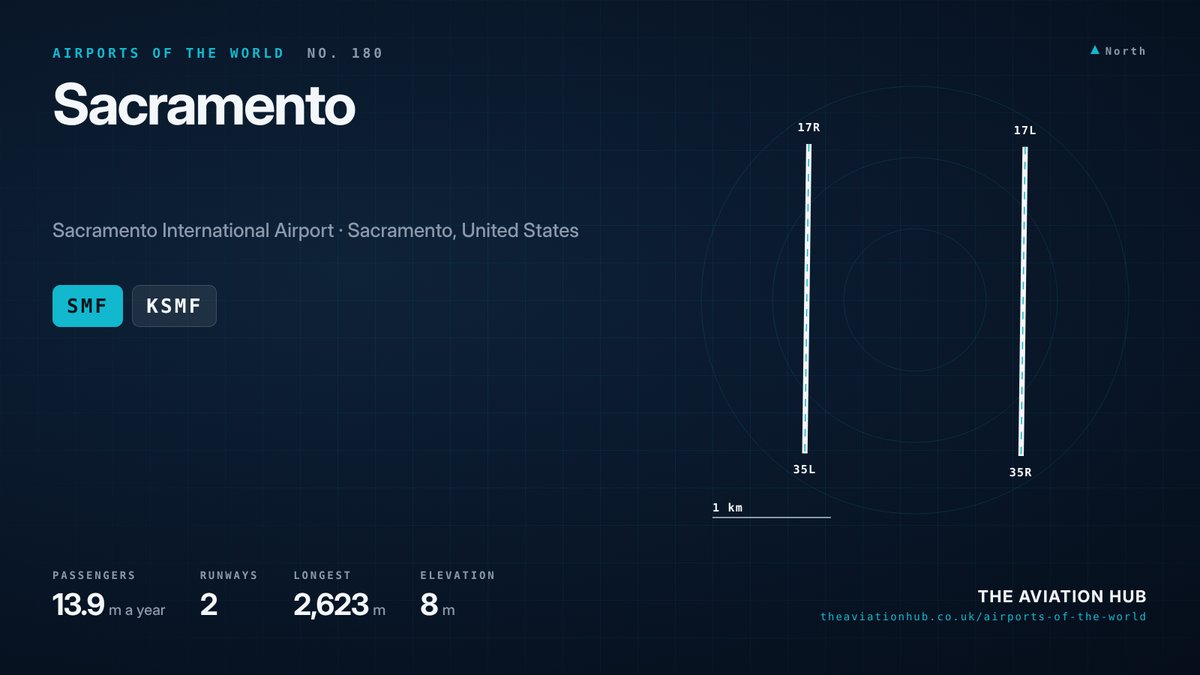
Sacramento Airport, formally Sacramento International Airport, sits about 10.5 miles (17 km) northwest of downtown among the rice fields and levees of the Natomas basin, just off Interstate 5. It is the main airport for the capital of California and the northern Central Valley, handling around 13.9 million passengers in 2025. The field is dominated by Southwest Airlines, growing faster than most American airports of its size and in the middle of a 1.3 billion dollar building programme.
Sacramento Airport at a Glance
The codes are SMF and KSMF. The airport lies 8 m (27 ft) above sea level on former farmland between the Sacramento river and the Sutter Buttes, flat enough that the levees along the river are the only rise for miles. It has two parallel runways, two terminals with 32 gates between them and a large consolidated rental car centre. In 2025 it recorded about 13.9 million passengers, up from 13.6 million the year before and a record for the field.
Southwest carries around 57 per cent of passengers, with United, Delta, American and Alaska the other main carriers and Hawaiian, JetBlue, Frontier, Air Canada, Aeromexico and Volaris filling out the board. The Sacramento County Airport System operates the field, along with Mather, Executive and Franklin airports, and funds it entirely from user fees and rents without local taxes. Parking and terminal information is on the airport’s official website.
How Sacramento Built Its Airport in the Fields
Until the 1960s Sacramento’s airline flights used the old Municipal Airport south of the city, now Sacramento Executive, which could not grow. The county bought farmland in the Natomas basin far to the northwest and opened Sacramento Metropolitan Airport on 21 October 1967. It is described as the first purpose built public use airport west of the Mississippi, a claim that reflects how most American fields grew out of military or private strips.
Southwest later arrived and made the airport one of its California strongholds. The present Terminal A opened in 1998 and the airport was renamed Sacramento International at the same time, four years before the first international flight, a Mexicana service to Guadalajara in 2002. The field became a port of entry in October 2006.
The decisive project was the Big Build, which delivered Terminal B on 6 October 2011 at a cost of about a billion dollars, with an automated people mover linking the landside building to its concourse. The runways were renumbered from 16/34 to 17/35 in 2020 as magnetic north drifted. The airport has had its share of minor drama, from a JetBlue tyre fire in 2010 to a FedEx engine fire in 2014, and in 2013 it took diverted San Francisco flights after the Asiana crash.
Runways at Sacramento Airport
Two parallel concrete runways run north to south. Runway 17L/35R measures 2,623 m (8,605 ft) by 46 m and 17R/35L is almost identical at 2,621 m (8,598 ft) by 46 m. The terminals sit between them, an efficient layout that keeps taxi times short, and the separation is wide enough for simultaneous independent operations in good weather. Both ends have precision approaches.
The Central Valley wind pattern decides the direction. In summer the sea breeze pushes up the delta from the southwest, so the 17 runways dominate with arrivals from the north over the rice paddies. Winter brings northerly winds behind storms and operations on 35, with the approach over the Garden Highway and the river. The notorious tule fog of the valley settles in December and January and can hold arrivals for hours, which is why the precision approaches matter.
At around 8,600 ft the runways are comfortable for Boeing 737s and Airbus A320s to Hawaii and the East Coast but marginal for heavy wide bodies, which is why the long term plan includes an extension to 11,000 ft. Sacramento Airport prefers north flow at night when conditions allow, routing flights over farmland, and FedEx and Amazon Air freighters keep the field busy overnight.
Terminals and Airlines
Terminal A, the 1998 building on the eastern side of Sacramento Airport, has 13 gates and handles the legacy carriers. United, Delta, American and Air Canada use it, with United and its regional partners flying the busiest schedules to San Francisco, Denver, Chicago and Houston. The rental car centre and a walkway to the parking garage adjoin the building.
Terminal B is the bigger and newer building with 19 gates and the distinctive red aluminium rabbit sculpture called Leap bounding through its hall, which earned the airport the nickname the Hare port. Southwest fills most of it, joined by Alaska, Hawaiian, JetBlue, Frontier, Aeromexico and Volaris, and the people mover carries passengers from check in to the concourse. All three alliances are represented, through United and Air Canada, Delta and Aeromexico, and American and Alaska.
Routes and Destinations
Las Vegas is the busiest route with about 593,000 passengers in 2025, flown by Southwest and Frontier many times a day. San Diego follows at around 542,000, then Denver at 511,000, Phoenix at 430,000 and Los Angeles at 424,000, with Seattle level at 423,000 and Dallas Fort Worth, Burbank, Portland and Orange County completing the top ten. The short hops to Southern California, flown with 737s and A320s, behave almost like a shuttle for state government and business travel.
Southwest serves the most destinations from Sacramento Airport and United the most hubs. JetBlue’s seasonal flight to New York JFK, at about 2,500 miles (4,050 km), is the longest route, a whisker ahead of Hawaiian to Lihue and United to Newark, with Honolulu close behind. International service covers Mexico, with Aeromexico and Volaris to Guadalajara and Volaris to Leon and Morelia, plus Air Canada to Vancouver and seasonally Toronto. Summer is the peak, and the ski season brings a modest winter bump from visitors heading to Lake Tahoe. Cargo through FedEx and Amazon is significant for a city of this size.
Getting to and from Sacramento Airport
There is no rail link yet, which is the airport’s biggest weakness. Yolobus routes 42A and 42B loop between the terminals, downtown Sacramento, West Sacramento, Davis and Woodland for a few dollars, and the SacRT Express 142 runs directly to downtown. These buses are the cheapest sensible option, taking around 30 to 40 minutes to the centre.
By road Airport Boulevard leaves Interstate 5 at exit 528 and reaches the terminals in a couple of minutes, with downtown 15 to 20 minutes away outside the rush hour. A one mile extension of Elkhorn Boulevard opened in May 2024 to link the airport directly to Highway 99 and the northern suburbs. A taxi downtown costs around 40 dollars (£32), and ride share cars collect from marked zones outside both terminals. Hourly and daily parking garages stand beside each terminal and economy lots with shuttles lie to the south.
Spotting and Photography
The flat farmland around Sacramento Airport makes for open sightlines. The levee roads and country lanes north of the field put spotters under the approach to the 17 runways in summer, with aircraft low over the rice paddies, while the Garden Highway along the river to the south catches arrivals on 35 in winter. The top levels of the Terminal B parking garage overlook the apron and the people mover.
The traffic is a steady flow of Southwest 737s and United, Delta and Alaska narrow bodies, with Hawaiian Airbus A321neos, FedEx freighters and the Amazon Air fleet for variety. Morning light favours the eastern side and evening light the western side. Stay off the levee tops where signed, respect farm property around the thresholds and keep drones out of the airspace.
What Comes Next
The SMForward programme, announced in February 2023 at 1.3 billion dollars, covers the first five years of a 20 year master plan. It adds three gates straight away, a 140 million dollar pedestrian walkway alongside the people mover for Terminal B, six to eight more gates on the western side of Terminal B by late 2028, a 5,500 space parking garage, a new rental car facility and a new control tower. Longer term the plan allows up to 50 gates, a possible Terminal C and the runway extension.
Sacramento Airport is growing on a booming region and on Southwest’s commitment to California, and the missing rail link is the only drag on its prospects. Compare it with San Francisco, Oakland and San Jose on the Airports of the World map.
Continue to follow The Aviation Hub for more analysis and insight.
Advertise with us Your brand, in front of an aviation audience Home page and in-article placements, sold directly, one advertiser per slot. From £250 a year. See the rates

