
Salt Lake City Airport Guide: Delta’s Mountain West Hub
Salt Lake City Airport is Delta's Mountain West hub, rebuilt from scratch with a new terminal and three runways. Read about its routes and spotting.
 By The Aviation Hub
7 min read
Updated October 20, 2026
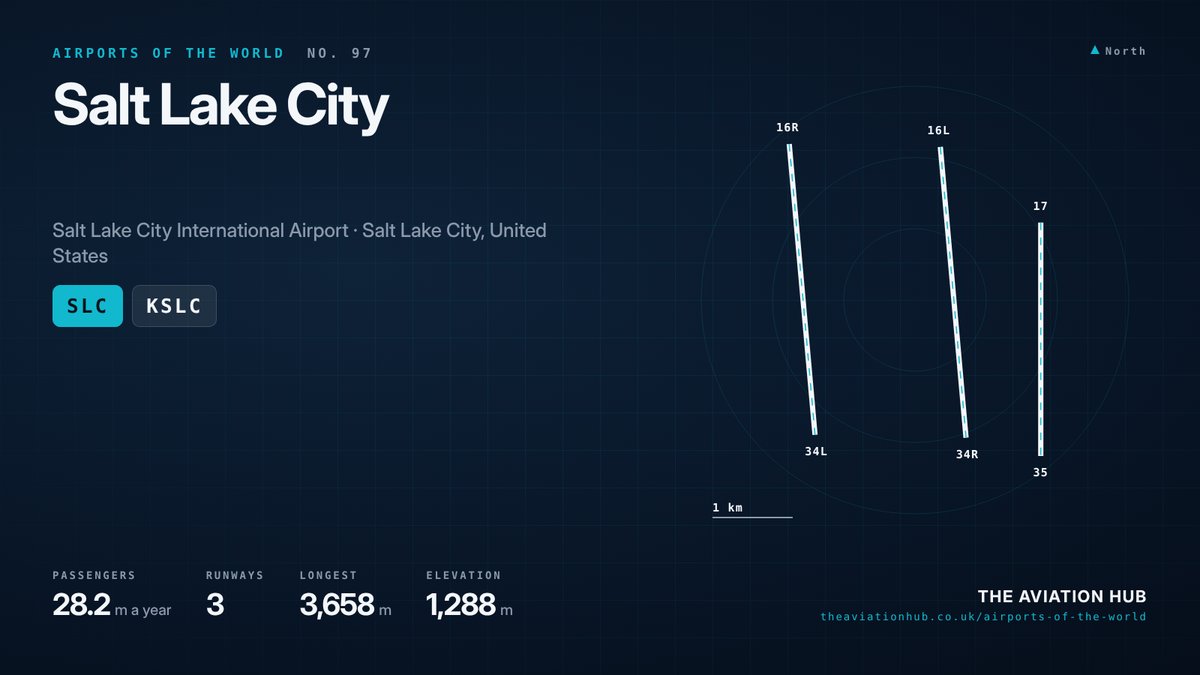
Salt Lake City International Airport is the main airport of Utah and one of the busiest in the Mountain West. It lies about 4 miles (6 km) west of downtown Salt Lake City, between the city and the Great Salt Lake, at the foot of the Wasatch Range. Salt Lake City Airport handled a little over 28 million passengers in 2025 and is one of the core hubs of Delta Air Lines. A complete rebuild, under way since 2014, has replaced the old terminals with a single new building and turned a tired 1960s facility into one of the newest big airports in the United States.
Salt Lake City Airport at a Glance
The codes are SLC and KSLC. The field sits at 4,227 ft (1,288 m) above sea level, among the highest major airports in the country, with the Wasatch peaks rising to over 11,000 ft (3,350 m) a few miles to the east. Downtown is 4 miles (6 km) away along North Temple Street, close enough that the city skyline forms the backdrop to most eastbound departures.
Salt Lake City Airport has three runways and one terminal with two concourses and 83 gates, rising to 94 as the final phase completes. The 2025 figure was 28,158,007 passengers, a fraction below the record 28.4 million of 2024. Delta carries around 70 per cent of them and serves about 90 destinations from the hub, while Alpine Air Express and Corporate Air base smaller fleets here. The City of Salt Lake City owns and operates the airport through its Department of Airports. Live information is on the airport’s official website.
How Salt Lake City’s Airport Came to Be
Flying in Salt Lake City began in 1911 on Basque Flats, an expanse of mud named after the Basque sheep herders who worked it. A cinder landing strip was laid that year for the Great International Aviation Carnival, which drew 20,000 spectators and saw Glenn Curtiss take off from the Great Salt Lake in a seaplane. The field was named Woodward Field in 1920 after local aviator John P. Woodward.
It became Salt Lake City Municipal Airport in 1930 and took its current name in 1968. Western Airlines built a large hub here in the postwar decades, and when Delta absorbed Western in 1987 it inherited the operation and kept growing it. Two United Airlines crashes, in 1935 and 1965, remain the worst in the history of Salt Lake City Airport, the second killing 43 of the 91 people on board just short of the runway.
The rebuild began in 2014. Phase one of the new terminal and the western ends of Concourses A and B opened in September 2020, the eastern part of Concourse A followed in October 2023, and the central River Tunnel and more of Concourse B arrived in October 2024. The old terminals have been demolished.
Runways at Salt Lake City Airport
The three runways all run roughly north north west to south south east, aligned with the prevailing winds down the valley. Runway 16L/34R is 3,658 m (12,002 ft) long and 46 m (150 ft) wide on asphalt. Runway 16R/34L matches it at 3,658 m (12,000 ft) by 46 m (150 ft) but is surfaced in concrete. Runway 17/35, the shortest, is 2,925 m (9,596 ft) long and 46 m (150 ft) wide on asphalt.
The two 16/34 parallels are spaced far enough apart for simultaneous independent approaches, with 17/35 adding a third stream for departures or for the general aviation traffic that makes up a large share of movements. When the wind allows, controllers favour north flow departures and south flow arrivals to limit noise over the city. Strong winds and heavy lake effect snow can cut capacity sharply.
The elevation is the defining feature. Thin air at 4,227 ft lengthens take off runs, especially in summer heat, so the 12,000 ft strips matter for Delta’s long haul departures to Europe and Seoul. An Air France Airbus A380 diverted here in 2015 after a bomb threat, the largest aircraft to have landed at the field.
Terminals and Airlines
The new terminal at Salt Lake City Airport is a single long building with a huge check in hall, a central security checkpoint and a canyon themed atrium. Concourse A sits closest to the terminal and Concourse B lies beyond it, the two linked by the original western tunnel and the River Tunnel opened in 2024. The walk to the far gates is long, and moving walkways do most of the work.
Delta occupies most of both concourses, with mainline and Delta Connection flights spread across the gates and two Sky Clubs, one in Concourse A. The other carriers, including American, United, Southwest, Alaska, JetBlue and Frontier, use the remaining gates, and an American Express Centurion Lounge serves premium passengers. KLM adds a seasonal Amsterdam flight alongside Delta’s European services.
The building has some quirks worth seeking out. The floor world map from the old terminal was reinstalled in the new one, and a replica allosaurus fossil stands near the gates as a nod to Utah’s dinosaur country.
Routes and Destinations
Denver is the busiest route, with more than 900,000 passengers in the year to May 2026, followed by Phoenix and Seattle. Los Angeles, Las Vegas, San Francisco, Atlanta, Minneapolis and Dallas Fort Worth all carry heavy traffic. Delta’s hub bank connects dozens of smaller western cities, from Boise and Bozeman to Idaho Falls and Grand Junction, with the rest of its network.
Amsterdam is the leading international route at more than 220,000 passengers a year, with Paris and Cancun next. Delta flies to London Heathrow and to Seoul Incheon, the longest route at around 5,900 miles (9,500 km). Ski season from December to March fills Salt Lake City Airport with traffic for Park City and the Cottonwood canyons, and summer brings national park visitors bound for Zion, Bryce and Arches.
Getting to and from Salt Lake City Airport
The UTA TRAX Green Line light rail runs from a station beside the terminal to downtown in about 20 minutes, continuing across the valley. Fares are a few dollars, which makes it the cheapest sensible option, and it connects with FrontRunner commuter trains to Ogden and Provo and with the wider UTA bus network.
By road, Interstate 80 and Interstate 215 pass the airport boundary and Terminal Drive feeds off both, with Bangerter Highway serving the south of the valley. Downtown is a 10 to 15 minute drive. Taxis, Uber and Lyft pick up from the ground transportation area, with a fare to the city centre of roughly $25 to $35 (£20 to £28). Shuttle companies run directly to the ski resorts in winter.
A parking garage stands next to the terminal, with economy lots further out served by shuttle buses. A pedestrian and cycle trail on the south side of the runways links the airport to the city’s path network.
Spotting and Photography
The mountains make Salt Lake City Airport one of the most photogenic in the country. Arrivals on the 34s pass the city with the Wasatch Range behind, and the snow covered peaks in winter give backdrops that few hubs can match. The terminal’s long glass walls and the concourse ends offer good views of the aprons and the 16 thresholds for anyone airside.
Outside the fence, the roads on the eastern perimeter near the general aviation area and the trail on the south side give the best vantage points. Morning light favours the eastern side. Afternoon light works for the western roads, with the sun setting over the Great Salt Lake.
Airport police patrol the perimeter and take the fence line seriously. Stay on public roads and trails, do not approach the de icing pads or cargo areas, and be ready to explain yourself. A tragic incident in January 2024, when a man climbed into the engine of an Airbus A220 on the de icing pad, has made staff more alert than ever.
What Comes Next
Phase four of the rebuild adds the final 11 gates at the eastern end of Concourse B in 2026, bringing the total to 94 and completing the programme that began over a decade ago. The master plan reserves space for a Concourse C and a tram link, although neither is scheduled. Delta’s growth and Utah’s booming population are the drivers, and the 2034 Winter Olympics will put Salt Lake City Airport in the spotlight.
With three long runways, a new terminal and a hub carrier committed to the Mountain West, Salt Lake City Airport is heading for 35 million passengers with room to spare. Compare it with the other western hubs on the Airports of the World map.
Continue to follow The Aviation Hub for more analysis and insight.
Advertise with us Your brand, in front of an aviation audience Home page and in-article placements, sold directly, one advertiser per slot. From £250 a year. See the rates

