
Salvador Bahia Airport Guide: Gateway to Brazil’s North East
Salvador Bahia Airport links the Bahian capital with Brazil and beyond. Codes, runways, terminal, airlines, routes, metro access and spotting tips.
 By The Aviation Hub
6 min read
Updated October 20, 2026
The Bahian capital is one of the great cultural centres of Brazil, and most visitors arrive through a single terminal on the city’s northern fringe. Salvador Bahia Airport handled about 8.1 million passengers in 2025, making it one of the main gateways to the north east of the country. It serves beach tourism, business travel and a large population spread along the Atlantic coast. A French operator won the concession in 2017, and a metro link now reaches the city centre.
Salvador Bahia Airport at a Glance
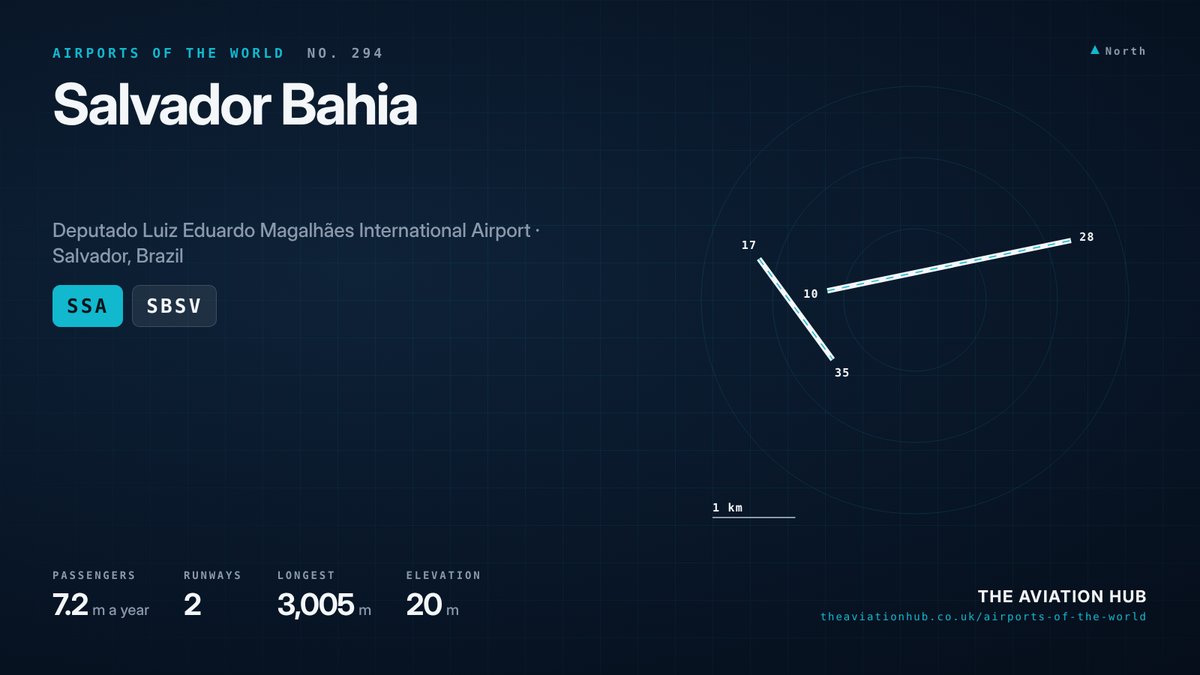
The IATA code is SSA and the ICAO code is SBSV. The airport lies about 17 miles (28 km) north east of downtown Salvador, at an elevation of 20 metres (64 ft). It has two asphalt runways and one passenger terminal, and it shares some facilities with Salvador Air Force Base.
Traffic reached about 8.1 million passengers in 2025, up 6 per cent on the 7.6 million of 2024, with about 57,600 commercial aircraft movements. Gol, Azul and LATAM carry most domestic travellers, and no airline uses the field as a formal hub. Vinci Airports holds a 30 year concession, won in March 2017, which ended decades of management by the state company Infraero. Flight details and parking rates are on the airport’s official website.
How Salvador’s Airport Came to Be
Flying began on the site in 1925, when Santo Amaro do Ipitanga Airport opened among the dunes and lagoons north of the city. During the Second World War, Panair do Brasil rebuilt it in 1941 with American and Brazilian support, as the Allies needed bases along the bulge of South America for the air route to Africa.
The name has changed several times. On 20 December 1955 the field became Dois de Julho International Airport, after the date in 1823 when Bahia secured independence from Portugal. Many locals still use that name. On 16 June 1998 it was renamed after Luís Eduardo Magalhães, a Bahian politician who had died that year. The change remains controversial, and there have been attempts to reverse it. Since 2017 the airport has traded as Salvador Bahia Airport.
The current terminal opened in 1998 and was completed by the end of 2000. It covers about 69,400 square metres and was originally designed for six million passengers a year.
Runways at Salvador Bahia Airport
Salvador Bahia Airport has two asphalt runways, both 45 metres wide. The main runway, 10/28, is 3,005 metres (9,859 ft) long and takes almost all airline traffic, including wide bodies on flights to Europe. The secondary runway, 17/35, is 1,520 metres (4,987 ft) long and serves smaller aircraft, general aviation and military traffic from the air base.
The south east trade winds blow steadily off the Atlantic for much of the year, so runway 10 is used more often than 28. Departures from 10 climb out over the coast and the ocean. The two runways cross, which limits simultaneous use, but traffic levels rarely require it.
Terminals and Airlines
All passenger flights at Salvador Bahia Airport use the single terminal, which has 11 jet bridges and a shopping mall built into the landside area. Vinci has invested in refurbishing the building since taking over, with the aim of raising capacity and improving the passenger experience.
Gol has the widest domestic network, linking Salvador with Brasília, Belo Horizonte, Recife, Fortaleza, Natal, Porto Alegre and both São Paulo airports. Azul connects Campinas, Belo Horizonte, Recife and smaller Bahian cities such as Porto Seguro. LATAM flies to Brasília, Fortaleza, Rio de Janeiro and São Paulo. International carriers include TAP Air Portugal, Air Europa, Air France, Copa Airlines, Aerolíneas Argentinas, Flybondi and Sky Airline. Through TAP and Copa, and through Air France, Air Europa and Aerolíneas, Star Alliance and SkyTeam both have a foothold.
Routes and Destinations
São Paulo is the dominant market, served at Guarulhos, Congonhas and Campinas. Rio de Janeiro and Brasília follow, along with the big north eastern cities of Recife and Fortaleza. Flights to Belo Horizonte and the south complete the domestic picture.
Lisbon, served by TAP, Madrid, served by Air Europa, and Paris, served by Air France, are the long haul links to Europe. Paris is the longest scheduled route from Salvador Bahia Airport at about 4,950 miles (7,970 km). Buenos Aires is the busiest international market, served by Aerolíneas Argentinas, Flybondi, Gol and Sky. Copa added Panama City in the 2025 to 2026 summer, Montevideo is also served, and LOT has run seasonal charters from Warsaw. LATAM Cargo connects the airport with Miami. Demand peaks around Carnival and the southern summer.
Getting to and from Salvador Bahia Airport
The metro is the cheapest sensible option. A free shuttle bus runs every 15 minutes from 5am to 1am between the terminal and Aeroporto station, which opened on 26 April 2018 at the end of Line 2. Trains run to the city, with connections to Line 1 for the historic centre near Lapa. The full trip takes around 45 minutes to an hour.
Taxis and ride hailing apps take 30 minutes to over an hour to the centre or Barra, depending on traffic, and the fare is far higher. The approach road runs through a famous tunnel of bamboo, now a local attraction in its own right. Car hire desks sit in the arrivals hall, and parking is next to the terminal. The beaches of Stella Maris and Praia do Forte are within easy reach by car.
Spotting and Photography
Salvador Bahia Airport has no formal viewing terrace, but the flat coastal land around it offers options. Roads near the eastern end of runway 10/28 give views of departures heading out over the coast, and the terminal windows look across part of the apron.
Morning light is best for the eastern side, and the trade winds make conditions predictable. Traffic is mostly Gol 737s, Azul A320neos and Embraer E195s and LATAM A320s, with TAP and Air Europa wide bodies adding interest. Military aircraft from the air base appear too. Do not photograph military installations, stay outside the fences and follow instructions from police.
What Comes Next
Vinci planned to double the size of the passenger terminal when it took over, and modernisation has continued in stages. More international routes are the obvious opportunity, given the city’s strong tourism appeal and the long runway already in place. Better airline connections to Europe and North America would also support the wider Bahian economy.
Salvador Bahia Airport has the runway and the terminal to grow, and the metro link has fixed one of its old weaknesses. The next step is turning tourism demand into more direct long haul flights. Compare it with other Brazilian gateways on the Airports of the World map.
Continue to follow The Aviation Hub for more analysis and insight.
Advertise with us Your brand, in front of an aviation audience Home page and in-article placements, sold directly, one advertiser per slot. From £250 a year. See the rates

