
San Francisco Airport Guide: Fog, Crossing Runways and the Pacific
San Francisco Airport explained: four crossing runways on the bay, United's Pacific gateway, Harvey Milk Terminal 1, BART access and the best spotting spots.
 By The Aviation Hub
7 min read
Updated October 20, 2026
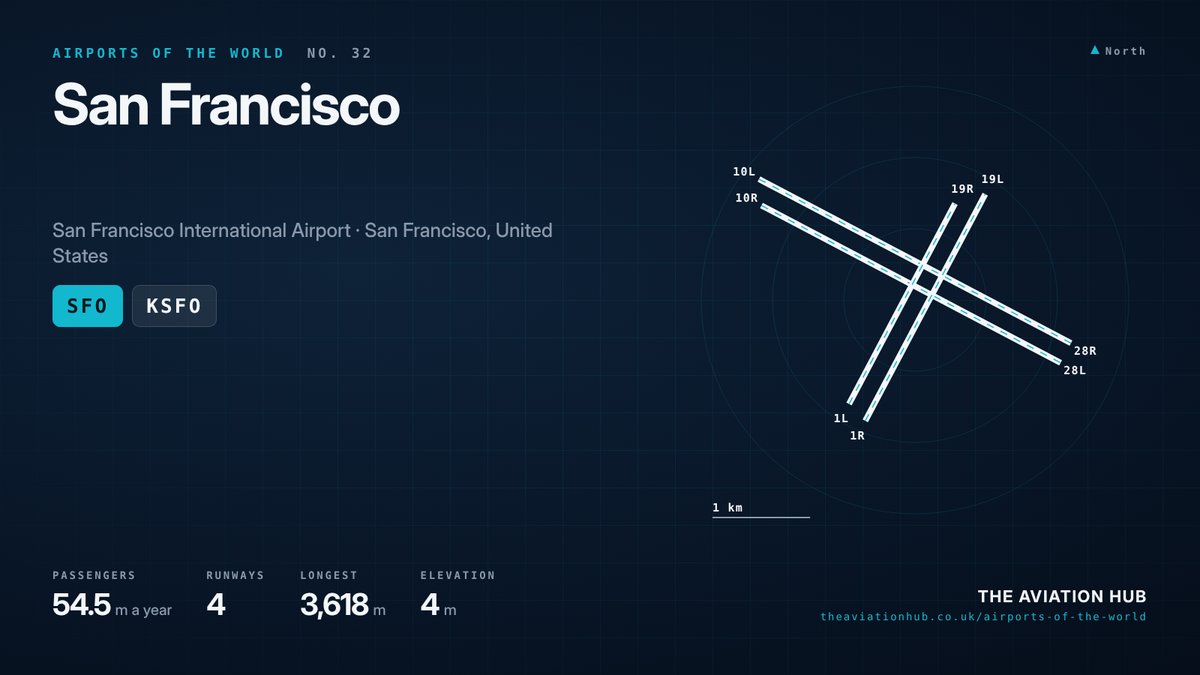
San Francisco Airport juts into the bay 13 miles (21 km) south of the city, a flat platform of fill with runways that cross each other and approaches that bring aircraft side by side over the water. It is United’s main transpacific gateway, a hub for Alaska Airlines and the busiest airport in Northern California. Around 54.5 million passengers used it in 2025. The fog that rolls in from the Pacific defines its operation as much as any runway, and a 2026 ruling on parallel approaches has made capacity tighter still.
San Francisco Airport at a Glance
The codes are SFO and KSFO. Despite its San Francisco address, the field sits in unincorporated San Mateo County on the western shore of San Francisco Bay, at an elevation of 4 m (13 ft). The City and County of San Francisco owns it and the San Francisco Airport Commission runs it. Four terminals arranged in a ring around a central garage handle the passengers.
Four asphalt runways in two crossing pairs serve the airport. United Airlines runs its transpacific hub and a major maintenance base at San Francisco Airport, and Alaska Airlines operates a hub too. More than 40 airlines fly here, with a heavy tilt towards Asia. Terminal maps, the AirTrain and parking details are on the airport’s official website.
How San Francisco’s Airport Came to Be
The city leased 150 acres of cow pasture from the Mills Estate on 15 March 1927 for what it called a temporary and experimental airport project. Mills Field opened on 7 May 1927 and grew to more than 1,100 acres by the 1930s. It became San Francisco Airport in 1931, and the word International was added after the Second World War as Pan Am and United built up overseas services across the Pacific.
The central terminal of 1954 set the ring layout that survives today. The International Terminal, a vast wing roofed hall by Craig Hartman, opened in 2000 and gave the airport its modern face. The BART station followed in 2003. The 1989 Loma Prieta earthquake closed the field, but it reopened the next morning with minor damage, a point of pride for its engineers.
Terminal 1 was rebuilt between 2016 and 2024 and named for Harvey Milk, the first openly gay elected official in California, making it the first airport terminal named for an LGBTQ leader. A new control tower opened in 2016, and the International Terminal is due to be renamed for the late Senator Dianne Feinstein.
Runways at San Francisco Airport
San Francisco Airport has four asphalt runways arranged as two intersecting pairs. Runway 10L/28R is 3,618 m (11,870 ft) and Runway 10R/28L is 3,469 m (11,381 ft), running from the bay shore towards the hills to the west. Runway 1R/19L is 2,640 m (8,660 ft) and Runway 1L/19R is 2,332 m (7,650 ft), crossing the 28s at right angles. All four are 61 m wide.
The parallels are only 750 ft apart, far closer than modern rules would allow. In clear weather controllers long landed pairs of aircraft side by side on 28L and 28R, with departures from the 1s between arrivals. This West Plan is in use about 81 per cent of the time. When the fog or low cloud comes in, only one arrival runway can be used, and the arrival rate collapses from around 54 an hour to about 30. Flow control delays spread across the country as a result.
On 31 March 2026 the FAA permanently banned simultaneous side by side landings on 28L and 28R, cutting the maximum arrival rate to 36 an hour even in good weather. A six month repaving of 1R/19L has added further strain. The Southeast Plan, landing on the 19s during winter storms, is used about 4 per cent of the time. The long 28s take the heaviest departures to Asia.
Terminals and Airlines
Harvey Milk Terminal 1, with Boarding Areas B and C, houses Alaska, American, Delta, JetBlue, Frontier, Hawaiian, Sun Country, Porter and Aer Lingus, and Alaska moved its whole operation here in June 2024. Terminal 2, Boarding Area D, serves Southwest, which consolidated here in March 2025, along with Air Canada, WestJet, Breeze and some United domestic flights.
Terminal 3, Boarding Areas E and F, is United’s domestic home and the heart of its hub. The International Terminal has Boarding Area G for United and its Star Alliance partners such as Lufthansa, ANA, Air China, Swiss and Air New Zealand, and Boarding Area A for most SkyTeam and Oneworld carriers, including British Airways, Cathay Pacific, Qantas, Air France, KLM and Korean Air, plus others such as Emirates and Singapore Airlines. Airside connectors opened in June 2024 so passengers can walk between terminals without leaving security. United’s Polaris lounge in Area G is the standout.
Routes and Destinations
Los Angeles was the busiest domestic route from San Francisco Airport in the year to June 2026 with about 1.40 million passengers, followed by Chicago O’Hare at around 995,000 and New York JFK at roughly 955,000. Seattle, Las Vegas, San Diego, Denver, Boston and Newark fill out the trunk routes. United, Alaska, Delta and American compete hard on the transcontinental services with premium cabins.
Taipei was the busiest international route in the same period with around 1.26 million passengers, then London Heathrow at about 1.04 million and Hong Kong at roughly 915,000. Tokyo, Seoul, Shanghai, Singapore, Sydney and Manila make this one of the leading US gateways to Asia. United flies the Boeing 777-300ER and 787-9 across the Pacific, and Singapore Airlines flies nonstop to Singapore. Traffic peaks in summer and around the Lunar New Year. Cargo is moderate, overshadowed by the Oakland and Los Angeles freight hubs.
Getting to and from San Francisco Airport
BART is the obvious choice. The station beside the International Terminal opened in 2003, and trains reach downtown San Francisco in about 30 minutes for roughly $10. The free AirTrain people mover links the station to every terminal, the garages, the rental car centre and long term parking. Caltrain to the Peninsula and San Jose connects at Millbrae, one BART stop away.
US Route 101 runs past the airport gates and Interstate 380 links to Interstate 280. The drive to downtown takes 25 to 45 minutes depending on traffic. Taxis charge roughly $55 to $70 to the city centre, and app based rides pick up from the garage levels. SamTrans buses serve both the domestic and international terminals, with route 292 to downtown the cheapest option at a few dollars. The central garages sit inside the terminal ring, and the long term lot on the AirTrain is far cheaper.
Spotting and Photography
San Francisco Airport has a famous view. Bayfront Park in Millbrae, beside the 28L approach, gives close views of arrivals as they cross the bay shore, with the aircraft near enough to read the registrations. The SkyTerrace observation deck on top of Terminal 2 is open to the public and overlooks the 1s and the central aprons. The shoreline trail along the bay north of the airport works for the 1 departures and the 28 arrivals from the side.
The light at Bayfront Park is best from noon to sunset, although heat haze is a problem even in winter. Afternoons also favour the SkyTerrace and the northern shoreline. Fog is the enemy, and summer mornings are often lost to it, so the clear days of autumn are the best time to visit. The Grand Hyatt at the airport has rooms facing the runways. Stay on the public trails, do not stop on the 101 shoulders and respect the fences around the maintenance base.
What Comes Next
A $2.6 billion rebuild of Terminal 3 West began in 2024 and is due for completion by 2029, giving United a modern base to match Terminal 1. The International Terminal will take Feinstein’s name. The runways will stay exactly as they are, because the bay, environmental law and the cost of fill rule out any realignment, and the FAA’s 2026 decision has locked in the lower arrival rate.
That makes schedule reliability the central question for the next decade. Airlines will respond with larger aircraft and fewer peak hour slots, and the airport is leaning on its Asian gateway role to keep growing yield. San Francisco Airport is heading for better terminals on a runway system that will never be fixed. See how it compares with the other West Coast gateways on the Airports of the World map.
Continue to follow The Aviation Hub for more analysis and insight.
Advertise with us Your brand, in front of an aviation audience Home page and in-article placements, sold directly, one advertiser per slot. From £250 a year. See the rates

