
San Jose California Airport Guide: Silicon Valley’s Own Field
San Jose California Airport, named for Norman Mineta, sits three miles from downtown. Parallel runways, Southwest's dominance, Tokyo flights and the VTA bus.
 By The Aviation Hub
7 min read
Updated October 20, 2026
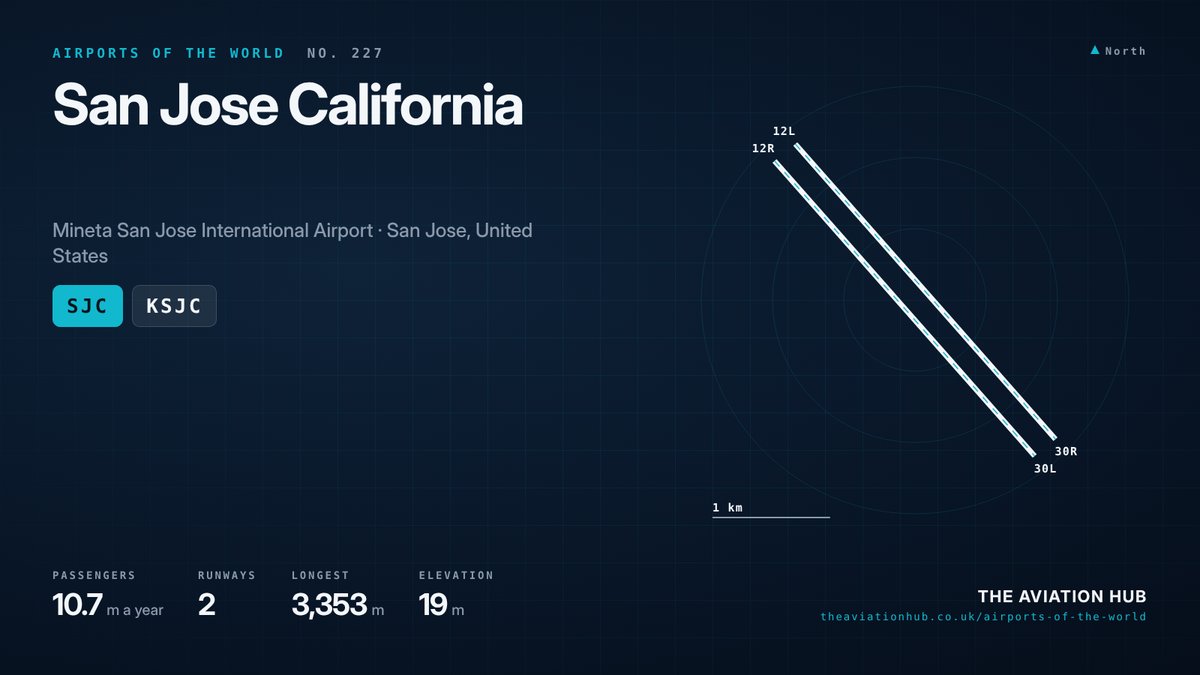
Norman Y. Mineta San Jose International Airport lies just 3 miles (5 km) north west of downtown San Jose, closer to its city centre than almost any other major American airport. It is the home airport of Silicon Valley and one of the Bay Area’s three main commercial fields, alongside San Francisco and Oakland. San Jose California Airport handled around 10.7 million passengers in 2025, well below its 2019 peak of 15.7 million, with Southwest Airlines carrying the majority of them. Two long parallel runways give it capacity far beyond its current traffic.
San Jose California Airport at a Glance
San Jose California Airport carries the IATA code SJC and the ICAO code KSJC. The field sits at 62 feet (19 m) above sea level on the flat floor of the Santa Clara valley, wedged between the Guadalupe River, Highway 101 and Interstate 880. There are two runways and two terminals, A and B, with 36 gates between them. In 2025 the airport handled about 10.68 million passengers, a fall of almost 10 per cent on 2024.
Southwest Airlines carries roughly 58 per cent of passengers, with Alaska Airlines second at around 14 per cent and Delta third. Alaska lists the airport as a focus city. The City of San Jose owns and operates the airport through its Airport Department. Parking rates, flight status and the free VTA bus details are on the airport’s official website.
How San Jose’s Airport Came to Be
In 1939 a group led by Ernie Renzel, a future mayor, secured an option on 483 acres of the Stockton Ranch beside the Guadalupe River. Voters approved a bond to buy the land in 1940. In 1945 test pilot James Nissen leased part of the site for a runway and flight school, and he later became the first airport manager. It began as a modest municipal field serving a city then known for orchards rather than microchips.
Growth followed the valley’s transformation. A new terminal, later called Terminal C, opened in 1965 and served for 45 years. Terminal A arrived in 1990, bringing jet bridges and an international arrivals hall. American Airlines ran a hub here in the late 1980s and early 1990s, including flights to Tokyo with DC-10 and later MD-11 aircraft, though the hub did not survive.
In November 2001 the city renamed the airport after Norman Mineta, a San Jose native who served as mayor, congressman and United States Secretary of both Commerce and Transportation. A master plan of about 3 billion dollars was trimmed in 2005 to a 1.3 billion dollar scheme. Terminal B and the north concourse opened on 30 June 2010 and the old Terminal C was demolished.
Runways at San Jose California Airport
There are two parallel runways, 12L/30R and 12R/30L. Each is 3,353 metres (11,000 feet) long and 46 metres wide with a concrete surface. The length comfortably handles the Boeing 787 that Zipair flies to Tokyo and the Airbus A330 and Boeing 777 that have served Europe and Asia in the past. The runways sit close together, so they are not used for fully independent parallel approaches.
Runway 30L and 30R are the normal configuration, with arrivals approaching from the south east directly over downtown San Jose. That alignment is why federal rules limit the height of buildings in the city centre, a constant irritation to developers. Runways 12L and 12R come into use with southerly winds in winter, bringing arrivals in over the salt marshes at the southern tip of San Francisco Bay. A curfew limits movements between 11.30pm and 6.30am for noisier aircraft.
Terminals and Airlines
Terminal A at San Jose California Airport opened in 1990 and has 16 gates, numbered 1 to 16. It handles American, Delta, United, Frontier and Volaris, and contains an international arrivals facility at gates 15 and 16. Terminal B opened in 2010 and now has 20 gates, numbered 17 to 36, after gates 29 to 36 were added in 2017 and 2019. Its gates 17 and 18 also handle international arrivals. Southwest, Alaska, Hawaiian and Zipair operate from it.
Southwest’s Boeing 737-700, 737-800 and 737 MAX 8 jets fill most of Terminal B. Alaska flies Boeing 737 and Embraer E175 aircraft to its Seattle and Portland hubs and along the coast. Delta and United serve their hubs with Airbus A320 family and Boeing 737 jets plus regional aircraft. Zipair, the low cost arm of Japan Airlines, operates the Boeing 787 to Tokyo Narita. JetBlue has cut its service and announced it will close its San Jose station altogether.
The two buildings are connected airside, so transfers are simple. Lounges are limited to two paid entry lounges in Terminal A called The Club at SJC, as the Admirals Club closed in 2010.
Routes and Destinations
San Diego is the busiest route, followed by Las Vegas, Seattle, Los Angeles and Phoenix. Southwest links the airport to its California network and to Denver, Austin and, in season, Baltimore. Hawaiian and Southwest both fly to Honolulu, and Hawaiian adds Maui plus seasonal Kona and Lihue, which are strong leisure markets for the valley’s well paid workforce.
Internationally, Guadalajara is the leading destination, reflecting San Jose’s large Mexican community, with Morelia and San Jose del Cabo the next largest Mexican routes. Tokyo Narita, served by Zipair, is the longest route and the only one to Asia today. Lufthansa and Air China both left San Jose California Airport in 2018, and British Airways suspended its Heathrow flights in October 2023. New services announced for late 2026 include Delta to Austin and Alaska to Los Angeles. Cargo is limited mainly to FedEx and UPS feeder flights.
Getting to and from San Jose California Airport
San Jose California Airport has no rail station of its own. The VTA Route 60 bus serves both terminals free of charge and connects to Santa Clara transit centre, where Caltrain, Amtrak and ACE trains stop, and to the light rail network. It also reaches the BART station at Milpitas. The bus is the cheapest option and takes about 15 minutes to the Caltrain station, though waits can be long at night.
By road, the airport sits at the junction of Highway 101, Interstate 880 and State Route 87, which reach downtown in 10 minutes outside peak hours. Bay Area traffic can double that. Taxis and ride hailing services pick up at designated kerbs outside both terminals, with downtown fares of around 15 to 20 dollars. Short term garages face each terminal, and the rental car centre sits across the road from Terminal B. A free cell phone waiting lot sits across State Route 87.
Spotting and Photography
The position of San Jose California Airport in an urban grid makes it easy to watch. The Guadalupe River Trail runs along the eastern boundary and gives open views of the aprons and both runways, with morning light behind the photographer. Streets beyond the south east end of the field put spotters under arrivals on 30L and 30R.
For departures off 30L and 30R, the trail north of the field works well. Traffic is mostly Southwest 737s, but the Zipair 787 adds wide body interest, and Silicon Valley’s business jet fleet at the Signature and Atlantic ramps is among the richest in the country.
Stay on the public trail, do not stop on the highway shoulders and keep clear of the fence near the fuel farm. Airport police patrol regularly and move on anyone with a ladder.
What Comes Next
Phase two of the terminal plan, in preparation since 2018, adds six gates and a concourse extension at the south end. A new on airport hotel and a consolidated security checkpoint are under study. The longer term ambition is a direct link to BART, but the planned automated people mover to the Diridon station has stalled on cost.
The bigger question is whether traffic recovers. The valley’s shift to hybrid working and the loss of long haul service left the airport well short of its 2019 numbers, and 2025 brought a further fall. San Jose California Airport has the runways and terminals for 15 million passengers again, but the airlines will decide when it gets there. See how it compares with San Francisco and Oakland on the Airports of the World map.
Continue to follow The Aviation Hub for more analysis and insight.
Advertise with us Your brand, in front of an aviation audience Home page and in-article placements, sold directly, one advertiser per slot. From £250 a year. See the rates

