
San Salvador Airport Guide: Avianca’s Central American Hub
San Salvador Airport is Avianca's Central American hub. Read about its history, runway, terminals, busiest US routes, road links and spotting tips.
 By The Aviation Hub
5 min read
Updated October 20, 2026
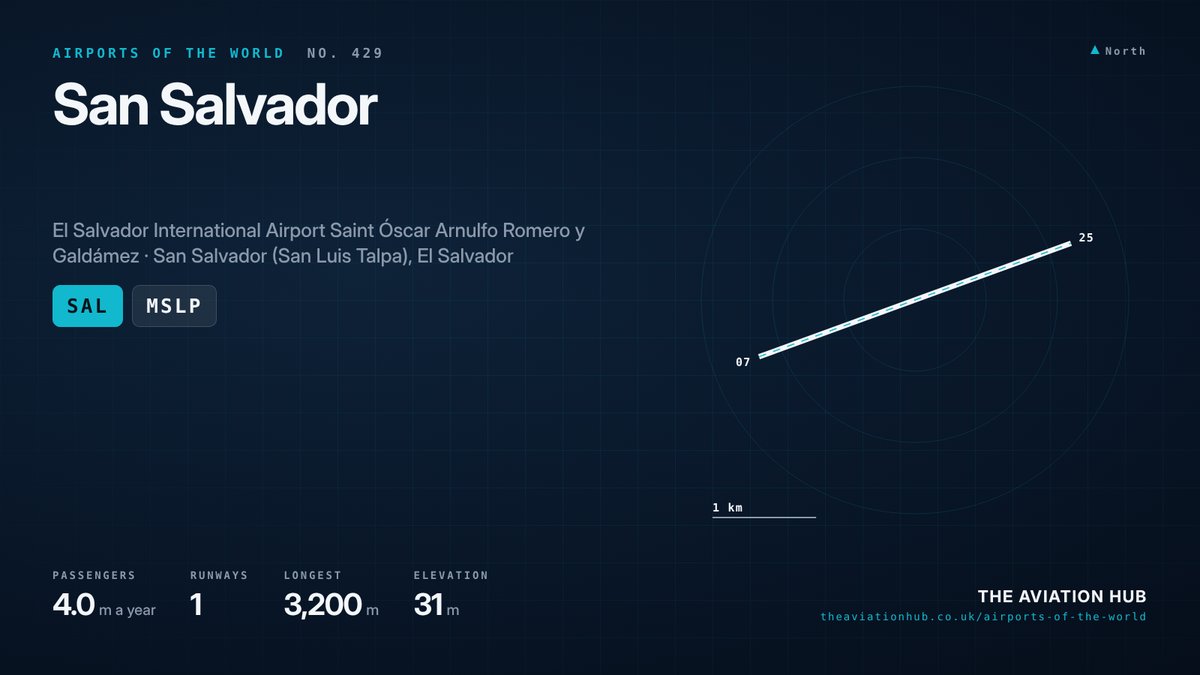
El Salvador is a small country, yet its main airport punches well above its weight. San Salvador Airport, officially El Salvador International Airport Saint Óscar Arnulfo Romero y Galdámez, handled about 5.3 million passengers in 2024. It is the connecting hub for Avianca across the region and a vital link for the large Salvadoran community in the United States. The field sits on the Pacific coastal plain, well south of the capital.
San Salvador Airport at a Glance
The IATA code is SAL and the ICAO code is MSLP. San Salvador Airport lies in San Luis Talpa, in La Paz department, about 26 miles (42 km) from the capital by four lane motorway. The elevation is 101 feet (31 metres). There is one active runway, two passenger terminals and a dedicated cargo terminal.
Traffic reached about 5.3 million passengers in 2024, with roughly 49,000 aircraft movements. Avianca El Salvador and Volaris El Salvador use the airport as a hub. The state ports and airports authority, CEPA, operates the site. Flight information and services are listed on the airport’s official website. Many people still call it El Salvador International Airport, or simply Comalapa.
How El Salvador’s Airport Came to Be
For decades the country’s main airport was Ilopango, on the eastern edge of San Salvador. By the 1970s it was hemmed in by the city and too small for modern jets. President Arturo Armando Molina pushed for a new site on the coast. Japan’s government funded the project and the Japanese contractor Hazama Gumi built it.
The new field opened on 31 January 1980 as Cuscatlán International Airport. It later became known as Comalapa International Airport, and the military side was called Comalapa Air Base. The opening came just as civil war broke out, and the airport remained a lifeline through the conflict. TACA, the local carrier, grew into a regional airline group and later merged into Avianca.
In 2014 President Mauricio Funes announced the airport would honour Monsignor Óscar Romero, the archbishop murdered in 1980. Lawmakers approved the change that March. After Romero’s canonisation in October 2018, San Salvador Airport took its full current name.
Runways at San Salvador Airport
The main runway, 07/25, measures 3,200 metres (10,500 feet) long and 45 metres (148 feet) wide, with an asphalt surface. It can handle a Boeing 747 or 777. A short crossing strip, 18/36, is only about 800 metres long and is closed. It now serves as parking for stored aircraft.
Wind direction decides whether runway 07 or 25 is in use. Runway 07 arrivals come in from the west along the coast. The rainy season from May to October brings heavy thunderstorms. The 2001 earthquake closed the field for several hours.
A single runway is adequate for current traffic. Peak waves of Avianca departures still create busy periods, especially in the morning and evening banks.
Terminals and Airlines
Terminal 1 has 14 aircraft stands with boarding bridges. Terminal 2 opened in February 2022 with five gates, including one with double boarding bridges for wide body jets, plus three remote stands. Its layout separates arriving, connecting and departing passengers. A wider rehabilitation by CEPA ran from 2012 to 2015.
Avianca El Salvador dominates, flying a large Airbus A320neo family fleet. Its only Central American connection centre is here, linking North America, South America and the rest of the isthmus. Volaris El Salvador flies low cost routes to the US and the region. American, United, Delta, Iberia, Aeroméxico, Copa and Frontier also serve the field.
All three global alliances are represented, with Star Alliance strongest through Avianca, Copa and United. The maintenance company Aeroman runs a large heavy maintenance base at San Salvador Airport, working on jets for North American airlines.
Routes and Destinations
The United States dominates the route map. Los Angeles was the busiest route in 2023, with about 492,000 passengers. Houston Intercontinental followed at around 489,000, and Washington Dulles at about 472,000. New York JFK and Miami completed the top five, with roughly 254,000 and 236,000 passengers.
Avianca also links the city with Bogota, Mexico City and Madrid. Madrid, about 5,400 miles (8,700 km) away, is among the longest routes. Iberia flies there too, and competition is growing. Iberojet began Barcelona and Madrid flights in September 2026, and Air Europa adds Madrid from December 2026.
Traffic peaks around Christmas, Easter and the August holidays, when Salvadorans abroad return home. The cargo terminal handles exports such as textiles alongside express parcels.
Getting to and from San Salvador Airport
The four lane motorway north to the capital takes around 30 to 45 minutes, depending on traffic. Authorised airport taxis charge fixed fares in US dollars, the national currency. Hotels in San Salvador often arrange pickups. Car hire desks sit in the arrivals area.
Surfers heading for El Tunco and the coast around La Libertad can use the coastal highway to the northwest, which avoids the capital entirely. Local buses run along the airport road and are by far the cheapest option. They are slow and awkward with luggage, so a shared shuttle is the cheapest sensible choice for most visitors. There is no rail service.
Spotting and Photography
San Salvador Airport offers a lively mix of Avianca jets, US carriers and stored aircraft on the old crossing runway. Aeroman’s maintenance hangars add visiting airliners from North America. Public roads across the flat coastal plain give views of the approaches, particularly for runway 07 arrivals from the west.
The sun stays mostly to the south during the dry season from November to April, which favours positions on the southern side. Haze from cane burning can soften images in the dry months.
The air force shares the field, and security is tight. Stay on public land, keep away from fences, carry identification and follow police instructions at once.
What Comes Next
Terminal 2 has added breathing room, and further phases are expected as connecting traffic grows. The government is also building a new Pacific airport in the eastern department of La Unión, which aims to spread tourism and trade across the country. Its effect on San Salvador Airport is likely to be limited, since the capital and the Avianca hub keep most traffic here.
Rising tourism, driven by surfing and improved security, has encouraged new European routes. Compare the field with other Central American hubs on our Airports of the World map. The verdict: San Salvador Airport is a busy, modernised hub with a strong US focus, and it is well placed to grow as long as Avianca keeps its connecting bank here.
Continue to follow The Aviation Hub for more analysis and insight.
Advertise with us Your brand, in front of an aviation audience Home page and in-article placements, sold directly, one advertiser per slot. From £250 a year. See the rates

