
Sanya Airport Guide: China’s Tropical Holiday Runway
Sanya Airport on Hainan island handles close to 23 million passengers a year on one runway. Read about its routes, Russian links, rail access and spotting.
 By The Aviation Hub
7 min read
Updated October 20, 2026
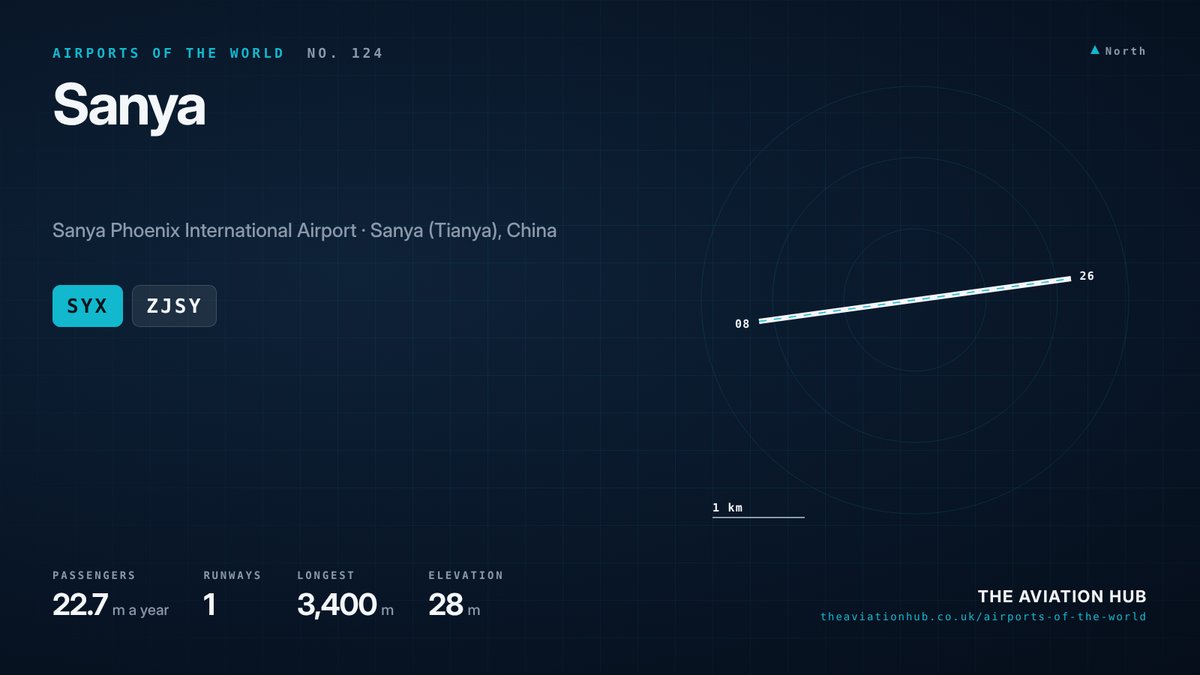
Sanya Phoenix International Airport sits on the south coast of Hainan, China’s tropical island province, about 9 miles (15 km) north west of Sanya city centre. It is the air gateway to the beaches of Yalong Bay, Dadonghai and Haitang Bay and the second busiest airport on the island after Haikou. Sanya Airport handled around 22.7 million passengers in 2025 from a single runway, ranking 24th among mainland Chinese airports. Winter sun traffic from the frozen north of China and a long standing Russian market give it a character unlike any other Chinese airport.
Sanya Airport at a Glance
The codes are SYX and ZJSY. The field lies at 28 m (92 ft) above sea level on flat land between the coast and the hills, in the Tianya district beside the town of Fenghuang, which gives the airport its Phoenix name. One concrete runway, 08/26, serves two domestic terminals, T1 and T2, and a separate international terminal, all extended in stages since 1994.
HNA Infrastructure Investment Group, the airport arm of the Hainan Airlines empire, operates the field. China Southern Airlines treats Sanya Airport as a hub, and Hainan Airlines, Beijing Capital Airlines and their affiliates base aircraft there. In 2025 the airport recorded about 139,900 aircraft movements and 117,000 tonnes of cargo alongside its passenger total. Opening hours, airline lists and transport links are set out on the airport’s official website.
How Sanya’s Airport Came to Be
Sanya had no proper civil airport until the early 1990s, when Hainan’s new status as a province and special economic zone brought money for a civil airport. Phoenix Airport opened on 1 July 1994 with a single runway and a terminal sized for a town that was then a sleepy fishing port. The tourism boom that followed changed everything.
The terminal was expanded in the 2000s as domestic charter and scheduled traffic grew. Transaero began non stop flights from Moscow around 2007, the first transcontinental service from Hainan. That route ended when Transaero collapsed in 2015, but from 2017 IrAero, Alrosa, Azur Air and later Aeroflot rebuilt the Russian market across several Russian cities.
A railway station opened just north of the airport on 30 December 2015, the day the Western Ring high speed line opened from Haikou. Terminal extensions continued into the 2020s as traffic climbed past 20 million. Offshore duty free shopping, expanded under the 2020 free trade port plan, and visa free entry for many nationalities both feed the airport directly.
Runways at Sanya Airport
Runway 08/26 measures 3,400 m (11,155 ft) and is surfaced in concrete. It is long enough for the Boeing 747 or Airbus A340, and in practice it handles Airbus A330s, Boeing 787s and the occasional Boeing 777 on busy winter days alongside a constant flow of narrow bodies.
The runway runs roughly east to west along the coastal plain. Prevailing winds in the winter high season come from the north east, so landings on 08 are common, bringing aircraft in over the sea and the western suburbs. Summer brings south westerlies and more arrivals on 26. With only one runway, every arrival and departure competes for the same strip of concrete at peak times.
A single runway serving close to 23 million passengers a year is working hard. Sanya Airport manages it through tight slot control and quick turnarounds. Slot constraints are tightest in the Chinese New Year peak, when demand for flights from northern cities outstrips capacity.
Terminals and Airlines
Domestic flights, which account for the overwhelming majority of traffic, use Terminals 1 and 2, where Hainan Airlines, China Southern, Beijing Capital Airlines, Air China, China Eastern, Sichuan Airlines, Spring Airlines, Juneyao and Xiamen Airlines all check in. A separate international terminal handles foreign flights, and dozens of passenger airlines serve the airport in total.
Hainan Airlines, Beijing Capital Airlines and China Southern offer the widest networks. The international terminal handles Aeroflot and the other Russian carriers, along with flights from Hong Kong, Singapore, Kuala Lumpur, Bangkok, Kazakhstan, Uzbekistan and Mongolia. Duty free shopping is a bigger feature here than at most Chinese airports because of Hainan’s offshore duty free rules.
Lounges are run by the airlines and the airport, with Hainan Airlines’ Fortune Wings lounge the most comfortable. The terminal is busy rather than beautiful, and queues at security during the morning peak are a regular complaint.
Routes and Destinations
Sanya Airport is a destination, not a transfer hub, so almost every flight is a point to point leisure service. Beijing, Shanghai, Guangzhou, Shenzhen, Chengdu, Chongqing, Xi’an, Wuhan, Hangzhou and Nanjing are among the busiest domestic routes. Winter adds heavy traffic from Harbin, Shenyang, Changchun and other cold northern cities whose residents spend the season on Hainan.
Internationally, Russia remains the signature market, with Aeroflot flying to Moscow, Saint Petersburg, Novosibirsk and Ufa and other carriers serving Siberian and Far Eastern cities. Belavia’s Minsk service, at almost 4,900 miles (7,800 km), is among the longest, and Condor links Sanya with Frankfurt. South East Asian and Central Asian routes have grown under the visa free rules.
Traffic is strongly seasonal. December to February is the peak, driven by Chinese New Year and northern holidaymakers, while the hot and humid summer is quieter. Cargo of around 117,000 tonnes a year is mostly belly freight of tropical fruit and seafood heading north, with Tianjin Air Cargo flying freighters to Singapore.
Getting to and from Sanya Airport
Sanya Phoenix Airport railway station sits a short walk north of the terminal and is served by trains on the Western Ring high speed railway. Services run east to Sanya railway station, about 6 miles (10 km) away, and connect there with the Eastern Ring line to Haikou. The airport train is cheap and quick and makes the cheapest sensible option for anyone staying near the city centre.
By road, the airport expressway and the G98 island ring road link the terminal to Sanya in 20 to 30 minutes and to Yalong Bay or Haitang Bay in 40 to 60 minutes. Taxis to the city centre cost around CNY 40 to 60 (roughly £4 to £7), with resort transfers to Haitang Bay nearer CNY 150. Didi ride hailing works well.
Airport buses run several routes to the bus station, the beach districts and the main resorts for a few yuan more than the train. Car parks sit in front of the terminal, and the larger resorts run their own shuttle buses to meet arriving guests.
Spotting and Photography
Sanya Airport is not set up for spotters, but the geography helps. Roads west of the airport pass under the approach to Runway 08, where arrivals are low enough for decent shots. The hills north of the field give elevated views of the whole runway and apron, and the departure lounge windows cover the main stands.
The fleet is a parade of Chinese domestic colours: Hainan Airlines Boeing 787-9s and Airbus A330-300s, China Southern Airbus A321neos, Beijing Capital Airlines A330s and endless 737-800s and A320s. Aeroflot Boeing 777-300ERs and A350-900s add interest in winter. Light is good most of the year, with morning sun on the eastern approach and warm evening light over the western threshold.
The airport shares its airspace with military fields nearby, and Hainan hosts sensitive naval facilities. Photograph only from public places, avoid pointing a lens at anything military, keep clear of the fence and move on politely if asked.
What Comes Next
Rail links are already in place, with the Western Ring line running from the airport station up the west coast to Haikou since 2015. Terminal refurbishment continues, and the airport has studied a second runway and a new terminal to cope with the free trade port’s ambitions. Hainan’s planners have also long discussed a new airport on reclaimed land at Hongtangwan, west of the city, though that scheme has stalled.
Growth depends on the Chinese domestic leisure market and on the island’s ability to attract foreign visitors under its visa free policy. Both have momentum, and the Russian market shows no sign of fading.
Sanya Airport will stay a single runway holiday field for now, but demand is pushing hard against that limit. Compare it with the other island airports on the Airports of the World map.
Continue to follow The Aviation Hub for more analysis and insight.
Advertise with us Your brand, in front of an aviation audience Home page and in-article placements, sold directly, one advertiser per slot. From £250 a year. See the rates

