
Sao Paulo Congonhas Airport Guide: Brazil’s Downtown Runway
Sao Paulo Congonhas Airport squeezes 24 million passengers onto two short city centre runways. Read about its history, slot limits and the Rio shuttle.
 By The Aviation Hub
7 min read
Updated October 20, 2026
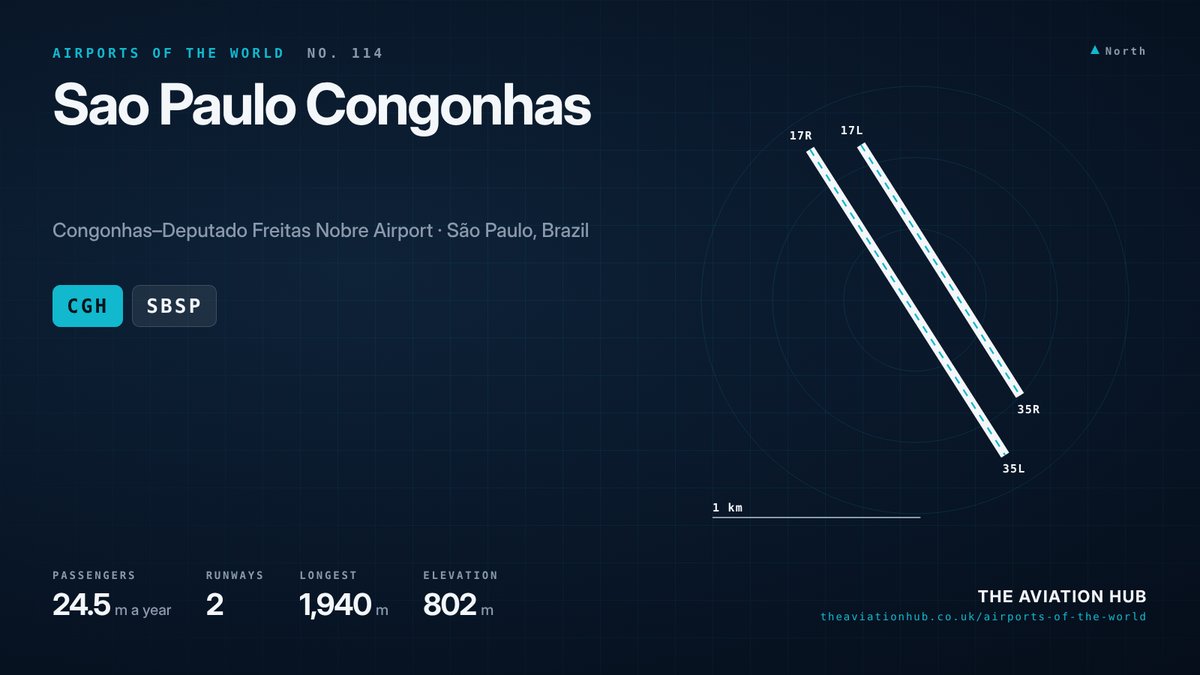
Congonhas Airport sits in the middle of Sao Paulo, surrounded on every side by apartment blocks, offices and some of the busiest avenues in South America. It is the domestic airport of Brazil’s largest city and the business traveller’s choice over distant Guarulhos. Sao Paulo Congonhas Airport handled around 24.5 million passengers in 2025 on two short runways, under a strict slot cap and a night closure. It is also the home of the Rio shuttle, one of the most famous air routes in the world, and the site of Brazil’s worst air disaster.
Sao Paulo Congonhas Airport at a Glance
The codes are CGH and SBSP. The airport lies around 5 miles (8 km) south of the historic centre of Sao Paulo, close to the business districts of Avenida Paulista and Brooklin, at an elevation of 802 m (2,631 ft) on the plateau. Two parallel asphalt runways serve a single passenger terminal that has been extended and refurbished many times.
In 2025 Sao Paulo Congonhas Airport handled around 24.5 million passengers, up six per cent on the year before. Gol and LATAM Brasil both treat it as a hub and Azul uses it as a focus city. Since 2023 the field has been run by the Spanish operator Aena under a 30 year concession awarded in August 2022. Slots are capped at 30 movements an hour and the airport operates only between 06.00 and 22.30. Flight information and parking rates are on the airport’s official website.
How Sao Paulo’s Airport Came to Be
Congonhas opened on 12 April 1936 as a private airfield for VASP, the Sao Paulo state airline, which wanted an alternative to the older Campo de Marte field north of the centre. The site was chosen for its favourable winds and its position on a high, sparsely vegetated hill in what was then the edge of the city. The name comes from the Vila Congonhas neighbourhood, named after a nineteenth century viscount whose title traces back to a Brazilian shrub.
The city grew out to meet the airport and then swallowed it. Long haul flights moved to Viracopos once the first jets arrived, and the remaining international services left when Guarulhos opened in 1985. The Ponte Aerea, the shuttle to Rio de Janeiro’s Santos Dumont airport, began in 1959 as a joint operation inspired by the Berlin Airlift and ran as a pooled service until 1999. It remains the busiest route in Brazil.
On 17 July 2007 TAM Flight 3054, an Airbus A320, overran runway 35L in heavy rain, crossed Avenida Washington Luis and struck a warehouse. All 187 on board and 12 people on the ground died, making it the deadliest accident in Brazilian aviation. The airport lost its international status in 2008 and its runways were grooved and later fitted with arrestor beds. Since June 2017 the official name has honoured Deputado Freitas Nobre, a local politician, though nobody calls it anything but Congonhas.
Runways at Sao Paulo Congonhas Airport
Sao Paulo Congonhas Airport has two parallel asphalt runways. The main runway 17R/35L is 1,940 m (6,365 ft) long and 45 m wide. The secondary runway 17L/35R is just 1,495 m (4,905 ft) long and 45 m wide, and it is used mainly by general aviation and smaller aircraft. Neither can be extended because the city presses against both ends.
The length rules out anything bigger than a narrow body. Airbus A320 family and Boeing 737 aircraft operate at reduced weights, and the Embraer E195-E2 has become a favourite for Azul because it performs well from short strips at altitude. Approaches to runway 35L come in low over the rooftops of the southern districts, and aircraft landing on 17R descend over the Ibirapuera area with the skyline filling the windscreen.
Engineered material arrestor systems, the crushable concrete beds known as EMAS, were installed at the runway ends in 2022 to catch any future overrun. The grooved surface added after 2007 improves braking in the heavy rain that falls on the plateau every summer afternoon. Even so, wet weather can force diversions to Guarulhos or Viracopos.
Terminals and Airlines
The single terminal at Sao Paulo Congonhas Airport is a long, low building facing Avenida Washington Luis. It has been patched and extended many times, and its central hall is seen as one of the finest examples of modern architecture in the city. Aena is now building a new passenger terminal roughly twice the size of the current one, with 19 airbridges replacing today’s 12.
LATAM Brasil and Gol are the two giants, each with a bank of gates and a schedule built around the business day. LATAM flies Airbus A319s and A320s, while Gol operates an all Boeing 737 fleet including the 737 MAX 8. Azul is the third force, using the E195-E2 and running free coaches to its Campinas hub at Viracopos. VoePass also flew here until the regulator withdrew its certificate in 2025. The airport has a strong general aviation side, with executive jets and helicopters serving Sao Paulo’s business elite.
Routes and Destinations
Rio de Janeiro Santos Dumont is the busiest route by a wide margin, with LATAM, Gol and Azul all competing on the hour long hop between the two downtown airports. Other busy routes include Brasilia, Belo Horizonte Confins, Curitiba, Porto Alegre, Recife, Salvador, Florianopolis and Goiania. Many state capitals in Brazil have a direct flight.
The schedule is shaped by the business week, with Monday mornings and Friday evenings the heaviest periods and weekends noticeably quieter. There are no international flights, and the slot cap of 30 movements an hour means the airport is essentially full from dawn to dusk. Cargo is negligible, with freight handled at Guarulhos and Viracopos. Free airline shuttle buses link Sao Paulo Congonhas Airport to those two fields for connecting passengers.
Getting to and from Sao Paulo Congonhas Airport
The monorail is the newest option. Congonhas station on Line 17 Gold sits beside the terminal and connects to Line 5 Lilac of the metro at Campo Belo, from where the rest of the network is a few stops away. The fare is the standard metro price of a few reais, which makes it the cheapest sensible route into the city once the full line is running.
Buses run along Avenida Washington Luis to the city centre and the Paulista district, and an EMTU executive coach links Congonhas with Guarulhos in about an hour, traffic permitting. Taxis and ride hailing cars queue outside arrivals, and a trip to Avenida Paulista costs around BRL 40 to 60 (about £6 to £9) and takes 20 to 40 minutes. Sao Paulo traffic is notorious, so allow double at rush hour. A multi storey car park faces the terminal.
Spotting and Photography
Sao Paulo Congonhas Airport is one of the great city airport spotting locations. The classic viewpoint is the pavement along Avenida Washington Luis at the northern end, where aircraft on short final to 17R pass low over the traffic. The overpass and footbridges near the southern threshold of 35L give equally close views of arrivals from the other direction, with the city skyline behind.
The terminal itself has a cafe area with windows onto the apron. Morning light favours the eastern side of the field and late afternoon the west. The traffic is almost entirely A320s, 737s and E2s, but the density and the urban setting make up for the lack of variety. Sao Paulo has a serious street crime problem, so keep camera gear discreet, stay in busy areas, do not spot alone after dark and avoid flashing expensive equipment near the road.
What Comes Next
Aena has committed more than BRL 2 billion under its concession, with the new terminal due in 2028, a bigger apron and new taxiways. There is no prospect of longer runways, so the focus is on comfort and efficiency rather than rapid growth. Proposals to allow larger aircraft or extend the operating hours resurface from time to time and meet strong opposition from neighbours.
The airport’s future is as a premium domestic field for a city that cannot live without it. The verdict is that Sao Paulo Congonhas Airport will remain crowded, constrained and indispensable for as long as Brazilians need to be in Rio by nine. See how it compares with Guarulhos and other city airports on the Airports of the World map.
Continue to follow The Aviation Hub for more analysis and insight.
Advertise with us Your brand, in front of an aviation audience Home page and in-article placements, sold directly, one advertiser per slot. From £250 a year. See the rates

