
Semarang Airport Guide: Central Java’s Floating Terminal
Semarang Airport serves Central Java from a terminal built over former swampland. Read its history, runway, airlines, routes, transport and plans.
 By The Aviation Hub
5 min read
Updated October 20, 2026
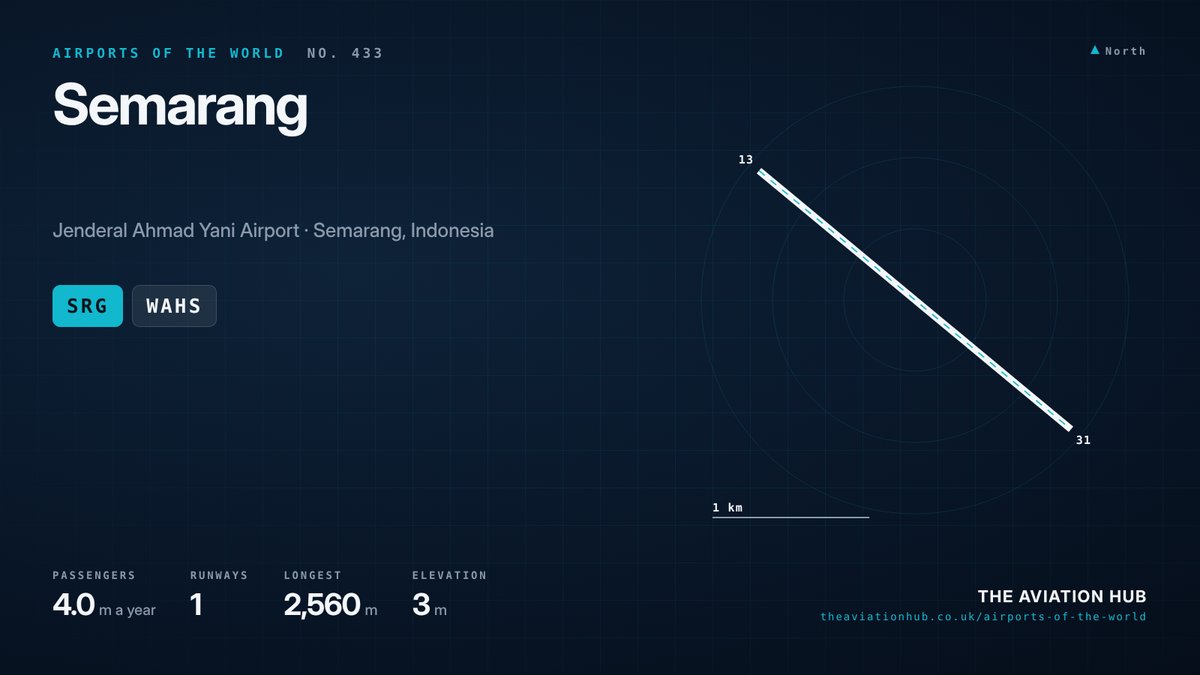
Semarang is the capital of Central Java and a busy port on the island’s north coast. Semarang Airport, officially Jenderal Ahmad Yani International Airport, serves the city and a wide hinterland of factories, farms and historic towns. It handled about 2.3 million passengers in 2024. Its 2018 terminal stands over former swampland and is often described as Indonesia’s first floating airport terminal, a distinctive answer to building on soft coastal ground.
Semarang Airport at a Glance
The IATA code is SRG and the ICAO code is WAHS. Semarang Airport lies about 4 miles (6 km) west of the city centre, close to the Java Sea. Its elevation is just 10 feet (3 metres). There is one runway and one passenger terminal, opened in 2018, with an older terminal set to pass to the Indonesian Army.
Traffic reached roughly 2.3 million passengers in 2024, with about 18,000 aircraft movements and 18,800 tonnes of cargo. The Lion Air group, Garuda Indonesia and Citilink carry most passengers. The state airport company formerly known as Angkasa Pura I runs the field, now within the merged InJourney Airports group. Flight details are on the airport’s official website.
How Semarang’s Airport Came to Be
Semarang’s first commercial airfield was at Simongan, which operated from 1928 until 1935. The Dutch East Indies government then opened Kalibanteng Airfield on the present site in March 1938. Japanese forces captured it in 1942 and forced Allied prisoners of war to upgrade it. Indonesian guerrillas besieged the airfield in 1946 during the independence struggle.
After independence it served as a military base, closed to commercial flights through the 1950s and early 1960s. Airlines returned on 31 August 1966. That year Suharto ordered the airport renamed after Ahmad Yani, the Army Chief of Staff killed during the 30 September Movement in 1965. Yani was later declared a National Hero.
By the 2010s the old terminal, built for 800,000 passengers a year, was badly overcrowded. Groundbreaking for a new terminal took place in 2014. It opened on 6 June 2018, transforming the experience at Semarang Airport.
Runways at Semarang Airport
A single asphalt runway, 13/31, measures 2,560 metres (8,399 feet) long and 45 metres (148 feet) wide. That suits narrow body jets such as the Boeing 737-800 and Airbus A320, along with ATR 72 turboprops. Wide body flights face payload limits, so a proposed extension to 3,000 metres would open the door to larger aircraft.
The monsoon influences runway direction. Westerly winds in the wet season from roughly November to March tend to favour runway 31. Southeasterly winds in the drier months bring runway 13 into use. Tropical downpours can be intense, and wet runways have caused accidents here. In 1994 a Merpati Fokker 28 overran in heavy rain and broke into three pieces, though all 85 people aboard survived.
The apron covers about 72,500 square metres and holds up to 12 narrow body aircraft, or 10 narrow bodies and 2 wide bodies. Land subsidence and tidal flooding are serious problems along Semarang’s coast.
Terminals and Airlines
The 2018 terminal has three storeys, three jet bridges and 30 check in counters. It can handle up to 7 million passengers a year, roughly three times current demand. Its design raises the building above the wet ground, with water features around it. The old terminal is due to be transferred to the army.
Domestic carriers dominate Semarang Airport. Garuda Indonesia and its low cost arm Citilink link the city with Jakarta and other hubs. The Lion Air group, including Lion Air, Batik Air, Super Air Jet and Wings Air, flies a wide domestic network. AirAsia flies to Kuala Lumpur and Scoot to Singapore, both resuming in 2025. Garuda belongs to SkyTeam, giving alliance travellers some connections via Jakarta.
Routes and Destinations
Jakarta is by far the busiest route, with many flights a day despite competition from trains and the Trans Java toll road. Surabaya, Denpasar and Balikpapan add other key domestic links. Routes to Kalimantan matter for business and family travel, since many Central Javanese work across the Java Sea.
International flights have been sporadic. The airport lost its international status on 2 April 2024 because no foreign flights were operating, then regained it on 26 April 2025. Services to Kuala Lumpur and Singapore resumed soon afterwards.
Demand peaks around the Lebaran holiday at the end of Ramadan, when millions travel home across Indonesia. Cargo is modest, mostly carried in the holds of passenger jets.
Getting to and from Semarang Airport
The Trans Semarang bus rapid transit system has served the airport since 2013. Buses run roughly every 15 to 30 minutes and are the cheapest sensible option for reaching the city. A dedicated shuttle bus operated from 2005 to 2007 but was withdrawn after protests from taxi drivers.
Airport taxis wait at arrivals, and app based ride services are widely used. The trip to central Semarang takes around 20 to 30 minutes, longer in rush hour. Some public taxis cannot enter the terminal area. Rail travellers connect at Semarang Tawang or Poncol stations, both in the city, for trains to Jakarta and Surabaya.
Spotting and Photography
Semarang Airport sits on flat coastal ground surrounded by fishponds and low lying land. Approaches over the water and ponds make for attractive shots, with Lion group jets, Garuda aircraft and ATR turboprops providing steady traffic.
Close to the equator, the sun shifts between north and south through the year. Early mornings bring the softest light and the least haze. Afternoon storms in the wet season can produce dramatic skies.
The military presence means security is taken seriously. Stay on public land, keep away from fences and follow instructions from police or airport staff.
What Comes Next
The new terminal has ample spare capacity, so attention has shifted to the runway. Extending it to 3,000 metres would allow wide body flights, including potential Hajj and Umrah services to Saudi Arabia. Proposals to move the airport to Demak or Kendal were rejected by the operator and opposed by the Central Java governor.
Coastal subsidence remains a long term risk for Semarang Airport and the city. Compare the field with other Javanese airports on our Airports of the World map. The verdict: Semarang Airport has a modern terminal waiting for traffic to catch up, and its growth depends on new international routes and a longer runway.
Continue to follow The Aviation Hub for more analysis and insight.
Advertise with us Your brand, in front of an aviation audience Home page and in-article placements, sold directly, one advertiser per slot. From £250 a year. See the rates

