
Sendai Airport Guide: Tohoku’s Gateway Reborn After 2011
Sendai Airport is the Tohoku region's main gateway. Its history, the 2011 tsunami, runways, airlines, the airport rail line and spotting tips.
 By The Aviation Hub
5 min read
Updated October 20, 2026
Sendai Airport sits on the Pacific coast south of Sendai, the main city of Japan’s Tohoku region. It is the main air gateway to north eastern Honshu, serving domestic routes across Japan and a growing list of flights to Korea, Taiwan and Hong Kong. The world watched in March 2011 as the tsunami swept across its runways. Today it handles close to 3.8 million passengers a year under private management.
Sendai Airport at a Glance
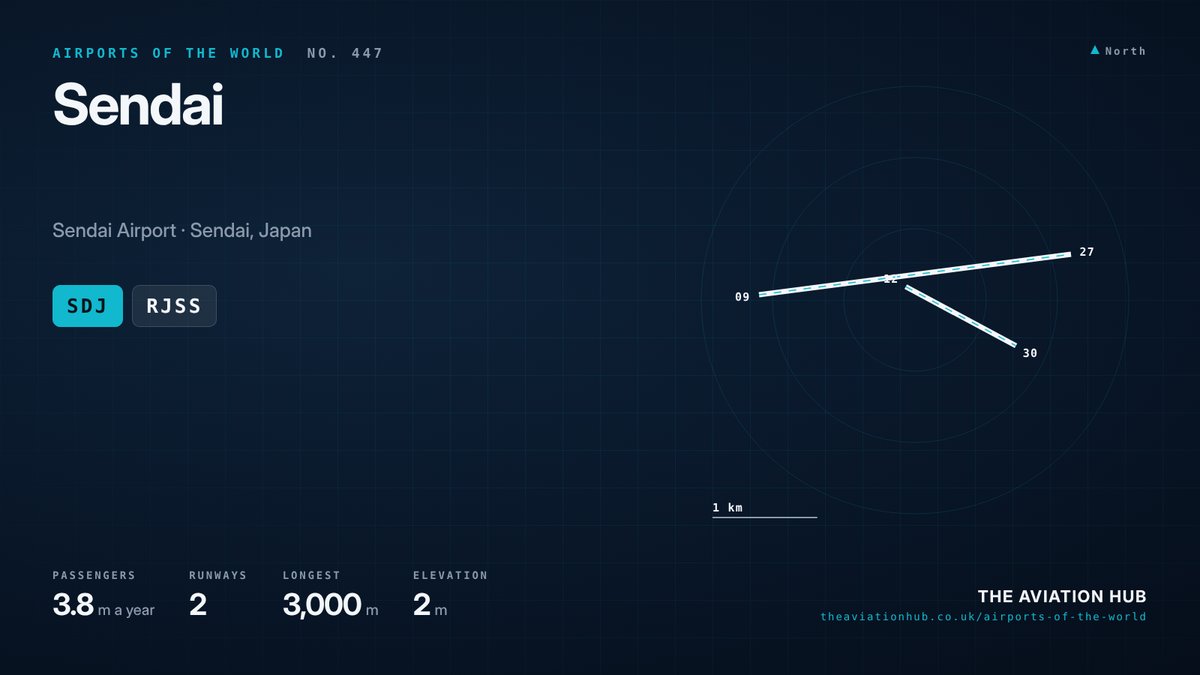
The IATA code is SDJ and the ICAO code is RJSS. The airport lies in Natori, about 8.5 miles (13.6 km) south south east of central Sendai, at an elevation of just 6 feet (2 m). It has two runways and one main terminal. Sendai Airport handled 3,778,423 passengers in 2024, up 6.4 per cent, along with 28,400 aircraft movements and about 2,800 tonnes of cargo.
The operator is Sendai International Airport Co., Ltd. ANA and its regional arm dominate the domestic schedule, and Ibex Airlines, a regional carrier, is based here. Timetables, parking and access details are on the airport’s official website.
From Army Airfield to Tohoku Gateway
The Imperial Japanese Army built the field in 1940 for a branch of the Kumagaya Army Flight School. Known variously as Natori, Masda and Yatori Airfield, it later housed the Sendai Army Flight School. After the war the United States Army took control, returning the site to Japan in 1956.
Civil aviation grew slowly. On 10 May 1963 All Nippon Airways Flight 802 crashed at the field after a missed approach, without loss of life. Commercial jet services began on 14 February 1970, and international flying started in 1990 with Asiana Airlines to Seoul. The main runway was extended in stages to 3,000 metres, a project completed in 1997 alongside a new terminal designed by Gyo Obata of Hellmuth, Obata and Kassabaum. In July 2016 the government handed the airport to a private consortium led by Tokyu under a long term concession, an early test of Japan’s airport privatisation policy.
The defining moment came on 11 March 2011. The earthquake damaged the buildings and the tsunami flooded the apron, both runways and part of the terminal’s second floor. Around 1,300 people were stranded until 13 March.
Runways at Sendai Airport
The main runway, 09/27, is asphalt and measures 3,000 metres (9,842 feet) long and 46 metres wide. It handles everything from regional jets to wide body aircraft. A shorter crosswind runway, 12/30, measures 1,201 metres (3,940 feet) and is used mainly by light aircraft and training flights.
The coastal site is flat, so approaches over the Pacific or the rice fields inland are straightforward. That same low elevation left Sendai Airport exposed in 2011. United States military personnel helped clear the debris during Operation Tomodachi, and a Boeing C-17 delivered 40 tonnes of relief supplies on 20 March. Limited commercial flights resumed on 13 April 2011, regular domestic services on 25 July and most international routes by October.
Terminals and Airlines
The single terminal has four levels: arrivals on the ground floor, an arrivals concourse above, departures on the second floor and shops and a business lounge on the third. Eight jet bridges serve the gates. Domestic flights use the western end and international flights the eastern side.
ANA and ANA Wings fly the core domestic network, with Ibex Airlines operating regional jets on ANA codeshare routes. Peach brings low cost competition. International carriers include Asiana, EVA Air, Starlux, Tigerair Taiwan and HK Express. The airline mix reflects Sendai’s role as a gateway for Taiwanese and Korean tourists exploring Tohoku’s hot springs, autumn colours and winter snow.
Routes and Destinations
There are no flights to Tokyo. The Tohoku Shinkansen reaches the capital in about 90 minutes, so the domestic network looks north, west and south instead. Sapporo Chitose, Osaka Itami and Nagoya Centrair are core routes, joined by Fukuoka, Hiroshima, Kobe and Naha in Okinawa. Osaka Kansai is another important low cost link.
Internationally, Sendai Airport connects with Seoul Incheon, Taipei Taoyuan, Kaohsiung and Hong Kong. Taiwan is the strongest market, with several airlines competing. Earlier international links have come and gone: Singapore Airlines withdrew during the 1997 Asian financial crisis, and most China routes were suspended in 2012 and 2013 amid tense diplomatic relations. Cargo is modest at under 3,000 tonnes a year.
Getting to and from Sendai Airport
The Sendai Airport Line opened on 18 March 2007 and links the terminal directly with Sendai Station in 17 to 25 minutes. Trains run several times an hour, and the fare is low, making the train the cheapest sensible option for most travellers. At Sendai Station passengers can change for the Shinkansen to Tokyo, Morioka and Aomori.
Buses run to Yamagata, Matsushima, Iwanuma, Tatekoshi Station and Aizu Wakamatsu, with seasonal winter services to Zao Onsen. By road, the airport is reached via the Sendai Tobu Road. Parking 1 has 970 spaces and Parking 2 another 250. Taxis to central Sendai take around 30 minutes but cost several thousand yen.
Spotting and Photography
Sendai Airport looks after enthusiasts well. The Smile Terrace observation deck opened on 19 March 2010 on top of the terminal and gives clear views across the apron to runway 09/27. The open farmland and minor roads around the perimeter offer alternative angles, especially close to the runway thresholds.
The variety is good for a regional field: ANA jets and turboprops, Ibex CRJ700s, Peach A320s and Taiwanese A321s on the international side. Training aircraft on the short runway add interest. Japanese airports are relaxed about photography from public areas, but stay outside the fences, park legally and follow any instructions from staff.
What Comes Next
Since privatisation the operator has focused on adding low cost and international routes. The concession plan set long term targets of roughly 5.5 million passengers a year by the 2040s, well above today’s levels. New links to Taiwan and Korea have helped. Better connections with the wider Tohoku region by bus and rail remain part of the strategy.
The airport also stands as a symbol of recovery from 2011, rebuilt and busier than before the disaster. The verdict: Sendai Airport is steadily becoming Tohoku’s international front door, with Asia’s tourists driving the next phase of growth. See it alongside other Japanese airports on the Airports of the World map.
Continue to follow The Aviation Hub for more analysis and insight.
Advertise with us Your brand, in front of an aviation audience Home page and in-article placements, sold directly, one advertiser per slot. From £250 a year. See the rates

