
Seville Airport Guide: Moneo Domes and Airbus Test Flights
Seville Airport mixes a Rafael Moneo terminal, Ryanair and Vueling bases and Airbus test flights. Runways, routes, transport and spotting tips inside.
 By The Aviation Hub
6 min read
Updated October 20, 2026
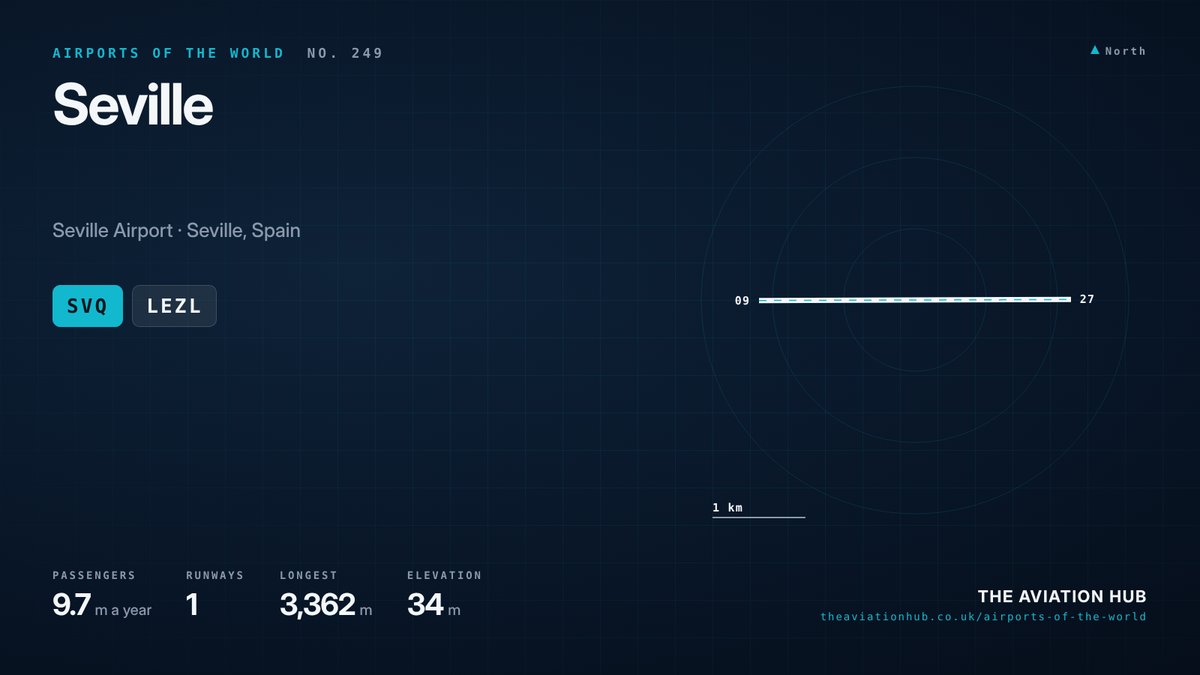
San Pablo Airport lies on the flat farmland of the Guadalquivir valley, about 6 miles (10 km) east of central Seville. Seville Airport is the main gateway to western Andalusia, with more than 9 million passengers a year and a schedule built around low cost flights to Spain and Europe. It also shares its runway with the Airbus factory that assembles the A400M military transport, which makes it far more interesting to enthusiasts than its size suggests.
Seville Airport at a Glance
The IATA code is SVQ and the ICAO code is LEZL. Seville Airport sits roughly 6 miles (10 km) east of the city centre at an elevation of 34 metres (112 feet). It has a single runway and one passenger terminal, enlarged between 2019 and 2022 to handle about 10 million passengers a year.
Traffic reached around 9.1 million passengers in 2024, up 13 per cent on the year before. Ryanair and Vueling both base aircraft here, and Ryanair also runs a maintenance hangar on site. The state controlled operator Aena manages the airport, and flight information and parking bookings are on the airport’s official website.
A Short History of San Pablo
Seville’s first airfield was Tablada, south of the city, which opened in 1914 and stayed in military hands until 1990. Work on a new site at San Pablo began in September 1945, on land that had earlier served as an airship mooring station. The name San Pablo distinguishes it from the older Tablada field, and locals still use it.
The big turning point came with Expo 92. Spain poured money into Seville for the world fair, and the architect Rafael Moneo designed a new terminal that opened in 1991. Its blue domes, arches and courtyards of orange trees nod to the mosques and palaces of Andalusia, and the building still defines the airport today.
After the Expo, traffic settled into a long slow climb. Low cost carriers drove growth from the 2000s, and a five storey car park opened in 2013. An expansion programme finished in 2022 enlarged the terminal and lifted capacity from 6 million to 10 million passengers a year.
Runways at Seville Airport
Seville Airport has one runway, 09/27, which is 3,362 metres (11,030 feet) long and 45 metres wide with an asphalt surface. That is ample for any aircraft that visits, including the A400M at maximum weight and the occasional wide body charter. Taxiways link the passenger apron with the Airbus facilities at San Pablo Sur and San Pablo Norte.
The runway runs east to west along the valley floor, with farmland and light industry at both ends. Wind decides the direction of operations, and summer heat often reduces climb performance on afternoon departures. There is no second runway and no plan for one, so a closure for works or an incident halts all traffic.
That vulnerability has shown itself. In 2006 an Air Algerie Boeing 737 rolled over after its landing gear collapsed on arrival, injuring 45 people. In May 2015 an A400M on a test flight crashed shortly after takeoff from the field, killing four Airbus crew.
Terminals and Airlines
All passenger flights at Seville Airport use the Moneo terminal, with check in on the upper level and gates reached through a single security area. The 2019 to 2022 works enlarged the building on both sides of security. Moneo’s domes remain the signature view from the forecourt, and the courtyard of orange trees survives.
Ryanair is the largest airline, flying Boeing 737-800 and 737 MAX 8 aircraft to a long list of domestic and European points. Vueling is the second big player with its Airbus A320 family fleet, focused on Barcelona and Europe. Iberia, through its regional partner Air Nostrum, links Seville with Spanish cities, and Binter connects the Canary Islands.
International carriers include easyJet, British Airways, Transavia and Volotea, with Moroccan routes adding a North African flavour. There is no alliance hub here, and premium traffic is modest. An Aena lounge serves business class passengers and those who pay for access.
Routes and Destinations
Barcelona is the busiest domestic route, followed by Palma de Mallorca, Madrid, Bilbao and Tenerife North. Madrid traffic is smaller than the distance suggests because the high speed AVE train covers the journey in about two and a half hours. Island routes carry heavy leisure demand, especially in summer.
Abroad, London Gatwick leads the way, with Paris Orly, Paris Charles de Gaulle, Lisbon and London Stansted close behind. Morocco is the main market beyond Europe, with Marrakech, Tangier and Casablanca all served. There are no scheduled long haul routes from Seville Airport yet, but Air Canada plans to start flights to Montreal in September 2027.
The calendar has a strong rhythm. Holy Week and the April Fair bring a spring peak, and the city fills with visitors in autumn and winter, when its weather beats northern Europe. High summer is quieter for city breaks, because July and August temperatures often pass 40C.
Getting to and from Seville Airport
There is no rail link. The Airport Express bus is the cheapest sensible option, running from Plaza de Armas bus station in the centre with a stop at Santa Justa, the main AVE station. The trip takes about 40 minutes, buses run from around 04:30 until after midnight, and the single fare is a few euros.
Taxis wait outside arrivals and charge a fixed fare to the city centre, usually around €30 (roughly £26), with a supplement at night and on holidays. The ride takes 15 to 25 minutes depending on traffic. Ride hailing apps operate in Seville too.
By road, Seville Airport sits beside the A4 motorway to Cordoba and Madrid, with the SE30 ring road close by. The multi storey car park faces the terminal, and cheaper long stay lots sit a short walk away. A rail branch to the terminal has been planned for years, but its delivery date remains uncertain.
Spotting and Photography
The Airbus connection is the big draw. A400M transports for the Spanish, British, French, German and export air forces fly test and acceptance sorties from the field, and C295 and CN235 aircraft built for overseas customers also appear. Watching these alongside Ryanair 737s and Vueling A320s gives Seville Airport an unusual mix.
There is no official viewing terrace. Spotters use public roads around the perimeter and near both runway ends, where approaches pass low over open farmland. The sun sits in the south for most of the day, so a position north of the runway gives the best light, and summer haze makes early mornings more productive.
The Airbus sites are private industrial premises, and staff and the Guardia Civil take a dim view of photography aimed at them from close range. Stay on public land, never block a road or gate and move on if asked.
What Comes Next
With capacity at about 10 million and traffic close to that level, Seville Airport is already near the limit of the 2022 expansion. Aena’s next planning cycle is likely to bring further terminal work, and the long promised rail branch would transform access if it is finally built. The Air Canada route to Montreal will be the airport’s first transatlantic link.
Airbus remains central to the airport’s future. The A400M programme keeps the Seville plants busy, and any new orders would mean more test flying from San Pablo. The verdict is a well loved terminal on a busy, single runway field that will need its next upgrade soon. Explore other Spanish airports on the Airports of the World map.
Continue to follow The Aviation Hub for more analysis and insight.
Advertise with us Your brand, in front of an aviation audience Home page and in-article placements, sold directly, one advertiser per slot. From £250 a year. See the rates

