
Sharjah Airport Guide: Air Arabia’s Low Cost Gulf Hub
Sharjah Airport is the home of Air Arabia and a major Gulf cargo gateway, with one 4,060 m runway. History, terminal, routes, access and spotting explained.
 By The Aviation Hub
7 min read
Updated October 20, 2026
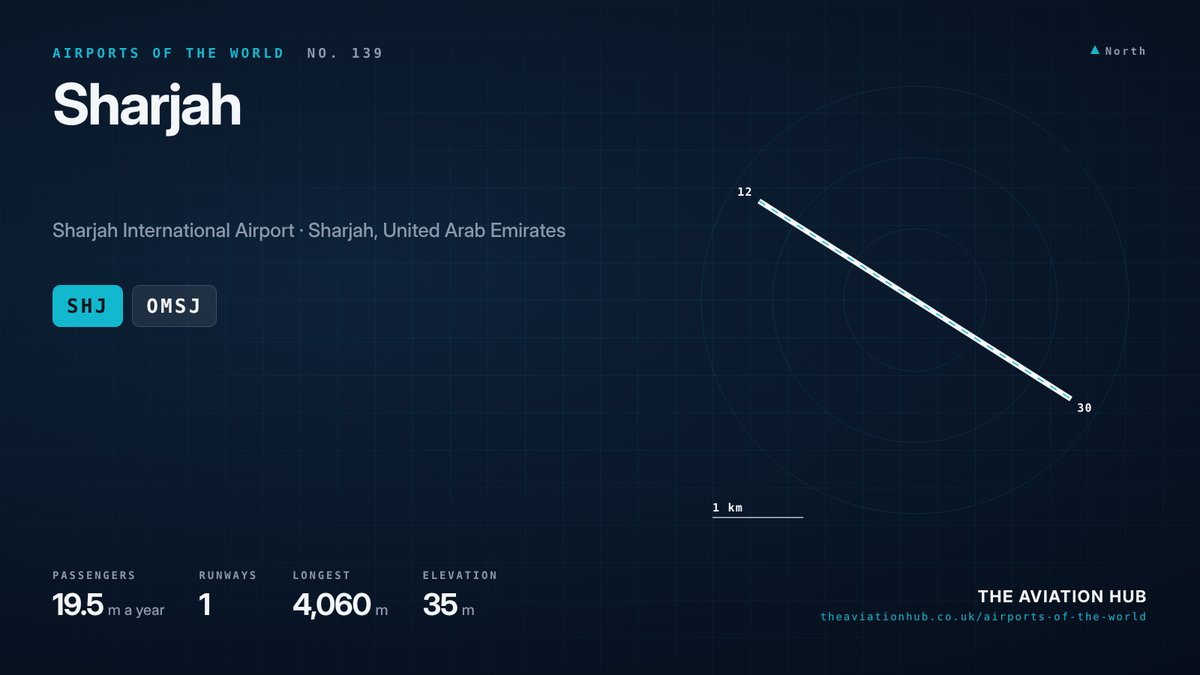
Sharjah International Airport lies about 8 miles (13 km) south east of the centre of Sharjah and roughly 10 miles (16 km) from Dubai, in the emirate that borders Dubai to the north on the Gulf coast of the United Arab Emirates. It is the third busiest airport in the country after Dubai and Abu Dhabi and the home of Air Arabia, the first low cost airline in the Middle East. Sharjah Airport handled around 19.5 million passengers in 2025 and is also one of the largest cargo gateways in the Gulf. A single runway and a single terminal carry a network that stretches from Morocco to Malaysia.
Sharjah Airport at a Glance
The codes are SHJ and OMSJ. The field sits at 35 m (116 ft) above sea level on flat desert east of the city, beside the Sharjah to Dhaid road. It has one runway, 12/30, and one passenger terminal of around 125,000 square metres, plus the Sharjah Freight Centre and an extensive cargo area.
Sharjah Airport Authority, a government body of the emirate, operates Sharjah Airport. Air Arabia, headquartered on the airport, is the home carrier and by far the largest operator. Traffic rose from about 17.1 million passengers in 2024 to around 19.5 million in 2025, a jump of about 14 per cent, and cargo throughput was roughly 320,000 tonnes in 2024. Flight status and parking details are on the airport’s official website.
How Sharjah’s Airport Came to Be
Sharjah was the first place in the Trucial States to see regular flying. An airfield opened in 1932 close to the city as a staging post on the Imperial Airways route from Britain to India, with a fort built beside the strip to shelter passengers overnight. It later became RAF Sharjah, and the RAF stayed until 14 December 1971, days after the United Arab Emirates came into being, and the old terminal and tower survive as the Al Mahatta Museum. The original runway is now part of King Abdul Aziz Street in the city centre.
Development pressure pushed the airport out into the desert, and the present site opened on 1 January 1977. For two decades it served as a secondary airport to Dubai, busy with cargo and the Russian and central Asian freighter fleets that made Sharjah a byword for Ilyushin and Antonov operations through the 1990s.
The turning point came in October 2003 when Air Arabia launched with two Airbus A320s and a low cost model copied from Europe. The airline grew into a fleet of more than 70 aircraft, and the airport has grown with it through repeated terminal expansions.
Runways at Sharjah Airport
The single runway, 12/30, is 4,060 m (13,320 ft) long and 60 m wide, surfaced in asphalt, and is one of the longest in the Middle East. It was built with heavy freighters in mind and still carries Boeing 747 and Antonov An-124 cargo aircraft without restriction, as well as the A320 family jets that make up most of the passenger traffic.
The prevailing shamal wind from the north west puts arrivals on 30, approaching from the south east over the desert and departing towards the coast and Dubai. Summer heat above 45 degrees cuts engine performance, which is where the extra length earns its keep. Sand and dust storms reduce visibility a few times a year, and the runway has instrument landing systems for both directions.
The airport has suffered serious accidents on approach. A Tajikistan Airlines Tupolev Tu-154 crashed short of the runway in 1997 killing 85 of the 86 aboard, and a Kish Air Fokker 50 came down in 2004 with 43 deaths. In 2009 an Azza Transport Boeing 707 freighter crashed on take off, killing its six crew. Sharjah Airport has had no fatal passenger accident since 2004.
Terminals and Airlines
The terminal is a long low building with a central check in hall, a departure concourse with a mixture of jet bridges and bus gates, and a separate arrivals hall. It is functional rather than lavish, which suits its airlines, and the shopping is smaller than Dubai’s. Lounge choice is limited.
Air Arabia flies Airbus A320s and A321neos to around 100 destinations from Sharjah Airport, and is the dominant airline by a very wide margin. Its network covers the Indian subcontinent, the wider Middle East, North Africa, the Caucasus, Central Asia and a growing list of European cities including London Gatwick, Munich, Vienna, Prague, Rome and Athens.
Other airlines fill the gaps on the subcontinent and Africa. IndiGo, Air India Express, Pakistan International Airlines, airblue, Biman Bangladesh, Egyptair, Ethiopian Airlines, Qatar Airways, Royal Jordanian and SalamAir are among the regulars. The cargo side hosts the Sharjah based freight operators and visiting freighters from Ethiopian, Singapore Airlines Cargo and UPS.
Routes and Destinations
The Indian subcontinent dominates. Routes to Kerala, with Kochi, Kozhikode and Thiruvananthapuram, plus Mumbai, Delhi, Hyderabad, Lucknow and Chennai carry the Gulf’s vast migrant workforce home and back, and Karachi, Lahore, Islamabad, Peshawar and Dhaka do the same for Pakistan and Bangladesh. Cairo, Amman, Beirut, Riyadh and Jeddah are the heavyweights within the Arab world.
Europe is a growing second tier with London Gatwick, Munich, Vienna, Rome, Prague and Athens, and the longest scheduled routes reach Kuala Lumpur at about 3,400 miles (5,500 km). The airport carries traffic year round, with summer peaks on the subcontinent routes as families travel for school holidays and Eid, and winter strong for Europe and Russia. Cargo is a core business, with Sharjah ranking third among Middle Eastern freight hubs in 2015 and still handling perishables, oil industry equipment and e commerce for the whole northern UAE.
Getting to and from Sharjah Airport
There is no rail or metro link. Sharjah city buses link the airport with the Al Jubail bus station, and services continue from there to Dubai. Direct airport buses to Dubai have operated to Al Rashidiya metro station and Deira, taking 45 to 60 minutes and costing around 15 to 20 dirhams (£3 to £4), the cheapest sensible option.
Most passengers use a car. Taxis to central Sharjah cost around 40 to 50 dirhams (£9 to £11) and to Downtown Dubai 100 to 150 dirhams (£21 to £32). Journey times are 20 to 30 minutes to Sharjah and 30 to 60 minutes to Dubai, with the border roads notorious for evening congestion. Careem and Uber pick up outside arrivals. Parking in front of the terminal is cheap and plentiful, and Air Arabia runs shuttle buses from Dubai, Abu Dhabi and the northern emirates.
Spotting and Photography
Sharjah Airport is one of the more interesting Gulf airports for spotters because of the freighters. Boeing 747-400Fs, 777Fs, Ilyushin Il-76s and the occasional Antonov An-124 sit on the cargo apron alongside dozens of Air Arabia A320s and A321neos. The departure gate windows give a good view of the passenger apron and the runway beyond.
Outside the fence, Sharjah National Park beside the E88 road to Dhaid, south east of the 30 threshold, gives views of 30 arrivals and 12 departures, with the best light from late morning to sunset in winter. On the city side, the karting track near the car souq works for 12 arrivals in the early morning.
The UAE takes airport photography seriously and police patrol the perimeter roads. Do not shoot from a parked car on the hard shoulder, keep away from the cargo gates and expect questions. Many spotters prefer the terminal windows.
What Comes Next
The airport is in the middle of a long expansion aimed at a capacity of 25 million passengers by 2027. The terminal is being extended with new gates and jet bridges, a larger arrivals hall and improved road access, and the cargo zone is being enlarged for the free zones and e commerce trade. Air Arabia has more than 100 A320neo family aircraft on order, most of them for Sharjah.
The single runway is not a constraint for years to come, and the main limit is the competition from Dubai and the proposed growth of Dubai World Central. Sharjah’s answer is lower costs, a cheaper terminal and a catchment that includes the whole of the northern emirates.
Sharjah Airport is heading for 25 million passengers as the low cost counterweight to its glamorous neighbour. Compare it with the other Gulf gateways on the Airports of the World map.
Continue to follow The Aviation Hub for more analysis and insight.
Advertise with us Your brand, in front of an aviation audience Home page and in-article placements, sold directly, one advertiser per slot. From £250 a year. See the rates

