
Sharm El Sheikh Airport Guide: Red Sea Gateway Reborn
Sharm El Sheikh Airport is the gateway to Egypt's Red Sea resorts. Our guide covers its runways, terminals, airlines, routes, transfers and history.
 By The Aviation Hub
6 min read
Updated October 20, 2026
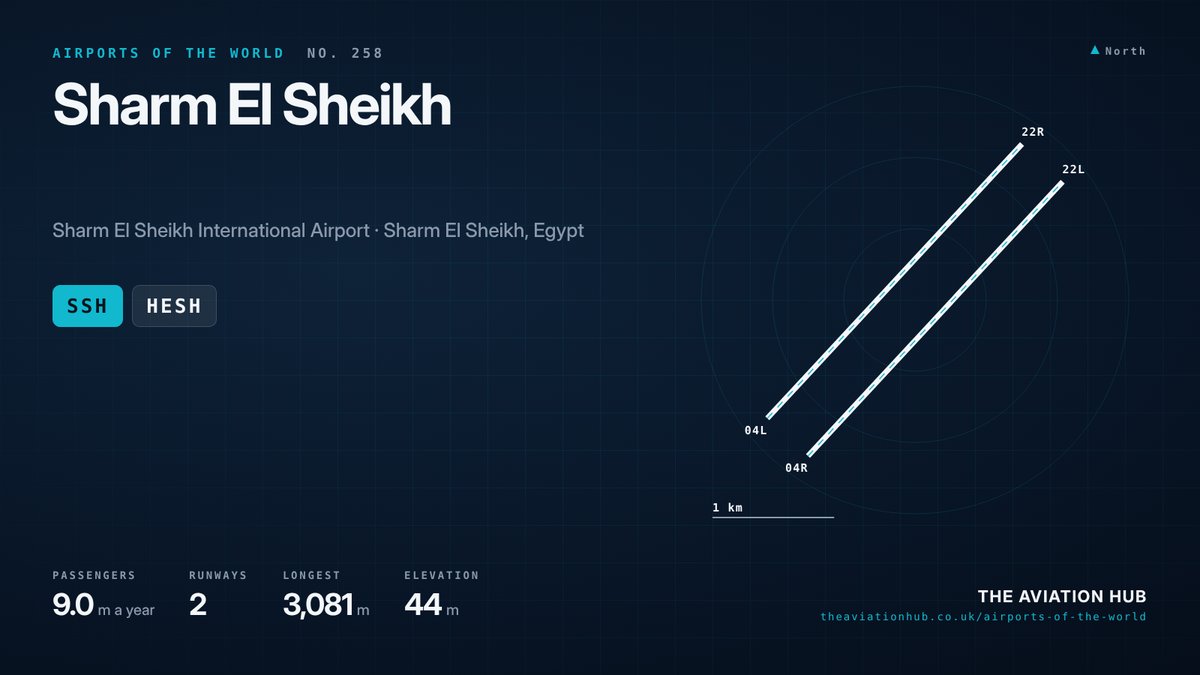
Sharm El Sheikh’s airport sits on the desert plain at the southern tip of the Sinai Peninsula, a short drive north of Naama Bay and the resort strip. Sharm El Sheikh Airport is the third busiest airport in Egypt, after Cairo and Hurghada, and lives almost entirely on tourism. Its story is one of booms, terrorist attacks and long flight bans, followed by a determined recovery.
Sharm El Sheikh Airport at a Glance
The IATA code is SSH and the ICAO code is HESH. The airport lies roughly 6 miles (10 km) northeast of Naama Bay and about 10 miles (16 km) from the old town, at an elevation of 44 metres (143 feet). It has two parallel runways and two passenger terminals, with a combined capacity of around 9 million passengers a year.
Traffic reached about 6.8 million passengers in 2024 and is rising towards that capacity as European and Middle Eastern tourism returns. Sharm El Sheikh Airport has no dominant home airline. EgyptAir and Air Cairo, which treats Sharm as a focus city, fly domestic and regional routes, while European charter and low cost airlines bring most visitors. The state owned Egyptian Airports Company is responsible for the airport, and information is available on the airport’s official website.
A Short History of Sharm’s Airfield
The airfield opened on 14 May 1968 as an Israeli Air Force base, built after Israel captured Sinai in the 1967 war. Under Israeli control the area was known as Ophira. After the 1979 peace treaty and Israel’s withdrawal from Sinai, the base passed to Egypt and became a civil airport.
Sharm grew quickly as a diving and beach destination from the 1990s, and charter flights from Europe and Russia multiplied. The original terminal was modernised in 2004, and a new Terminal 1 opened on 23 May 2007 with capacity for 5 million passengers. In January 2004 Flash Airlines Flight 604, a Boeing 737-300, crashed into the Red Sea shortly after takeoff, killing all 148 on board.
The darkest moment came on 31 October 2015. Metrojet Flight 9268, an Airbus A321 bound for St Petersburg, was destroyed by a bomb shortly after leaving Sharm, killing all 224 people on board. Russia suspended flights, and the UK banned flights until October 2019. Russian services resumed in August 2021, and the city hosted the COP27 climate summit in 2022.
Runways at Sharm El Sheikh Airport
Sharm El Sheikh Airport has two parallel asphalt runways of identical size. Runway 04L/22R and runway 04R/22L are each 3,081 metres (10,108 feet) long and 45 metres wide. Both are long enough for the wide bodies that have served the resort, including the Boeing 777.
The parallel layout gives flexibility during charter peaks, when waves of arrivals and departures cluster at weekends. Northerly winds are common in South Sinai, so runway 04 is used for much of the time, with arrivals approaching from the southwest.
The setting is spectacular. The rugged mountains of Sinai rise to the west, and the Red Sea lies a few miles to the east. Clear skies and good visibility are the norm for most of the year, so weather disruption is rare.
Terminals and Airlines
Terminal 1, opened in 2007, handles most international and charter flights. It has 40 check in counters and eight gates. Terminal 2 is the original building, expanded in 2019 to raise total airport capacity to 9 million passengers and gates from eight to 12. A third terminal was proposed in 2008 but has not been built.
The UK market has returned strongly since the ban was lifted. easyJet and TUI fly from several British airports, typically using Airbus A320 family aircraft and Boeing 737 MAX 8 jets. Italian, Polish, Czech and German charter carriers are also important, alongside Turkish and Gulf airlines.
EgyptAir and Air Cairo link Sharm El Sheikh Airport with Cairo and other Egyptian cities. Russian carriers such as Rossiya and Red Wings fly from Moscow, the latter using the Boeing 777 at times, while Saudi and Gulf low cost airlines bring growing numbers of regional visitors.
Routes and Destinations
Cairo is the busiest domestic route, used by Egyptian residents and international visitors connecting via EgyptAir. Russia was historically the biggest single market, and Moscow flights were the largest regular operation before 2015. They have returned, though not yet to their old scale.
The UK, Italy, Poland and Germany are leading European markets, with London Gatwick, Manchester, Milan, Rome and Warsaw among the most important links. Winter is the high season for Europeans seeking guaranteed sun, while summer brings more visitors from the Middle East.
The longest regular flights come from the UK and northern Europe, at around five to six hours. Cargo is negligible, as Sharm El Sheikh Airport exists almost entirely to serve the resorts.
Getting to and from Sharm El Sheikh Airport
There is no rail link and public buses are limited. Most visitors arrive on package holidays and use pre booked coach transfers to their hotels, which is the simplest and often the cheapest sensible option.
Taxis wait outside both terminals. The drive to Naama Bay takes around 15 minutes, and the old town is about 25 minutes away. Fares should be agreed before setting off. Hotels in Nabq Bay, north of the airport, are closer still.
British visitors staying only in the Sharm area can usually obtain a free Sinai only entry stamp on arrival instead of a full Egyptian visa. Travellers planning to visit Cairo, Luxor or elsewhere in Egypt need the full visa. Security screening is thorough, so allow plenty of time for departure.
Spotting and Photography
Sharm El Sheikh Airport offers striking backdrops, with mountains, desert and blue skies framing every arrival. The mix includes European charter jets, Egyptian carriers, Gulf airlines and occasional Russian wide bodies.
However, Egypt restricts photography of airports, military and security sites. Spotting from outside the fence is not tolerated, and anyone seen with a long lens near the perimeter is likely to be questioned or detained. Photographs taken discreetly from aircraft windows or inside the terminal carry less risk, but even these can attract attention.
Respect all local rules. Keep cameras away from police and military personnel, follow any instruction from security staff without argument and never fly drones near the airport.
What Comes Next
The 2019 expansion lifted capacity to 9 million, and tourism has recovered strongly since the UK and Russian bans ended. A planned new runway and the long discussed Terminal 3 would allow further growth if demand continues to rise.
Egypt is pushing hard to grow tourism, and Sharm is central to that plan. The verdict is that Sharm El Sheikh Airport has rebuilt confidence after a decade of setbacks and looks set to keep growing as Europeans return. Compare it with other Red Sea airports on the Airports of the World map.
Continue to follow The Aviation Hub for more analysis and insight.
Advertise with us Your brand, in front of an aviation audience Home page and in-article placements, sold directly, one advertiser per slot. From £250 a year. See the rates

