Shenyang Airport Guide: China’s Northeastern Rust Belt Hub
Shenyang Airport is the busiest field in northeastern China, with a single runway, a China Southern hub and almost 25 million passengers. Read the full guide.
 By The Aviation Hub
6 min read
Updated October 20, 2026
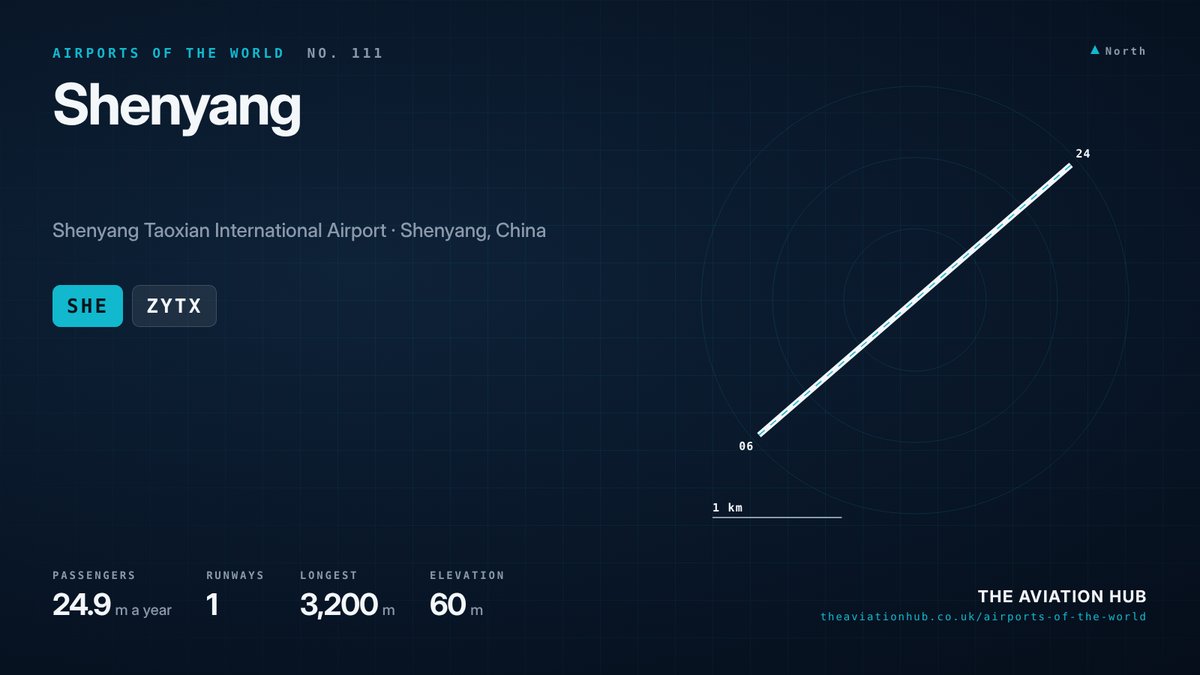
Shenyang Taoxian International Airport serves the capital of Liaoning Province and the largest city in northeastern China. It opened in 1989 on a site well south of the city and has grown into the principal gateway for the old industrial heartland once known as Manchuria. Shenyang Airport handled close to 25 million passengers in 2025, all of them through a single runway and a large Terminal 3. China Southern Airlines runs a hub here, and the field has a longer international history than most Chinese airports of its size.
Shenyang Airport at a Glance
The codes are SHE and ZYTX. The airport lies in the Hunnan district, around 12 miles (20 km) south of the centre of Shenyang, at an elevation of 60 m (198 ft) on the flat plain of the Hun River. One concrete runway serves a terminal complex dominated by Terminal 3, which opened in 2013 and absorbed the traffic of the two older buildings.
In 2025 Shenyang Airport handled around 24.9 million passengers, a rise of five per cent, which placed it around twenty first among airports in mainland China. Cargo came to roughly 211,000 tonnes and aircraft movements to about 164,000. China Southern is the hub carrier, having inherited the base of China Northern Airlines when the two merged in 2003. The Shenyang Taoxian Airport Authority operates the field. Flight information and transport details are on the airport’s official website.
How Shenyang’s Airport Came to Be
Shenyang’s aviation history runs deep. Dongta Airport, in the east of the city, opened in 1921 and served as a military base under Japanese occupation from the 1930s and then under the People’s Liberation Army after 1950. Civil flights used Dongta through the decades of the planned economy, but by the 1980s the reform era was bringing passengers the old field could not handle.
Construction of a new airport at Taoxian began on 1 July 1985 and it opened on 16 April 1989. Dongta reverted to military use and finally closed in 2013. The new airport became the home of China Northern Airlines, one of the carriers spun out of the old CAAC monopoly, and it gained international status early thanks to Shenyang’s links with Korea, Japan and the Russian Far East.
China Northern was folded into China Southern in 2003, which kept Shenyang as a regional hub. Terminal 3 opened in 2013 to serve the National Games held in Liaoning that year, bringing a modern building of around 250,000 square metres and a new ground transport centre. Lufthansa began a Frankfurt service in 2012, suspended it in 2016 and brought it back in 2018, a sign of the city’s up and down fortunes.
Runways at Shenyang Airport
Shenyang Airport has a single concrete runway, 06/24, which is 3,200 m (10,499 ft) long and 45 m wide. The orientation runs southwest to northeast, which suits the prevailing winds on the Liaoning plain, with northerly and northeasterly winds in winter and southerly winds in summer. One runway handling 164,000 movements a year is a heavy workload, and peak hour delays are common.
Winter is the defining feature of operations here. Temperatures regularly fall below minus 20 degrees Celsius, and snow clearance and de icing shape the schedule from November to March. The airport has invested heavily in snow removal fleets and remote de icing pads. The 3,200 m length is adequate for the wide bodies that China Southern uses on long haul routes, though the field is not rated for the largest wide bodies.
Terminals and Airlines
Terminal 3 is the whole passenger operation. It is a long curved building with a central processor and two piers, connected to the ground transport centre on the landside. Domestic flights fill most of the gates at Shenyang Airport. China Southern has the largest presence by far, operating Airbus A320 family and Boeing 737 aircraft on trunk routes and A330s on the busiest. China Eastern, Air China, Hainan Airlines, Sichuan Airlines, Xiamen Airlines, Shenzhen Airlines and the low cost carriers Spring, Lucky Air and 9 Air all operate here.
International carriers use a dedicated section of the terminal. Korean Air and Trinity Airways serve Seoul, China Southern and Spring cover Tokyo and Osaka, Air Koryo flies to Pyongyang and a scattering of Russian and Southeast Asian charters appear seasonally. Lufthansa Cargo operates freighters through the field.
Routes and Destinations
Beijing and Shanghai dominate the domestic schedule, with Guangzhou, Shenzhen, Chengdu, Hangzhou, Xi’an and Kunming also busy. The high speed railway to Beijing takes under two and a half hours and has eaten into the shortest air routes, so the airport has pivoted towards the south and west of China, where rail cannot compete. Sanya and Haikou are heavy winter routes as northerners flee the cold.
Internationally, Seoul Incheon is the leading destination, and Tokyo Narita, Osaka Kansai, Busan and Taipei are also served. Long haul has included Frankfurt with Lufthansa, Vancouver with Sichuan Airlines, Dubai and Singapore. Moscow Sheremetyevo reflects the region’s Russian trade links. Cargo of around 211,000 tonnes a year moves heavy machinery, automotive parts and seafood, and the field sits within reach of the BMW plants that have made Shenyang a car town.
Getting to and from Shenyang Airport
Shenyang Airport is linked to the city by tram lines 2 and 6, which run from the ground transport centre into the Hunnan new district and connect with the metro network. The trams are slow but cheap, with fares of a couple of yuan, and they are the budget option for anyone with time.
Airport buses run from the terminal to the main railway stations and the city centre in around 50 minutes to an hour for roughly CNY 15 to 20. Taxis take 40 to 50 minutes to the centre and cost around CNY 80 to 100 (about £9 to £11). The airport expressway connects to the Shenyang ring road and the G1 Beijing to Harbin expressway, and large car parks sit in front of Terminal 3.
Spotting and Photography
Shenyang is not a well known spotting airport, but the mix is more interesting than many Chinese fields thanks to the Korean, Japanese and Russian traffic. The departure hall of Terminal 3 has wide windows overlooking the main apron and the runway beyond, which is the most practical place to watch. The glass is tinted, so the middle of the day gives the best results.
Outside the fence, the farmland and service roads beyond the thresholds of runway 06 and 24 give views of arrivals, with the approach to 24 crossing open country to the northeast. Winter light is low, clear and often spectacular, with aircraft trailing contrails of their own exhaust in the freezing air, though temperatures make long sessions hard. As everywhere in China, keep well away from the fence, avoid military areas and be ready to explain yourself politely to police.
What Comes Next
The single runway is the obvious constraint. Shenyang Airport has long planned a second runway and a fourth terminal, and work on the runway finally began in September 2026. The project is due by 2029 and is designed for 45 million passengers a year. Progress has been slower than at the coastal airports because the region’s population and economy have been shrinking, which makes it harder to justify big spending.
Traffic growth of five per cent in 2025 suggests the airport is finally moving past the pandemic and the regional slump. The verdict is that Shenyang Airport will stay the dominant field in the northeast, but its next phase of growth depends on getting that second runway built. See where it sits among China’s regional hubs on the Airports of the World map.
Continue to follow The Aviation Hub for more analysis and insight.
Advertise with us Your brand, in front of an aviation audience Home page and in-article placements, sold directly, one advertiser per slot. From £250 a year. See the rates