
Shenzhen Airport Guide: The Flying Fish on the Pearl River
Shenzhen Airport ranks among mainland China's four busiest, with a new third runway, the Fuksas Terminal 3 and a huge cargo base. Routes, access and spotting.
 By The Aviation Hub
6 min read
Updated October 20, 2026
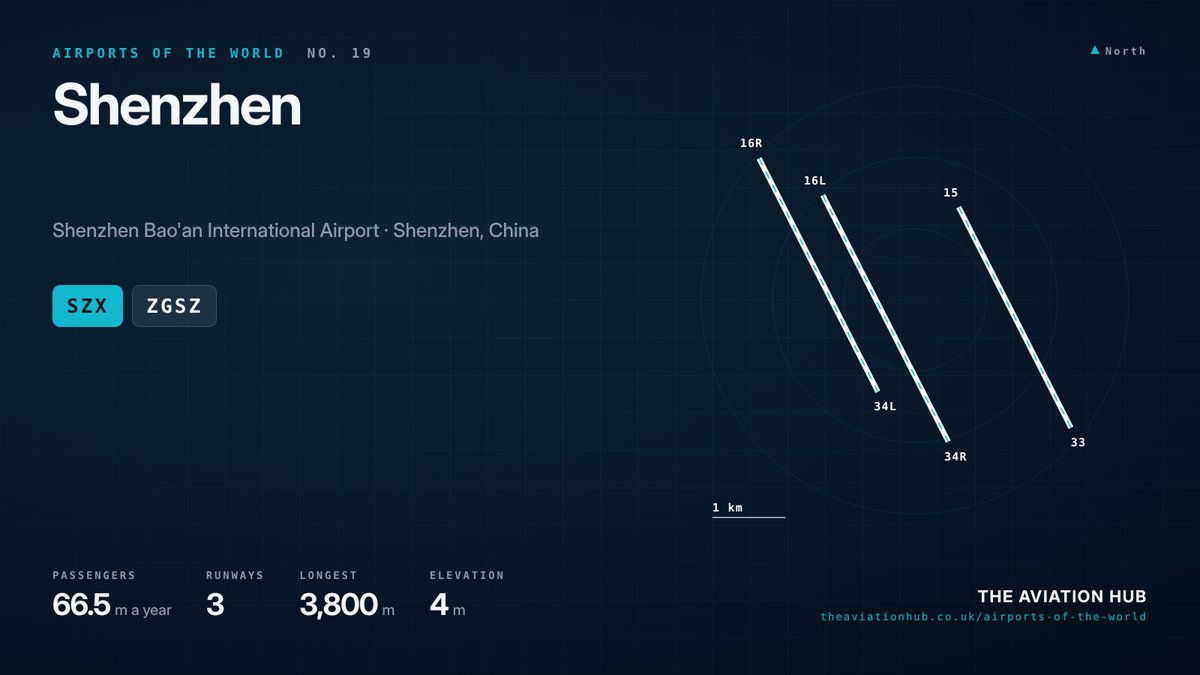
Shenzhen Airport sits on reclaimed land along the east bank of the Pearl River estuary, about 20 miles (32 km) northwest of the city centre in Bao’an District. It serves the technology capital of China and sits less than an hour from Hong Kong, whose own airport is visible across the water. Around 66.5 million passengers used it in 2025, with growth of 8 per cent, and more than two million tonnes of freight passed through the cargo zone. A third runway opened in November 2025 and the field now ranks among the four busiest in mainland China.
Shenzhen Airport at a Glance
The IATA code is SZX and the ICAO code is ZGSZ. The terminal lies around 20 miles (32 km) from the Futian central business district, a short shuttle ride from the Fuyong ferry pier on the delta shore. Elevation is 13 feet (4 m), and most of the site was once tidal mudflat.
Three runways serve a single passenger terminal, the Studio Fuksas designed Terminal 3, and a satellite concourse linked by an automated people mover. Traffic in 2025 reached roughly 66.5 million passengers and 448,000 aircraft movements. Shenzhen Airlines, China Southern and Donghai Airlines run hubs here, Hainan Airlines and Air China keep large operations, and SF Airlines and UPS use it as major cargo bases. Shenzhen Airport Group, owned by the city government, operates the field. Flight information and terminal guides appear on the airport’s official website.
How Shenzhen Built an Airport in a Decade
Shenzhen was a fishing town until Deng Xiaoping made it China’s first special economic zone in 1980. The city needed an airport almost immediately, and one opened on 12 October 1991 as Shenzhen Huangtian Airport, named after the village that stood on the site. It took the name of the surrounding Bao’an District in 2001 as traffic climbed past the capacity of its first small terminals.
A second runway opened in 2011 on land reclaimed from the estuary, and on 28 November 2013 Terminal 3 replaced the old Terminals A, B and D in a single overnight move. The building, a 450,000 square metre honeycomb skinned hall by the Italian architects Fuksas, earned the nickname of the giant flying fish. A satellite concourse by Aedas followed in December 2021, and the third runway entered service on 29 November 2025.
The airport’s worst accident came on 8 May 1997 when China Southern Flight 3456, a Boeing 737-300, broke up on a hard landing in a thunderstorm, killing 35 people. The airport has otherwise been defined by relentless growth and the rise of its home carrier, Shenzhen Airlines.
Runways at Shenzhen Airport
Shenzhen Airport has three concrete runways roughly aligned north to south along the delta shore. The original runway, now 15/33, is 3,400 metres (11,155 feet) and lies on the eastern side. Runway 16L/34R, the second strip from 2011, is the longest at 3,800 metres (12,467 feet) and 60 metres wide. The new third runway, 16R/34L, measures 3,600 metres (11,811 feet) and sits furthest west on reclaimed land.
Winter brings northerly winds and operations on the 33 and 34 runways, with arrivals from the south. Summer monsoon flow from the south switches traffic to the 15 and 16 runways, and typhoon season from July to October can shut the airport for a day at a time. Airspace in the Pearl River Delta is the most congested in China, shared with Hong Kong, Guangzhou, Macau and Zhuhai, and flow control delays are common on summer afternoons.
Terminals and Airlines
Terminal 3 handles every passenger flight. The six floor building is split into domestic and international zones, with the long central concourse and three fingers giving 63 gates and the satellite adding more for domestic traffic. Shenzhen Airlines, a Star Alliance member and Air China subsidiary, is the largest operator, followed by China Southern, which uses the airport as a second hub behind Guangzhou. Donghai Airlines and Hainan Airlines also add volume.
International carriers are a smaller presence. Emirates flies Boeing 777-300ERs from Dubai, Singapore Airlines and Malaysia Airlines serve their hubs, and Air China’s Frankfurt route, launched in 2016, was the first intercontinental service from the city. Connections to Hong Kong run by ferry rather than by air. Lounges are plentiful but unremarkable, and the honeycomb roof with its thousands of hexagonal skylights is the real attraction.
Routes and Destinations
Domestic routes dominate. Shanghai, Beijing, Chengdu, Hangzhou, Xi’an and Chongqing all see dozens of flights a day, many on Airbus A330s and Boeing 787s because of slot scarcity. High speed rail has taken much of the Guangzhou and Changsha traffic, but the Shanghai and Beijing trunks remain among the busiest in the country. Shenzhen Airlines and China Southern together operate more than half of all movements.
International growth is a city priority. China Southern links Shenzhen Airport with Bangkok, Singapore, Kuala Lumpur, Tokyo, Seoul, Sydney and Mexico City, and Hainan Airlines has used its 787-9s to open European points such as Brussels, Madrid and Vienna. Southeast Asia provides the busiest international routes. Cargo is the standout: UPS routes its Asia Pacific network through Shenzhen to Anchorage, Cologne, Dubai and Singapore, and SF Airlines, China’s largest cargo carrier, is headquartered in the freight zone with a fleet of 757s, 767s and 747s.
Getting to and from Shenzhen Airport
Metro Line 11 is the cheapest sensible option. Airport Station sits in the Ground Transportation Centre beneath Terminal 3, and express trains reach Futian in about 30 minutes for roughly 8 yuan (£0.90). Line 11 also has business class carriages for a higher fare. The Guangzhou to Shenzhen intercity railway stops at Shenzhen Airport and Airport North stations, linking the terminal with Dongguan and Guangzhou.
Airport buses serve districts across the city and cross border coaches run to Hong Kong, Dongguan and Zhongshan. Taxis cost 80 to 120 yuan (£9 to £13) to Futian and take 40 to 60 minutes on the Guangshen Expressway or the coastal road. The most distinctive option is the ferry. Fast boats from Fuyong Pier, reached by a free shuttle, run to Macau and to the SkyPier at Hong Kong International Airport, where passengers connect without passing Hong Kong immigration. The Shenzhong Link bridge and tunnel, opened in 2024, puts Zhongshan 30 minutes away by road.
Spotting and Photography
Spotting at Shenzhen Airport is better than at most Chinese fields. The Hyatt Regency next to the terminal has a terrace, open to guests, that covers arrivals on the 34s, and a disused road near the terminal access road, within walking distance, also faces the 34 approaches. A car park reached through the Ground Transportation Centre gives a limited view of departures from runway 15, and security may move you on if you stay long.
Haze is common in autumn and winter, while summer brings heat, thunderstorms and typhoons. Expect Shenzhen Airlines A320neos and 737 MAX 8s in bulk, China Southern A330s and 787s, Hainan 787-9s, Emirates 777s and a steady stream of UPS 747-8Fs and SF Airlines freighters at night. Chinese police are sensitive about cameras near airports, so stay on public paths, keep away from the fence and have identification ready.
What Comes Next
The third runway lifts declared capacity towards 80 million passengers, and the next step is Terminal 4 on the northern side of the field, where a metro station already waits underground. The planned Shenzhen to Maoming high speed line and a Hong Kong to Shenzhen western express railway would put the terminal within half an hour of both cities’ centres and deepen its role as a Greater Bay Area hub.
Competition with Guangzhou and Hong Kong is intense, and airspace rather than concrete is the constraint. Even so, the Pearl River Delta generates more air traffic than any region in China, and Shenzhen Airport is heading for 100 million passengers within a decade. Compare its coastal runway layout with other hubs on the Airports of the World map.
Continue to follow The Aviation Hub for more analysis and insight.
Advertise with us Your brand, in front of an aviation audience Home page and in-article placements, sold directly, one advertiser per slot. From £250 a year. See the rates

