
Shiraz Airport Guide: Long Runways in the Land of Persepolis
Shiraz Airport serves the city of poets and the ruins of Persepolis. Read about its two long runways, terminals, airlines, Gulf routes and access.
 By The Aviation Hub
5 min read
Updated October 20, 2026
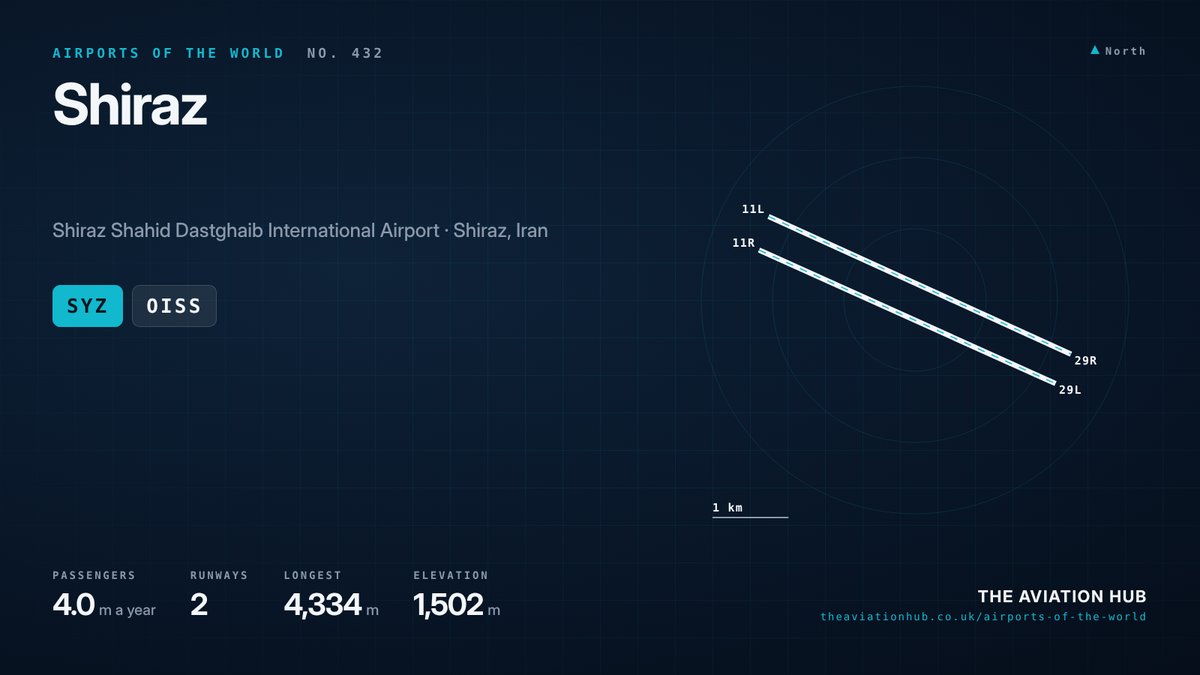
Shiraz is Iran’s city of poets and gardens, and the jumping off point for the ancient ruins at Persepolis. Shiraz Airport, officially Shahid Dastghaib International Airport, serves the capital of Fars Province from a high plateau in the Zagros Mountains. It handles roughly 3.5 to 4 million passengers a year. Two exceptionally long parallel runways and a shared military base give the field a profile quite unlike most regional airports.
Shiraz Airport at a Glance
The IATA code is SYZ and the ICAO code is OISS. Shiraz Airport lies on the southeastern side of the city, roughly 6 miles (10 km) from the centre. It sits 4,927 feet (1,502 metres) above sea level. There are two runways and two connected passenger terminals, one domestic and one international, with a new international terminal under construction.
The last published annual figures show about 3.5 million passengers, along with roughly 34,000 movements and 33,000 tonnes of cargo. Iran Air and a long list of private Iranian airlines serve the field. Gulf and Turkish carriers provide most foreign links. The airfield is shared with an Iranian air force base. Information is available on the airport’s official website.
How Shiraz’s Airport Came to Be
Commercial flying in Shiraz grew in the decades before the 1979 revolution, when tourism to Persepolis and the city’s gardens was booming. The Shah’s government celebrated 2,500 years of the Persian monarchy at Persepolis in 1971, and Shiraz handled a stream of international dignitaries. That same year, a Douglas C-47 of Air Taxi Co was written off in an accident at the airport.
After the revolution the airport took the name of Ayatollah Abdolhossein Dastghaib, the city’s Friday prayer leader, who was killed in a bombing in 1981. The title Shahid, meaning martyr, reflects that history. The 1980s war with Iraq gave the co located air base an important wartime role.
A major renovation in 2005 modernised the terminals and control systems. Afterwards, Shiraz Airport was ranked the second most reliable and modern airport in Iran for flight safety and tower systems, behind Tehran’s Imam Khomeini International Airport.
Runways at Shiraz Airport
Two parallel asphalt runways dominate the site. Runway 11L/29R measures 4,334 metres (14,219 feet) long and 45 metres (148 feet) wide. Runway 11R/29L is 4,283 metres (14,051 feet) long and also 45 metres wide.
The length is no accident. At an elevation of around 1,500 metres, summer temperatures above 40°C sharply reduce engine and wing performance. Heavy jets need very long takeoff runs in that thin, hot air. At Shiraz Airport, the runways also serve military fast jets and transports from the air base.
Westerly winds favour the 29 direction, while easterly winds bring the 11 direction into use. The parallel layout allows civil and military traffic to be separated when needed. Snow is rare but possible in winter, while dust storms occasionally reduce visibility.
Terminals and Airlines
The domestic terminal, also called Terminal 1, is the older and larger building. The international terminal, Terminal 2, handles scheduled and charter flights abroad. The two buildings are connected. A new international terminal has been under construction, and once it opens, the current international building is due to handle Hajj flights.
Iran Air, the national carrier, links Shiraz Airport with Tehran and other cities. Private airlines such as Iran Aseman, Mahan, Pars Air, Taban, Varesh, Sepehran and Caspian add domestic flights. Foreign carriers include Qatar Airways, Turkish Airlines, flydubai, Air Arabia, Jazeera Airways, Kuwait Airways, Oman Air, Pegasus and SalamAir. Sanctions mean Iranian fleets rely on ageing Airbus, Boeing, Fokker and McDonnell Douglas aircraft.
Routes and Destinations
Tehran is the core domestic route, served many times a day by several airlines. Mashhad draws large numbers of pilgrims to the Imam Reza shrine. Isfahan, Bandar Abbas, Kish Island and Rasht are among other domestic links.
Internationally, the Gulf dominates the schedule at Shiraz Airport. Dubai, Sharjah, Doha, Muscat and Kuwait City connect Shiraz with the large Iranian business communities across the region. Istanbul, roughly 1,550 miles (2,500 km) away, links the city to Europe and is typically among the longest regular routes. Pilgrim flights to Najaf in Iraq peak around religious occasions.
Spring is the busiest season for tourism, especially around Nowruz, the Persian New Year in March, when the gardens bloom. Iranian airspace closures during the 2025 conflict with Israel halted flights for a period.
Getting to and from Shiraz Airport
Taxis are the simplest option, reaching central Shiraz in around 20 to 30 minutes. Fares are low by international standards. App based ride services such as Snapp operate widely in Iran and are often cheaper than airport taxis.
Line 1 of the Shiraz Metro reaches the airport area, offering the cheapest sensible option for light travellers. Car hire with a driver is popular for day trips to Persepolis, about 37 miles (60 km) northeast, and Pasargadae beyond. Parking sits beside the terminals. The Vakil Bazaar, the Nasir al Mulk Mosque and the tombs of the poets Hafez and Saadi are all a short taxi ride away. Visitors should carry cash, since foreign cards do not work in Iran.
Spotting and Photography
Shiraz Airport would fascinate any enthusiast, with older Western jets in Iranian service and military aircraft on the base side. In December 2018 a Norwegian Boeing 737 MAX 8 made an unplanned landing here after an engine failure. US sanctions delayed its recovery until February 2019.
However, photography of airports and military sites in Iran is strictly prohibited. Visitors have been detained for far less. Do not photograph aircraft from the perimeter, keep cameras away in the terminal and follow every instruction from security staff. Enjoy the views from the window seat instead.
What Comes Next
The new international terminal is the main project. It was due for completion by 2024, though its current status is unclear. Once open, it should relieve pressure on the older buildings and improve the experience for foreign visitors.
Tourism growth depends heavily on politics. Sanctions, regional conflict and currency problems all weigh on airlines and passengers. The runways have capacity to spare, and Shiraz Airport could handle far more traffic if conditions allowed. Compare it with other Middle Eastern airports on our Airports of the World map. The verdict: Shiraz Airport has the infrastructure for strong growth, but its future depends on geopolitics more than concrete.
Continue to follow The Aviation Hub for more analysis and insight.
Advertise with us Your brand, in front of an aviation audience Home page and in-article placements, sold directly, one advertiser per slot. From £250 a year. See the rates

