
Skopje Airport is the main air gateway to North Macedonia, a small landlocked Balkan country with a large diaspora across Western Europe. It sits on the plain east of the capital, near the village of Petrovec. Traffic reached close to 2.9 million passengers in 2023 and has kept rising since, driven by low cost airlines and families travelling between Skopje and Germany, Switzerland and Scandinavia. A modern terminal opened in 2011 under a Turkish operator.
Skopje Airport at a Glance
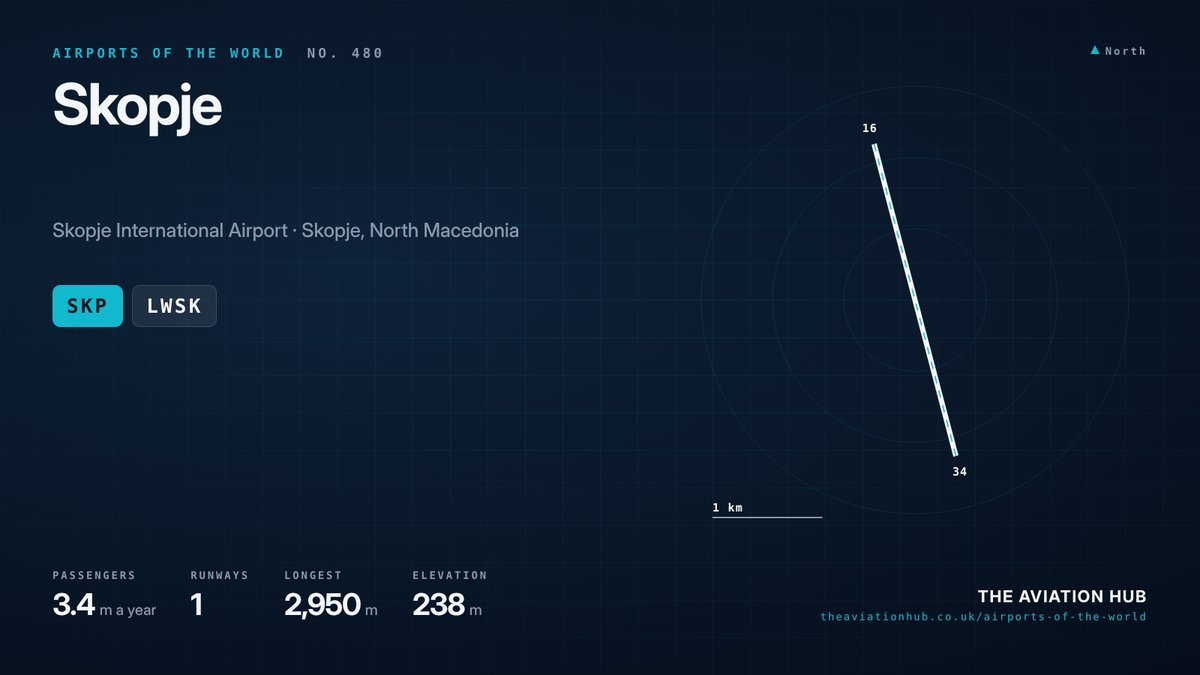
The codes are SKP for IATA and LWSK for ICAO. The airport lies in Petrovec municipality, about 10 miles (17 km) east of central Skopje. Elevation is 238 metres (781 feet). There is one runway and one passenger terminal. It is the larger of the country’s two international airports, the other being Ohrid on the shore of Lake Ohrid.
Traffic in 2023 was 2,883,378 passengers, up from about 2.14 million in 2022. Wizz Air dominates the schedule from its Skopje base, while Turkish carriers, Austrian Airlines and others link the city with major hubs. TAV Airports has run Skopje Airport and Ohrid under a concession since 2008. Flight details are on the airport’s official website.
A Short History of Skopje’s Airport
Aviation came early to Skopje. The first flight and landing took place in 1912, during the Balkan Wars, and a military airfield followed in 1915. In 1928 an airport was built near today’s Aerodrom district, and the Yugoslav airline Aeroput began commercial flights to Belgrade in 1929.
The current airport was built after the Second World War on open land near Petrovec. For decades it was a modest Yugoslav regional field. After the earthquake of July 1963 destroyed much of Skopje, relief flights brought international aid into the city. Independence in 1991 turned it into a national gateway, and the 1990s brought new international routes alongside economic hardship.
Names have been political. In December 2006 the government renamed it Skopje Alexander the Great Airport, angering Greece. In February 2018, as the two countries worked towards the Prespa agreement, the name reverted to Skopje International Airport. TAV signed a 20 year concession in 2008 and opened a new terminal, a runway extension and a cargo building in September 2011.
Runways at Skopje Airport
There is a single asphalt runway, 16/34, measuring 2,950 metres (9,678 feet) long and 45 metres wide. The 2011 extension gave it enough length for wide body charters, though the Airbus A320 family dominates traffic.
The runway runs roughly north to south along the Vardar plain, with mountains on several sides. Winter fog and icing are the main hazards. On 5 March 1993 Palair Macedonian Airlines Flight 301, a Fokker 100, crashed after take off from runway 34. Its wings had not been de iced, and 83 of the 97 on board died.
Other accidents have touched Skopje Airport too. An Antonov An-12 crashed near Tetovo in July 1992 while approaching with the Skopje DME out of service. In 2009 an Austrian Airlines Dash 8 made a safe emergency landing after its gear failed to retract. Modern instrument approaches have improved safety, but winter conditions still demand care.
Terminals and Airlines
The 2011 terminal handles all passenger flights, with modern check in halls, a single security area and a duty free zone. It was designed with room to expand and feels comfortable outside the summer and Christmas peaks.
Wizz Air is by far the largest airline, with Airbus A320 and A321neo aircraft based at Skopje Airport. It flies to Germany, Switzerland, Sweden, Austria, Italy, the UK and beyond. Turkish Airlines and Pegasus link Skopje with Istanbul, and Austrian Airlines connects to Vienna. Other airlines, including LOT, Aegean and easyJet, have featured in recent schedules.
Routes and Destinations
Germany is the largest market, accounting for about 24 per cent of passengers. Turkey follows at around 19 per cent, then Switzerland at roughly 14 per cent. Sweden and Austria each take around 6 to 7 per cent.
Those figures reflect migration. Hundreds of thousands of people from North Macedonia live and work in Germany, Switzerland and Scandinavia, and they fly home for summer, Christmas and Easter. Istanbul serves both Turkish visitors and onward connections across the world through the Turkish hubs.
Demand peaks sharply in July and August and again around Christmas and New Year. There are no long haul flights. Cargo is small, at around 3,600 tonnes a year.
Getting to and from Skopje Airport
There is no rail link. A scheduled airport bus links the terminal with central Skopje, and it is the cheapest sensible option. Journey time is around 30 minutes, depending on traffic.
Taxis wait outside arrivals and take around 20 to 25 minutes to the city centre, typically for a fixed fare of roughly €20 (about £17). Car hire desks in arrivals are useful for travellers exploring Ohrid, Mavrovo and the mountain villages. Private transfer services are also popular, especially for travellers heading to Ohrid, Tetovo or Kosovo. By road, the airport is close to the motorway that runs along the Vardar corridor towards Skopje and the Greek border. Parking sits directly in front of the terminal.
Spotting and Photography
The open farmland around Skopje Airport gives spotters reasonable access. Minor roads near both runway ends offer views of aircraft on approach, with mountains forming a dramatic backdrop when the air is clear.
Wizz Air Airbus A321neos and A320s dominate, with Turkish Airlines and Pegasus jets, Austrian Airlines aircraft and occasional charters adding interest. Summer weekends bring the busiest diaspora waves. Avoid photographing military or police aircraft, stay on public land and follow instructions from police and airport security.
What Comes Next
TAV’s 20 year concession, signed in 2008, is approaching its later stages, so the next few years will shape who manages the airport and what investment follows. Traffic is growing, and the 2011 terminal will need expansion if low cost airlines keep adding routes.
Skopje Airport looks set to keep growing on the strength of diaspora travel and Wizz Air’s network, with tourism a potential bonus. Political stability and EU accession talks will influence how far it can go. See how it compares with other Balkan airports on our Airports of the World map.
Continue to follow The Aviation Hub for more analysis and insight.
Advertise with us Your brand, in front of an aviation audience Home page and in-article placements, sold directly, one advertiser per slot. From £250 a year. See the rates

