
Sofia Airport Guide: Bulgaria’s Gateway Below Vitosha
Sofia Airport passed eight million passengers in 2025. Explore its runway, terminals, Bulgaria Air hub, low cost bases, metro link and Terminal 3 plans.
 By The Aviation Hub
7 min read
Updated October 20, 2026
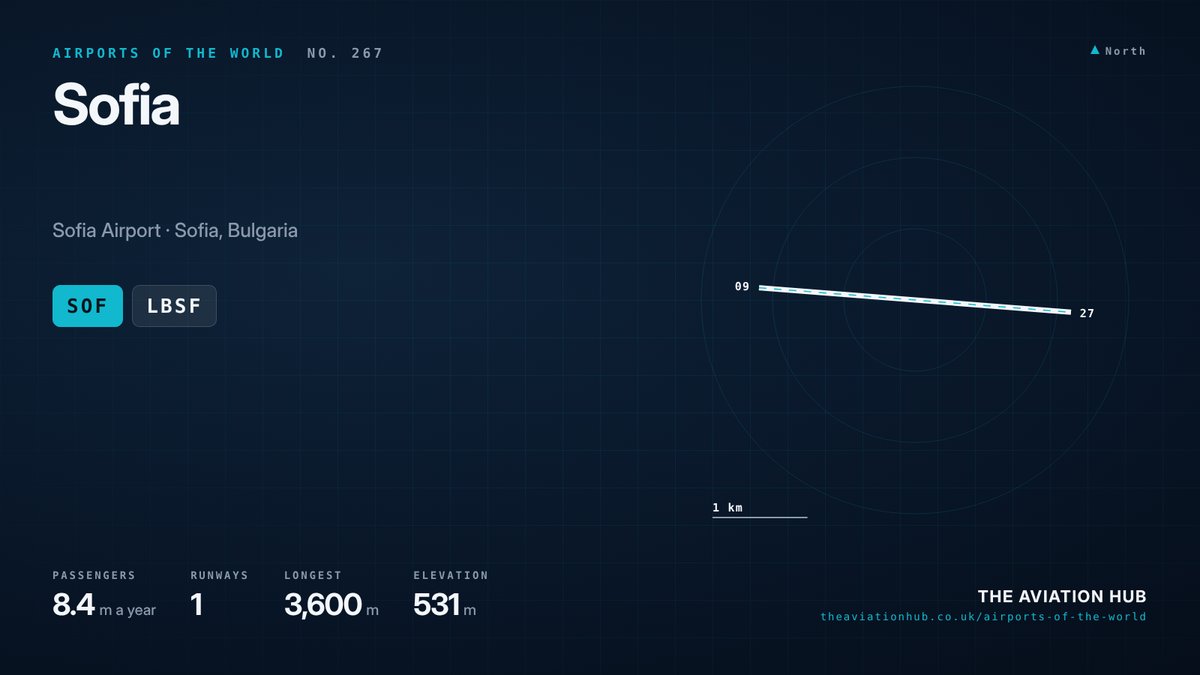
Sofia Airport sits on the eastern edge of the Bulgarian capital, in a wide basin framed by Vitosha to the south and the Balkan range to the north. It is the country’s main international gateway and the home of the national carrier, Bulgaria Air. Traffic topped eight million passengers for the first time in 2025, driven largely by Wizz Air and Ryanair. A private concessionaire now runs the field, a third terminal is planned for the end of the decade, and the metro stops at the door.
Sofia Airport at a Glance
The codes are SOF for IATA and LBSF for ICAO. The airport lies in the Vrazhdebna district, roughly 6 miles (10 km) east of the city centre, at an elevation of 531 metres (1,742 feet). It has one runway and two passenger terminals on separate sites, linked by a free shuttle bus. Since February 2025 it has also carried the name of Vasil Levski, the nineteenth century revolutionary and national hero.
Passenger numbers reached about 8.4 million in 2025, alongside roughly 22,000 tonnes of cargo and some 68,000 aircraft movements. Bulgaria Air is the hub carrier. Wizz Air and Ryanair both base aircraft here and carried more than half of all passengers between them in 2021, while BH Air and European Air Charter fly holiday and contract work. SOF Connect, a consortium led by the French infrastructure investor Meridiam, has run Sofia Airport under a 35 year concession since April 2021. Timetables and terminal maps are on the airport’s official website.
A Short History of Vrazhdebna
Tsar Boris III signed the decree that created the airport on 16 September 1937, allocating land in the village of Vrazhdebna. A first passenger waiting room opened in 1939 and a paved runway was complete by about 1941. Passenger operations from the terminal on the south side, today’s Terminal 1, began in 1947. Under communism the field became the base of Balkan Bulgarian Airlines, which flew Soviet types such as the Ilyushin Il-18 and Tupolev Tu-154 across Europe, Africa and the Middle East.
Those decades had dark moments. A Tupolev Tu-134 crashed on approach in 1984, killing all 50 people on board, and a Yak-40 came down in the Iskar river in 1988. After 1989 the market opened up. Balkan struggled through the 1990s and collapsed in 2002, and the newly formed Bulgaria Air took over its role.
The modern airport took shape in 2006. A new runway opened on 31 August, offset 210 metres north of the old strip, and Terminal 2 opened on 27 December with seven air bridges. A metro station followed in 2015. The government then put Sofia Airport out to concession, and SOF Connect took over on 20 April 2021, with Munich Airport International operating the field for the first twelve years.
Runways at Sofia Airport
Sofia Airport has a single asphalt runway, 09/27, measuring 3,600 metres (11,811 feet) long and 45 metres wide. At 531 metres above sea level the air is thinner than at coastal airports, which lengthens take off runs on hot summer afternoons. The runway length removes any real constraint for narrow bodies and comfortably handles wide body charters and diversions.
Arriving traffic is generally routed to approach from the east onto runway 27, over villages and fields. Arrivals on runway 09, which come in from the west over the eastern suburbs of the city, are used when the wind demands. The eastern end of the runway crosses the Iskar river on a bridge. With only one runway, every movement shares the same strip, so the morning departure wave from the based low cost fleets can bunch up at the holding point.
The real limit is the weather. The Sofia basin traps cold air in winter, and thick fog can settle over the field for long spells. Radio interference from perimeter fencing and a large lorry park delayed certification of the new runway’s landing aids in 2007. Winter fog still forces flights to divert, sometimes adding many hours to a journey.
Terminals and Airlines
Terminal 1 is the older and smaller building, closer to the city along Brussels Boulevard. Extended in 1975 and renovated in 2000, it handles Wizz Air, easyJet and European Air Charter through seven gates, all with bus boarding. Capacity is tight at peak times, and the building shows its age.
Terminal 2 is the main building at Sofia Airport, with seven air bridges and a cleaner modern layout. It handles Bulgaria Air, the full service foreign airlines and, since January 2017, Ryanair. Lufthansa, Austrian Airlines and Turkish Airlines connect the city to their hubs, British Airways serves London, and flydubai provides a Gulf link. Bulgaria Air flies a compact European network plus domestic routes to the Black Sea coast.
Behind the terminals sits a significant engineering cluster. Lufthansa Technik Sofia, a joint venture founded in 2007, carries out heavy maintenance on narrow body jets for airlines across Europe. Wizz Air added a maintenance base in 2018, cementing its commitment to the city.
Routes and Destinations
London is the busiest route by a distance. Around 358,000 passengers flew between Sofia and London in 2025, spread across several of the capital’s airports and reflecting the large Bulgarian community in Britain. Vienna came second with about 216,000, ahead of Istanbul with 204,000, Frankfurt with 174,000 and Milan with 169,000.
The wider network leans heavily on Wizz Air and Ryanair, which link Sofia with dozens of cities in Italy, Spain, Germany, France and the UK. Bulgaria Air adds domestic flights to Varna and Burgas, which peak in summer when the coast fills with holidaymakers. The longest services are GullivAir’s seasonal flights to Thailand and the Maldives. Winter brings its own season, with ski charters carrying visitors bound for the resorts of Bansko and Borovets.
Getting to and from Sofia Airport
The metro is the cheapest sensible option. Line M4 terminates at Sofia Airport station, beside Terminal 2, and trains reach the city centre in about 20 minutes. Services run from roughly 05:30 until midnight on a standard city fare. Passengers arriving at Terminal 1 can take the free shuttle bus, which runs between the terminals from 05:00 to 23:00, and pick up the metro at Terminal 2.
City bus 84 serves both terminals and runs into the centre, though it is slower than the train. By road the airport sits off Brussels Boulevard, with quick connections to the ring road and the Trakia and Hemus motorways. Yellow! holds the official taxi contract until 2028, and a ride to the centre typically takes 20 to 30 minutes and costs around €10 to €15 (roughly £9 to £13). Short and long stay car parks serve both terminals. National rail services do not reach the terminals.
Spotting and Photography
Because the runway runs east to west, the southern side of Sofia Airport keeps the sun behind the camera for most of the day. That makes it the side to aim for, with the Balkan range forming a backdrop to the north on clear days. Minor roads and open ground around the perimeter give views of aircraft on short final, though access shifts as construction continues.
The mix rewards patience. Wizz Air Airbus A321neos and Ryanair Boeing 737 MAX 8s dominate, with Bulgaria Air, BH Air and European Air Charter adding local colour. Lufthansa Technik’s hangars draw visiting airframes in unusual liveries for heavy checks, and flydubai, cargo flights and occasional ski charters add variety. Carry identification, stay on public land, keep away from the fence and stop if police or security staff ask.
What Comes Next
The big project is Terminal 3. SOF Connect plans to complete it by 2030 at a cost of about €250 million, with 52 check in counters and a target of a five star Skytrax rating. Once it opens, Terminal 1 is due to handle only VIP and business aviation, consolidating airline traffic at Sofia Airport into one modern complex beside the metro.
The runway has plenty of spare capacity, so growth depends on terminal space, airline appetite and how well the operator copes with winter fog. The trajectory points towards ten million passengers, with low cost airlines still in the driving seat. See how Sofia compares with other Balkan capitals on our Airports of the World map.
Continue to follow The Aviation Hub for more analysis and insight.
Advertise with us Your brand, in front of an aviation audience Home page and in-article placements, sold directly, one advertiser per slot. From £250 a year. See the rates

