
Spokane Airport Guide: Geiger Field to Inland Northwest Hub
Spokane Airport took its GEG code from wartime Geiger Field and now serves the Inland Northwest. Runways, concourses, routes and TREX explained.
 By The Aviation Hub
5 min read
Updated October 20, 2026
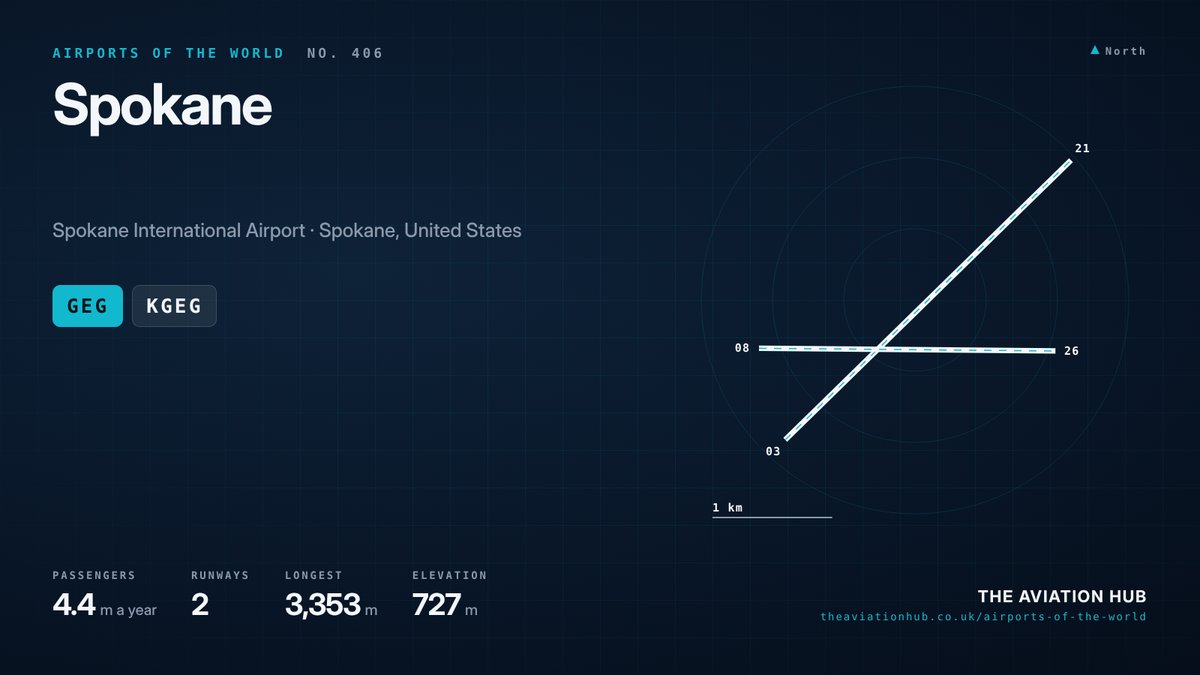
Spokane International Airport serves the Inland Northwest, a vast region of eastern Washington, northern Idaho and western Montana. Spokane Airport carried about 4.35 million passengers in 2025, making it the second busiest airport in Washington after Seattle. Its code, GEG, recalls its wartime identity as Geiger Field. Today a major terminal rebuild is reshaping the passenger experience for the first time in decades.
Spokane Airport at a Glance
The IATA code is GEG and the ICAO code is KGEG. The airport sits roughly 7 miles (11 km) west of downtown Spokane, at an elevation of 727 metres (2,385 feet). It has two runways and a terminal split into three concourses. Spokane Airport recorded about 4.35 million passengers in 2025, up from around 4.26 million in 2024.
Southwest is the largest single carrier, ahead of SkyWest, Delta, Alaska and Horizon. Empire Airlines, a FedEx feeder operator, uses the field as a hub. The Spokane Airport Board runs the site on behalf of the City and County of Spokane, across a generous 6,140 acres. Schedules and parking details are on the airport’s official website.
How Spokane’s Airport Came to Be
The site was known as Sunset Field until 1941, when the War Department bought it for military use. The Army renamed it Geiger Field after Major Harold Geiger, an Army aviation pioneer killed in a 1927 crash. Wartime traffic was heavy, and a rail spur even linked the base to the Great Northern Railway.
In 1946 Geiger Field became Spokane’s municipal airport, replacing the older Felts Field beside the Spokane River. It took its current name in 1960 but kept the GEG code. The A and B concourse complex opened on 1 April 1965, and Concourse C was rebuilt in 2000 for about $20 million.
Runway 03/21 gained 2,000 feet in 2010, allowing heavier departures from Spokane Airport in the summer months. That same year the control tower was named after Ray Daves, a Second World War radioman who later worked as a Spokane controller. It is believed to be the only federally run tower named after a single person.
Runways at Spokane Airport
Runway 03/21 is the primary strip. It measures 3,353 metres (11,002 feet) long and 46 metres wide, with an asphalt surface. Runway 08/26 measures 2,499 metres (8,199 feet), also 46 metres wide and asphalt. The longer runway handles most airline arrivals, while 08/26 takes crosswind duty and lighter traffic.
The elevation of over 2,300 feet matters on hot summer days, when thinner air lengthens take off runs. Winter brings snow, freezing fog and low cloud, and several past accidents here involved poor visibility on approach. Modern instrument approaches now make Spokane Airport a useful alternate when weather closes airports west of the Cascades.
Terminals and Airlines
The terminal is really two buildings. Concourse A has five gates and is home to Southwest. Concourse B has eight gates used by Delta and United. Concourse C serves Alaska, American and Horizon, and its rebuilt gates now use jet bridges in place of ground boarding. A and B are not connected airside to C, so connecting passengers must pass back through landside areas.
Alaska Airlines and its Horizon arm fly Boeing 737 and Embraer E175 aircraft, chiefly to Seattle. Delta and United feed their Salt Lake City, Minneapolis, Denver and Chicago hubs. Allegiant and Sun Country add leisure flights. UPS links Spokane Airport with its Louisville hub, while FedEx and Empire run an extensive feeder network across the region.
Routes and Destinations
Seattle is by far the busiest route, with about 540,000 passengers in the year to August 2025. Denver follows at around 250,000, then Salt Lake City and Phoenix at roughly 155,000 each. Minneapolis completes the top five. Las Vegas, Los Angeles, Dallas Fort Worth and Atlanta round out a network focused on major hubs.
Atlanta, nearly 2,000 miles (3,200 km) away, is the longest year round route. A weekly Alaska flight to Honolulu, due from December 2026, will go further still. Leisure demand peaks in winter, when Arizona, California and Nevada sunshine draws visitors from the cold interior. Summer brings its own rush as tourists head for the lakes of northern Idaho. Cargo is significant for a city this size, reflecting the region’s role as a distribution centre.
Getting to and from Spokane Airport
Road is the default. The airport connects to Interstate 90 and US Route 2, and downtown Spokane is about 15 minutes away by car. A consolidated rental car facility beside the ground transportation centre opened in 2008. Taxis and ride hailing pick up at the kerb, and parking garages sit directly opposite the terminal.
Spokane Transit buses on routes 7 and 63 serve the airport, the cheapest sensible option into the city. Regional coaches include the Travel Washington Gold Line, Northwestern Trailways and Wheatland Express, linking Spokane Airport with smaller towns across the Inland Northwest. Amtrak’s Empire Builder calls at the downtown intermodal centre, a short taxi ride from the terminal.
Spotting and Photography
Open terrain makes this a pleasant place to watch aircraft. Public roads around the perimeter give clear views of arrivals on Runway 21, which is often in use when the prevailing southwesterly winds blow. The terminal windows overlook the apron. Fairchild Air Force Base lies a few miles west, and its Boeing KC-135 tankers often pass overhead.
Evening light in summer is long and golden, while winter fog can create atmospheric shots. Expect a mix of Southwest 737s, Alaska and Delta jets, regional jets and FedEx feeder turboprops. Stay on public land, keep clear of fences and never stop on airport roads where parking is banned. Respect the signs around Spokane Airport and cooperate with any security check.
What Comes Next
The TREX programme is the biggest overhaul in the airport’s history. Phase one expanded Concourse C by 144,000 square feet and six gates at a cost of around $150 million. The first three new gates opened in June 2024, and the work was completed in May 2026. Phase two is a Central Hall with a single security checkpoint and baggage claim, linking all three concourses. Groundbreaking is expected in early 2027, subject to funding.
A new control tower has already been built south of the airport, replacing the old one near Concourse C. Longer term, the ageing A and B complex could wind down in favour of a new terminal, no earlier than 2030. Expect a modernised regional gateway with steady growth. Compare it with other Pacific Northwest fields on our Airports of the World map.
Continue to follow The Aviation Hub for more analysis and insight.
Advertise with us Your brand, in front of an aviation audience Home page and in-article placements, sold directly, one advertiser per slot. From £250 a year. See the rates

