
Srinagar Airport Guide: Flying Into the Kashmir Valley
Srinagar Airport links the Kashmir Valley with Delhi, Mumbai and beyond. Our guide covers its long runway, terminal, airlines, security and expansion.
 By The Aviation Hub
5 min read
Updated October 20, 2026
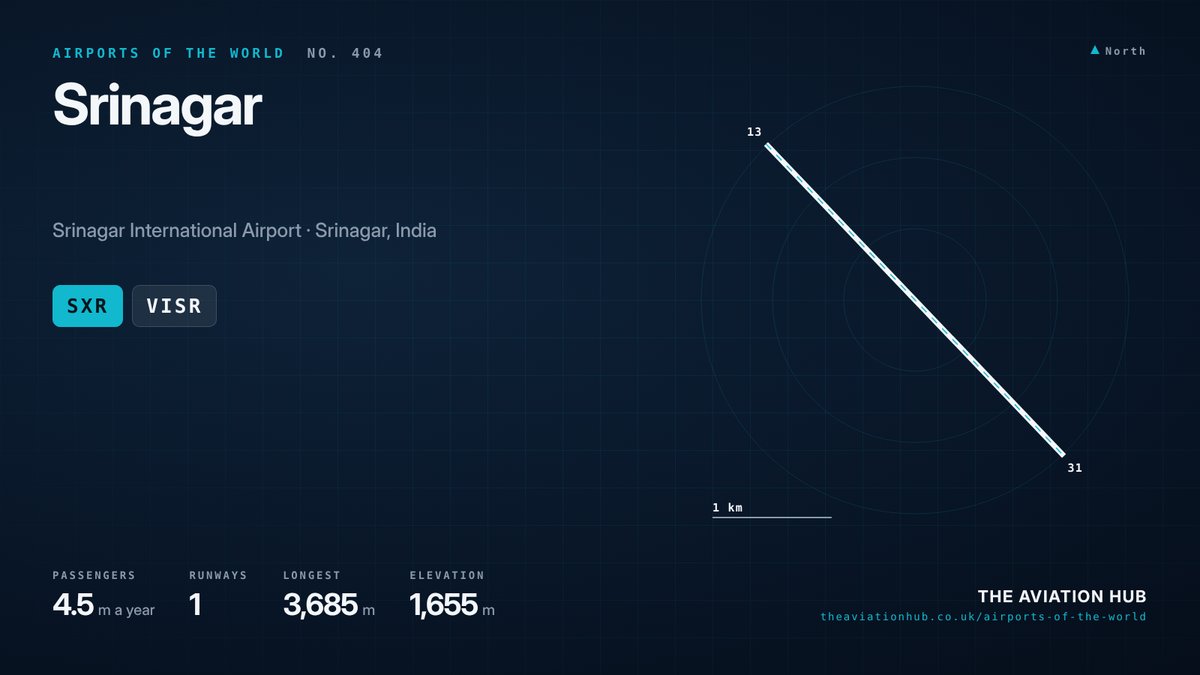
Ringed by the Pir Panjal and the Himalaya, the Kashmir Valley depends on air travel more than most Indian regions. Srinagar Airport is its main gateway, a civil enclave on an Indian Air Force station at Budgam. It handled around 3.4 million passengers in the year to March 2026, down sharply after a turbulent 2025. When the roads close in winter, the airport becomes a lifeline for residents, traders and pilgrims alike.
Srinagar Airport at a Glance
The IATA code is SXR and the ICAO code is VISR. The airport lies about 7.5 miles (12 km) south of Srinagar city, at an elevation of 1,655 metres (5,429 feet). It has one runway and one integrated terminal for domestic and international flights. Srinagar Airport recorded about 3.37 million passengers in 2025 to 2026, after roughly 4.5 million the year before.
No airline bases aircraft here, but IndiGo runs the largest schedule. The Airports Authority of India operates the civil enclave, while the Indian Air Force controls the airfield itself. Flight information and passenger rules are on the airport’s official website.
How Kashmir’s Airport Came to Be
The airfield began as a military strip, and it shaped history early. In late October 1947, during the first war between India and Pakistan, the Indian Air Force airlifted troops here to defend the city. Civil aviation took a back seat for decades. The National Airports Authority, forerunner of today’s AAI, opened a civil enclave only in 1979.
Conflict returned repeatedly. On 7 September 1965 Pakistani air attacks damaged an Air Force C-47 and an Indian Airlines DC-3 on the ground. During the 1999 Kargil War, civilian flights stopped and the Air Force took over completely. Hajj flights began in January 2002, and the field gained international status in March 2005.
The current terminal opened on 14 February 2009 at a cost of around ₹1.3 billion. An instrument landing system followed in February 2011, and commercial night flights finally began on 19 March 2021. Proposals to rename Srinagar Airport after the Sufi saint Sheikh ul Alam, or after war hero Major Somnath Sharma, have never become official.
Runways at Srinagar Airport
A single runway, 13/31, handles everything. It measures 3,685 metres (12,090 feet) long and 46 metres wide, with an asphalt surface. That generous length reflects both military needs and the high elevation, where thinner air lengthens take off runs, especially in summer.
Mountains surround the valley, so approaches follow carefully designed paths, and the instrument landing system makes low cloud far more manageable. Winter is the real test at Srinagar Airport. Fog, snow and freezing conditions can disrupt schedules for days, and airlines often cancel in batches during heavy snowfall. Military traffic shares the same runway, and civil movements are slotted around it.
Terminals and Airlines
The integrated terminal covers about 19,700 square metres and can handle around 950 passengers at a time. Its sloping roof is designed to shed snow. Nine aircraft stands serve the building, five of them equipped with jet bridges.
IndiGo dominates with Airbus A320neo and A321neo jets, flying to around a dozen Indian cities. Air India and Air India Express offer the main competition, while Akasa Air adds capacity to Delhi and Mumbai and SpiceJet to Delhi and Jammu. No foreign airline flies scheduled services. Hajj charters operate seasonally, often with wide body aircraft, and they bring a rare change of pace to the apron at Srinagar Airport.
Routes and Destinations
Delhi is by far the most important link, with frequent daily departures from several airlines. Jammu, the winter capital of the Union Territory, is another vital route, alongside Mumbai and Bengaluru. IndiGo also reaches Ahmedabad, Amritsar, Chandigarh, Hyderabad, Kolkata, Navi Mumbai and Noida. Air India serves Leh, a short but spectacular hop across the mountains to Ladakh.
Demand is seasonal and sensitive to security. Summer brings tourists for the houseboats of Dal Lake, and the Amarnath pilgrimage swells traffic in July and August. The longest regular domestic sectors run south to Bengaluru and Hyderabad, at over three hours. A Go First service to Sharjah in 2021 proved short lived after overflight problems. Traffic at Srinagar Airport fell by about a quarter in 2025 to 2026, as security events and temporary closures hit tourism.
Getting to and from Srinagar Airport
Security shapes every journey. Vehicles stop at an outer checkpoint, and passengers and bags are screened before reaching the terminal. Allow at least two to three hours before departure, and more in peak season. A free AAI shuttle bus runs between the terminal and the main gate, about 0.6 miles (1 km) away.
A government bus links the airport with the Tourist Reception Centre near Lal Chowk, the cheapest sensible option into the city. Taxis and car hire desks sit outside arrivals, and the drive to Dal Lake takes around 30 to 45 minutes depending on traffic. Parking is limited to about 250 vehicles. There is no rail link to Srinagar Airport, although the Kashmir railway reaches Srinagar station at Nowgam, a short taxi ride away.
Spotting and Photography
This is not a spotting airport in the usual sense. Srinagar Airport sits on an active Indian Air Force station in a sensitive region, and photography of the airfield, military aircraft or security installations is prohibited. Cameras pointed at the perimeter will attract immediate attention from soldiers or police. Treat the whole area as a no photography zone and follow every instruction from security staff.
The rewards come from the window seat instead. Arrivals cross the snowy Pir Panjal range and descend over a patchwork of orchards and paddy fields. Clear autumn days give the sharpest mountain views, while winter fog can hide the valley floor completely. Sit on the side facing the peaks, which depends on the runway in use, and enjoy the descent.
What Comes Next
Expansion has been on the agenda for years. In 2019 officials floated a separate international terminal. In February 2026 the Union Cabinet approved a new integrated terminal of about 71,500 square metres, at a cost of around ₹17 billion. It should lift capacity to around 10 million passengers a year by 2031. The project was at the tendering stage in August 2026.
The new rail line to Kashmir, opened through the mountains in 2025, will compete with flights for some travellers. Even so, demand for quick journeys to Delhi and Mumbai will keep the airport busy. Expect steady recovery and a bigger terminal, with security always setting the pace. Compare it with other mountain airfields on our Airports of the World map.
Continue to follow The Aviation Hub for more analysis and insight.
Advertise with us Your brand, in front of an aviation audience Home page and in-article placements, sold directly, one advertiser per slot. From £250 a year. See the rates

