
St Louis Airport, known to everyone in Missouri simply as Lambert, lies about 14 miles (22 km) northwest of the Gateway Arch in the suburbs of Bridgeton and Berkeley. Formally St. Louis Lambert International Airport, it was the main hub of Trans World Airlines for two decades and later an American Airlines hub, and it has four runways built for traffic that no longer comes. Around 15.3 million passengers used the field in 2025, nearly two thirds of them on Southwest Airlines. The 1956 domed terminal by Minoru Yamasaki remains one of the finest airport buildings in the United States.
St Louis Airport at a Glance
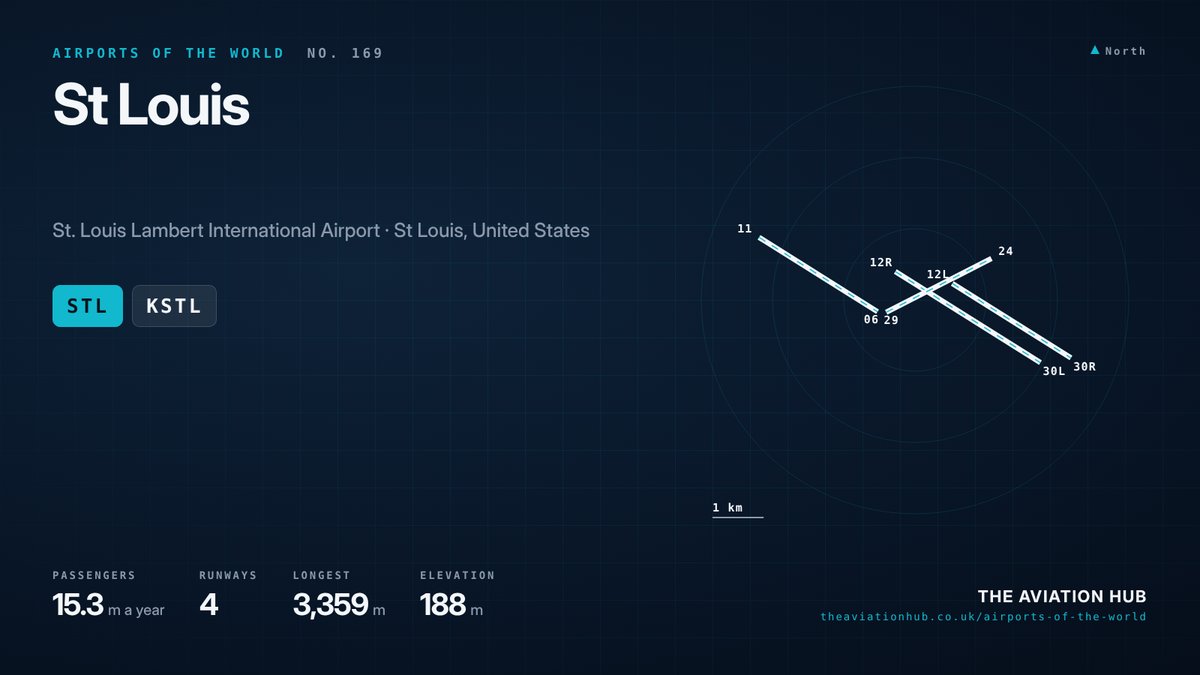
The codes are STL and KSTL. The airport sits 188 m (618 ft) above sea level on the limestone plateau south of the Missouri River, with Interstate 70 along its southern edge. There are four runways, three of them roughly parallel, and two terminals with 54 gates between them. Passenger traffic was roughly 15.3 million in 2025, a little below 2024 and well under the peak of more than 30 million in 2000.
Southwest carries around 63 per cent of passengers and runs St Louis Airport as one of its largest focus cities, with American, Delta, United, Frontier, Alaska, Air Canada and Sun Country making up most of the rest. The City of St. Louis owns and operates the field even though it lies outside the city limits. Flight information and parking are on the airport’s official website.
How Lambert Field Came to Be
Flying at this site began in 1909, when the Aero Club of St. Louis set up a balloon base at Kinloch Park. Theodore Roosevelt, by then out of office, became the first American president to fly when he went up from Kinloch in 1910. Albert Bond Lambert, an Olympic golfer, Listerine executive and the city’s first licensed pilot, named the field after himself in 1923 and bought it outright in 1925. Charles Lindbergh flew the airmail from Lambert before his Atlantic crossing.
The city bought the field in 1928 and it grew into the home of TWA and of McDonnell Aircraft, which built fighters and the Mercury and Gemini spacecraft on the north side. Yamasaki’s terminal of 1956, with its three thin shell concrete domes, influenced airport design for a generation, and a fourth dome was added in 1965. The name became Lambert St. Louis International in 1971.
TWA ran one of the world’s biggest connecting hubs here until American bought the bankrupt airline in 2001. American cut the hub back within two years and closed it in 2010. A tornado tore through Terminal 1 on Good Friday 2011 and the repairs doubled as a renovation. The airport adopted its present name in 2016.
Runways at St Louis Airport
Four concrete runways serve St Louis Airport. Runway 12R/30L is the longest at 3,359 m (11,020 ft), and it takes most arrivals and the heavy departures. Runway 12L/30R, at 2,747 m (9,013 ft), lies close alongside it, too close for independent approaches in poor weather. That limitation drove the construction of runway 11/29, a 2,743 m (9,000 ft) strip opened in 2006 well to the northwest, which allows simultaneous instrument arrivals.
The fourth runway, 06/24, is a 2,317 m (7,603 ft) crosswind strip used when strong southwesterly or northeasterly winds blow across the parallels. The parallels are used in both directions as the wind dictates, while 11/29 mostly takes arrivals on 11 and departures on 29 because it sits closest to the Terminal 1 airlines. The long runway handles the Boeing 737 MAX and Airbus A321 traffic with ease.
Runway 11/29 cost 1.1 billion dollars, required the clearance of around 2,000 homes in Bridgeton, and opened just as the hub traffic it was built for disappeared. Ozark Air Lines Flight 809 crashed on approach in a wind shear event in 1973, killing 38, and the astronauts Elliot See and Charles Bassett died in a T-38 crash while landing in 1966.
Terminals and Airlines
Terminal 1 is the Yamasaki building. The domed main hall leads to Concourses A and C with 36 gates in all, where American, Delta, United, Frontier, Alaska and Air Canada operate. American’s Admirals Club and one of the largest USO facilities in the country are here. Concourse C is the former TWA pier.
Terminal 2, opened in 1998 as the East Terminal, is Southwest’s domain. Its 18 gates on Concourse E handle the carrier’s near constant stream of 737s, and the building also holds the international arrivals facility for flights without preclearance, which is why Cancun and Punta Cana flights, the Frankfurt service and the seasonal London flights use it. A Wingtips public lounge is the only lounge here. The two terminals sit more than a mile apart along the access road and are linked by free MetroLink trains and shuttle buses.
Routes and Destinations
St Louis Airport serves more than 80 nonstop destinations. Denver, Atlanta, Orlando, Chicago O’Hare, Phoenix, New York LaGuardia, Las Vegas, Dallas Fort Worth, Charlotte and Dallas Love Field were the busiest domestic routes in the year to May 2026, with Southwest and the big three hubs shaping the list. Southwest alone links more than 50 cities from here.
International flying is thin but growing. Cancun is the busiest foreign route, followed by Frankfurt, Punta Cana, Toronto and Montreal. Lufthansa’s Frankfurt service, at roughly 4,600 miles (7,400 km), is the longest route, and British Airways has added a seasonal London Heathrow flight in 2026. Caribbean and Mexican beach routes peak in winter and spring. Cargo is modest, although the Boeing defence plant on the north side ships F-15 and F/A-18 fighters from its own ramp.
Getting to and from St Louis Airport
The MetroLink Red Line is the easy answer. Stations sit at both terminals and trains run downtown in around 35 minutes and on to Illinois, for a single fare of a few dollars, which makes it the cheapest sensible option. Travel between the two terminal stations has been free since July 2024, so it doubles as the terminal shuttle.
Interstate 70 runs along the southern boundary, with downtown 20 to 25 minutes east in normal traffic and the St. Charles County suburbs to the west. I-170 and I-270 connect to the rest of the metro area. A taxi or rideshare to downtown costs around $40 to $50 (£31 to £39). Parking fills several garages at both terminals plus cheaper remote lots served by shuttles, and the consolidated rental car centre is a short bus ride away.
Spotting and Photography
St Louis Airport lacks an official viewing area, but there are good options. The Terminal 1 cell phone lot looks over 29 line ups and the 06/24 and 11/29 runways in morning light, and a path by Washington Park Cemetery near I-70 catches 30R landings after noon. Berry Hill Golf Course at the western corner suits 12L arrivals, and an elevated lot at the west end of Navaid Road covers every movement on 11/29.
Northwesterly operations bring arrivals on 30R and 30L in over the suburbs to the southeast, and most of the spots for them are best from noon to sunset. The Boeing ramp adds military variety that few civil airports can match, with F-15EX and F/A-18 test flights appearing most weeks. Photographing the Boeing plant itself is unwise. Stay on public roads, keep away from the fence and expect airport police to ask what you are doing.
What Comes Next
A 2022 plan would consolidate both terminals into a single new 62 gate concourse at the Terminal 1 site while keeping Yamasaki’s domes as the front door. The project would end the awkward split between Southwest and everyone else and is costed in the billions, with construction stretching into the 2030s. Southwest’s growth and the return of transatlantic flying give the airport momentum it has not had since the TWA days.
St Louis Airport is heading for a smaller, smarter footprint with plenty of runway to spare. Compare it with the other Midwestern airports on the Airports of the World map.
Continue to follow The Aviation Hub for more analysis and insight.
Advertise with us Your brand, in front of an aviation audience Home page and in-article placements, sold directly, one advertiser per slot. From £250 a year. See the rates

