
Stavanger Airport Guide: Sola, Oil and North Sea Helicopters
Stavanger Airport at Sola mixes airline traffic with busy North Sea helicopter flights. Our guide covers its history, runways, routes, access and spotting.
 By The Aviation Hub
5 min read
Updated October 20, 2026
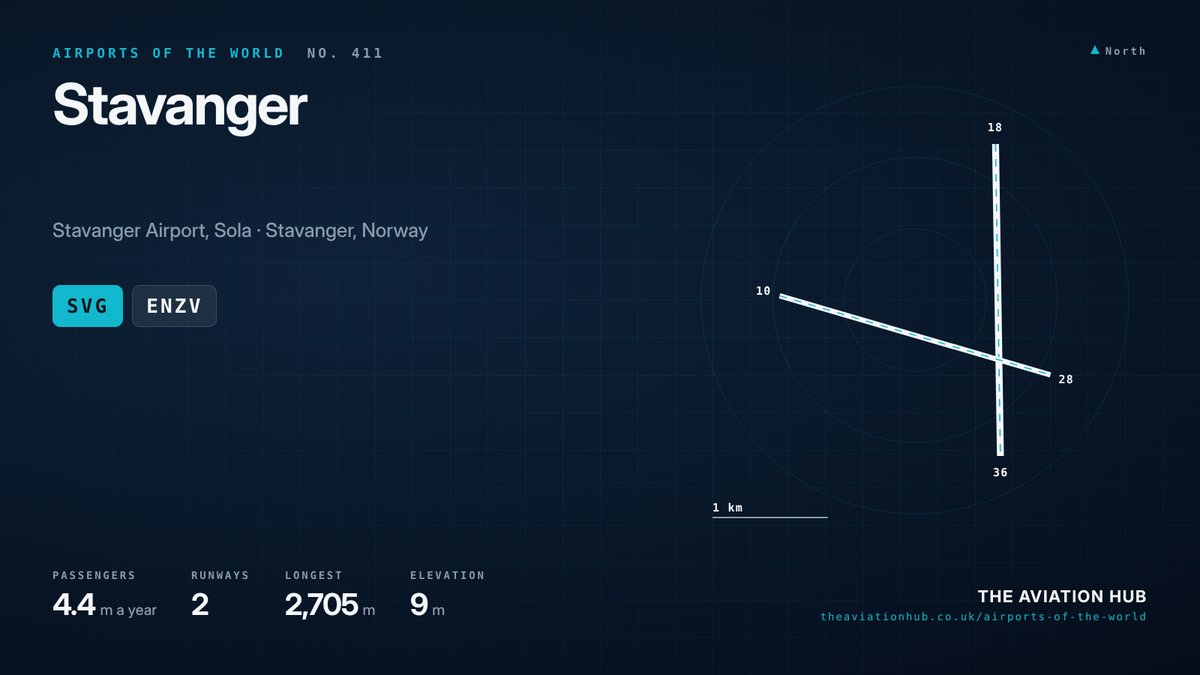
Sola sits on the flat coastal plain southwest of Stavanger, Norway’s oil capital. Stavanger Airport handled close to 4 million passengers in 2025 and doubles as a major base for helicopters serving North Sea platforms. Opened in 1937, it is one of Norway’s oldest airports. The blend of airliners, offshore helicopters and search and rescue crews gives Sola a character of its own.
Stavanger Airport at a Glance
The IATA code is SVG and the ICAO code is ENZV. The airport lies about 7 miles (11 km) southwest of Stavanger city centre, in Sola municipality, at an elevation of 9 metres (29 feet). It has two crossing runways, a passenger terminal for aeroplanes and a separate helicopter terminal. Stavanger Airport recorded around 3.98 million passengers in 2025, still below the 2019 total of 4.31 million and the 4.5 million of 2015.
SAS and Norwegian are the two largest airlines, while Widerøe flies many of the regional routes. Two offshore helicopter operators work from the heliport. State owned Avinor runs the airport. Flight times, parking and transport details are on the airport’s official website.
How Stavanger’s Airport Came to Be
King Haakon VII opened the airport on 29 May 1937. Planners had first looked at Forus, inside Stavanger itself, before settling on the open land at Sola. The flat sandy ground near the coast suited a hard runway at a time when most Norwegian flying still relied on seaplanes. War came within three years. On 9 April 1940 German paratroopers seized the airfield, and the Luftwaffe turned it into a major base for operations over the North Sea.
After liberation the Royal Norwegian Air Force used Sola, and the Forus plan was quietly dropped. Tragedy struck on 9 August 1961, when a Vickers Viking from London Heathrow hit a hillside at Holta on approach. All 39 people aboard died, among them 34 English schoolboys. The crash remains a defining moment in the airport’s history.
Oil reshaped everything from the late 1960s. Offshore helicopter flights began from Forus in 1966 and moved to a new heliport at Sola on 7 March 1989, at a cost of about 120 million kroner. The passenger terminal was extended in 2009. Widerøe took over many SAS regional routes from 2010, and Stavanger Airport became firmly tied to the fortunes of the energy industry.
Runways at Stavanger Airport
Runway 18/36 is the main runway for aeroplanes. It measures 2,705 metres (8,875 feet) long and 60 metres wide, with an asphalt surface, and has a Category II landing system. Runway 10/28 measures 2,449 metres (8,035 feet) long and 45 metres wide, also asphalt. It has no ILS and relies on satellite based approaches.
The two runways cross, so they cannot operate independently. Runway 10/28 mainly serves helicopters, but it becomes the main runway when strong Atlantic winds blow across 18/36. Those westerly gales are a defining feature of flying at Stavanger Airport. Crews must handle sudden gusts, low cloud and driving rain, especially from autumn through early spring.
Terminals and Airlines
The aeroplane terminal handles all scheduled passenger flights. Its 2009 extension was built without jet bridges, so many passengers walk or take a bus to their aircraft. The helicopter terminal sits apart and processes thousands of offshore workers heading to platforms every week.
SAS and Norwegian fly Boeing 737 and Airbus A320 family jets on the trunk routes, while Widerøe uses Dash 8 turboprops. KLM and other foreign carriers connect Stavanger with their hubs. SAS runs a lounge for its frequent flyers, many of them oil industry regulars who commute weekly. Offshore operators fly heavy helicopters such as the Sikorsky S-92. The Royal Norwegian Air Force’s 330 Squadron keeps a search and rescue detachment here around the clock.
Routes and Destinations
Oslo Gardermoen is by far the busiest route, with around 28 daily flights at peak times. Bergen and Trondheim are the other key domestic links. In total, four airlines fly domestic routes to four destinations, while 11 airlines serve around 35 international points from Stavanger Airport.
The international map reflects oil and leisure. Aberdeen, London and Amsterdam link Sola with the wider energy industry, while Copenhagen and Frankfurt offer hub connections. SAS once flew a business class link to Houston, operated by PrivatAir, before cancelling it. Summer brings charter and low cost flights to the Mediterranean, and links to Poland and the Baltic states serve the region’s large communities from those countries. Winter schedules thin out, but the business core runs year round.
Getting to and from Stavanger Airport
The Flybussen airport coach runs to Stavanger city centre in around 20 to 30 minutes, the simplest and cheapest sensible option for most visitors. Local Kolumbus buses also serve the terminal and nearby business districts such as Forus. Taxis reach the centre in about 20 minutes outside rush hour.
There is no rail link. By road, the airport sits close to the main routes into Stavanger and Sandnes. The parking garage was rebuilt after a fire on 7 January 2020 that burned for nearly seven hours and destroyed an estimated 200 to 300 vehicles. Nobody was hurt. Allow extra time at Stavanger Airport during the morning and evening rush, when roads around Sola and Forus clog with commuters.
Spotting and Photography
The flat landscape keeps views open on every side. Sola beach, just west of the field, offers a dramatic setting with dunes and sea in the foreground. The Flyhistorisk Museum Sola, beside the airport, displays historic aircraft and makes a good start for any visit. Afternoon and evening light favours the western side, and long summer evenings give extra hours of shooting.
The helicopter traffic sets Stavanger Airport apart. Offshore S-92s and the 330 Squadron’s search and rescue aircraft appear throughout the day. Runway 18/36 handles most airliner movements, but strong westerlies switch the action to 10/28. Stay outside fences, avoid military areas and follow Norwegian rules on drones near airports.
What Comes Next
The airport is positioning itself as a testbed for greener flying. In 2025 an electric Beta Alia CX300 began trial cargo flights to Bergen, and charging infrastructure is already on site. Avinor sees short Norwegian routes as ideal for electric aircraft in the decades ahead. Sola’s flat terrain, short regional sectors and strong engineering base make it a natural candidate for early trials.
Passenger numbers depend heavily on the oil sector, which still drives business travel and helicopter demand. Traffic has not yet regained its 2019 level, but the gap is narrowing. Expect a steady energy hub that may pioneer electric aviation. Compare it with other Norwegian fields on our Airports of the World map.
Continue to follow The Aviation Hub for more analysis and insight.
Advertise with us Your brand, in front of an aviation audience Home page and in-article placements, sold directly, one advertiser per slot. From £250 a year. See the rates

