
Stockholm Arlanda Airport Guide: Sweden’s Hub in the Forest
Stockholm Arlanda Airport is Sweden's largest airport and the home of SAS. Read about its three runways, four terminals, routes, rail links and spotting.
 By The Aviation Hub
7 min read
Updated October 20, 2026
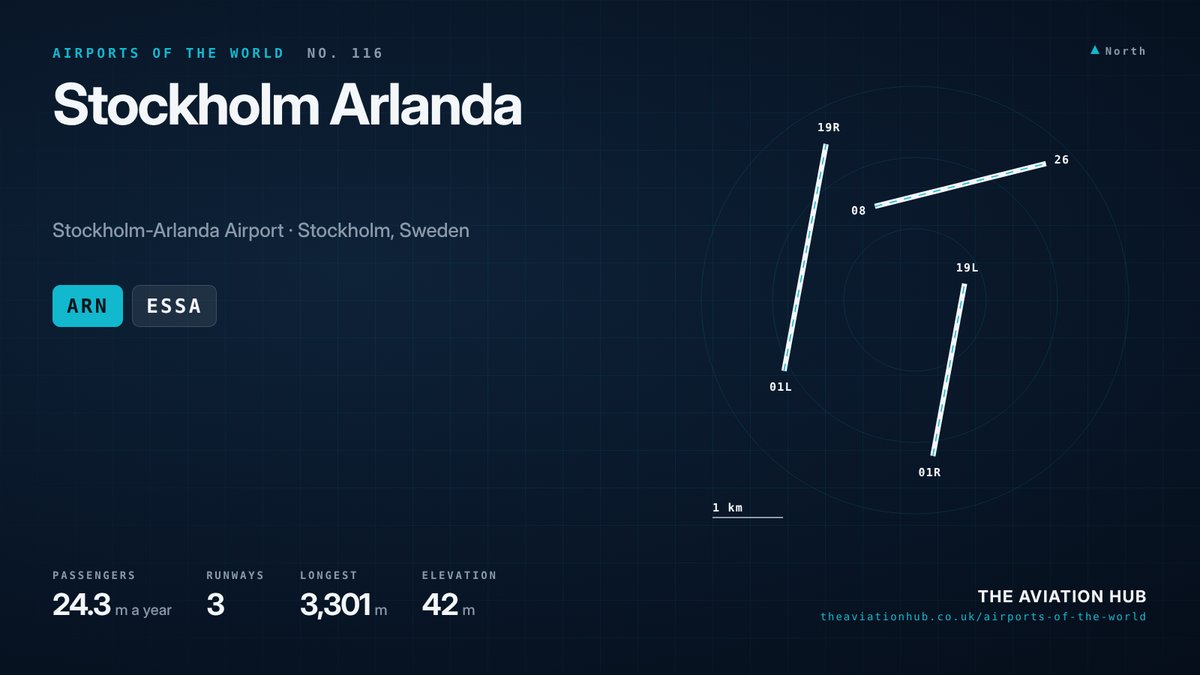
Stockholm Arlanda Airport lies in the pine forest north of the Swedish capital, far enough from the city that it has room for three runways and few close neighbours. It is the largest airport in Sweden, the main hub of SAS and a hub for Norwegian, with Ryanair and Wizz Air also flying here. Around 24 million passengers used it in 2025. It is famous for refusing to close in snow, for a terminal numbering scheme that skips the number one, and for an MD-81 that glided into a field in 1991 with everyone on board surviving.
Stockholm Arlanda Airport at a Glance
The codes are ARN and ESSA. Stockholm Arlanda Airport sits in Sigtuna Municipality about 23 miles (37 km) north of Stockholm city centre, at an elevation of 42 m (137 ft). It has three asphalt runways and four passenger terminals, numbered 2 to 5. Swedavia, the state owned company that runs Sweden’s main airports, operates the field and keeps its head office in the control tower.
In 2025 the airport handled roughly 24.3 million passengers, of whom about 20.2 million were international and 4.1 million domestic, on just under 100,000 landings. SAS is the dominant carrier and uses Arlanda as one of its three Scandinavian hubs. Norwegian is the second largest operator, while Ryanair and Wizz Air provide most of the low cost capacity. Live flight data, parking and the long list of shops in Terminal 5 are on the airport’s official website.
A Short History of Arlanda
Bromma, close to the city, served Stockholm from 1936 but its short runways could not handle the jets that were coming. The state chose a forest site in Sigtuna Municipality, used it for practice flights from 1959 and opened it to limited civil traffic in 1960, with the formal inauguration in 1962. The name Arlanda was coined from Ärlinghundra, the old district name, with a nod to the Swedish verb landa, to land.
The oldest surviving terminal, now Terminal 5, opened in 1976 as Arlanda International. Domestic flights moved up from Bromma in 1983 into what is now Terminal 4, and Terminal 2 followed in 1990. Sky City, the landside concourse between Terminals 4 and 5, now links them with hotels and shops. The Arlanda Express railway began running in 1999, and the third runway, 01R/19L, opened in 2003 after a long environmental fight.
The airport’s best known incident came on 27 December 1991. SAS Flight 751, a McDonnell Douglas MD-81, lost both engines shortly after take off when clear ice from the wings was ingested. The crew put the aircraft down in a field near Gottröra and all 129 people on board survived. De icing procedures across the industry changed as a result. The airport has never had a Terminal 1, and Terminal 2 opened as a domestic terminal before switching to international flights.
Runways at Stockholm Arlanda Airport
Stockholm Arlanda Airport has three runways. Runway 1, 01L/19R, is the longest at 3,301 m (10,830 ft) and 45 m wide. Runway 3, the parallel 01R/19L, is 2,500 m (8,201 ft) long. Runway 2, 08/26, crosses the field at 2,500 m (8,202 ft). All three are asphalt. Runways 1 and 3 are equipped for Category III operations and are far enough apart to be used simultaneously, which gives the airport more capacity than its traffic currently needs.
Runway 1 takes the heaviest aircraft, while runway 3 is used mainly at peak hours for environmental reasons. Aircraft use 01L and 01R when the wind blows from the north and 19L and 19R when it comes from the south. Runway 08/26 comes into use when the wind demands it. Swedavia has a stated policy of never closing the airport for snow. Fleets of ploughs and sweepers clear a runway in minutes, and de icing is done at remote pads rather than at the gate.
Terminals and Airlines
Terminal 5 is the heart of Stockholm Arlanda Airport and the biggest building, with piers D, E and F and more than 30 airbridge stands. SAS and Norwegian run their operations from here, and most Star Alliance, long haul and Schengen traffic uses it. The pier extension and the new central security hall with CT scanners, completed between 2022 and 2024, moved the whole terminal up a class. Lufthansa, Turkish Airlines, Qatar Airways, Emirates and Delta all use Terminal 5.
Terminal 4 has long been the home of Ryanair and Wizz Air, though its check in, security and baggage functions moved into Terminal 5 in October 2025 and the two buildings are now joined airside. Terminal 2 handles a group of international carriers including Air France, KLM, easyJet, Vueling and Transavia. Terminal 3 is the small regional building where passengers walk out to small turboprops operated by regional carriers such as PopulAir and Jonair. SAS flies Airbus A320neos and A330-300s here, with Embraer E195s and ATR 72s on regional contract flying.
Routes and Destinations
Domestic flying is a large part of the schedule by Swedish standards. Lulea, Umea, Gothenburg, Skelleftea and Malmo were the busiest internal routes in 2024, and the northern cities depend on them in winter when the trains take all day. London was the busiest international route, followed by Copenhagen, Oslo and Helsinki, which SAS and Norwegian compete on many times a day. Amsterdam completes the top five.
Long haul capacity is modest. SAS serves Newark all year and Miami in season, Delta flies to New York JFK in summer, and Emirates and Qatar Airways connect Stockholm Arlanda Airport to Dubai and Doha. Thai, Air China and ANA add Bangkok, Beijing and Tokyo. Summer brings a surge of leisure flying to Spain, Greece and Turkey. Winter adds ski and sun charters and tourists heading north to Kiruna for the northern lights. Cargo City handles a mix of belly freight and dedicated freighters.
Getting to and from Stockholm Arlanda Airport
The Arlanda Express is the fastest option, running non stop to Stockholm Central in around 18 minutes from stations under Terminal 5 and under Terminals 2 to 4. It is also the most expensive at well over SEK 300 (roughly £22) for a single bought on the day, though advance and group fares bring that down. SL commuter trains and SJ and Mälartåg regional services call at Arlanda Central under Sky City and are cheaper, with the catch of a station exit fee added to the ticket.
Flygbussarna coaches run to the city bus terminal in about 45 minutes and are the cheapest sensible choice at under SEK 150. SL local buses link the airport with Märsta for the commuter rail. The E4 motorway passes the airport and a taxi to the centre costs around SEK 500 to 700 (roughly £37 to £52) at a fixed rate from the licensed ranks that Swedavia regulates. Car parks range from the terminal multi storeys to cheap long stay fields with shuttle buses.
Spotting and Photography
Sky City has a large viewing area inside the terminal with windows onto the apron between Terminals 4 and 5, which is a comfortable option in a Swedish winter. Outside, the official spotters’ hut at the northern end of runway 01R/19L gives close views of aircraft landing on 19L, and a gravel road near the runway 26 approach lights suits days when that runway is in use. Upper rooms at the Radisson Blu SkyCity hotel look out over the aprons.
Spotting here means dressing for the climate. Light is long and low from autumn to spring, which flatters aircraft but leaves little daylight. Summer offers almost endless light and the chance of SAS A330s, Gulf wide bodies and visiting cargo jets. Stay on public roads, do not park in forest tracks that block emergency access, and keep away from the perimeter fence, which is patrolled.
What Comes Next
Swedavia is working through a long term development plan. The joining of Terminals 4 and 5, the new security hall and the enlarged duty free concourse were the first phase. A new Pier G is planned to lift capacity to around 40 million passengers a year by 2040. Braathens Regional Airlines is moving its SAS contract flying up from Bromma, a shift that could hasten the closure of Bromma and concentrate Stockholm’s flying at Arlanda.
Environmental pressure is real. Sweden was the birthplace of flight shame and domestic traffic has not fully recovered from the pandemic, but international numbers keep climbing. The verdict is that Stockholm Arlanda Airport has the space, the runways and the political backing to grow for decades. Compare it with Oslo, Copenhagen and Helsinki on the Airports of the World map.
Continue to follow The Aviation Hub for more analysis and insight.
Advertise with us Your brand, in front of an aviation audience Home page and in-article placements, sold directly, one advertiser per slot. From £250 a year. See the rates

