
Subang Airport Guide: Kuala Lumpur’s City Airport Reborn
Subang Airport was Kuala Lumpur's main gateway until 1998. Now jets are back. Read about its history, runway, airlines, routes and transport links.
 By The Aviation Hub
5 min read
Updated October 20, 2026
Subang Airport was Kuala Lumpur’s international gateway for more than three decades, until the much larger KLIA at Sepang replaced it in 1998. Today it is a compact city airport for turboprops, business jets and, since August 2024, narrow body jets once again. It carried about 1.86 million passengers in 2025, a fraction of its 1997 peak but rising quickly. For travellers heading to Petaling Jaya, Shah Alam or central Kuala Lumpur, it is far closer than KLIA.
Subang Airport at a Glance
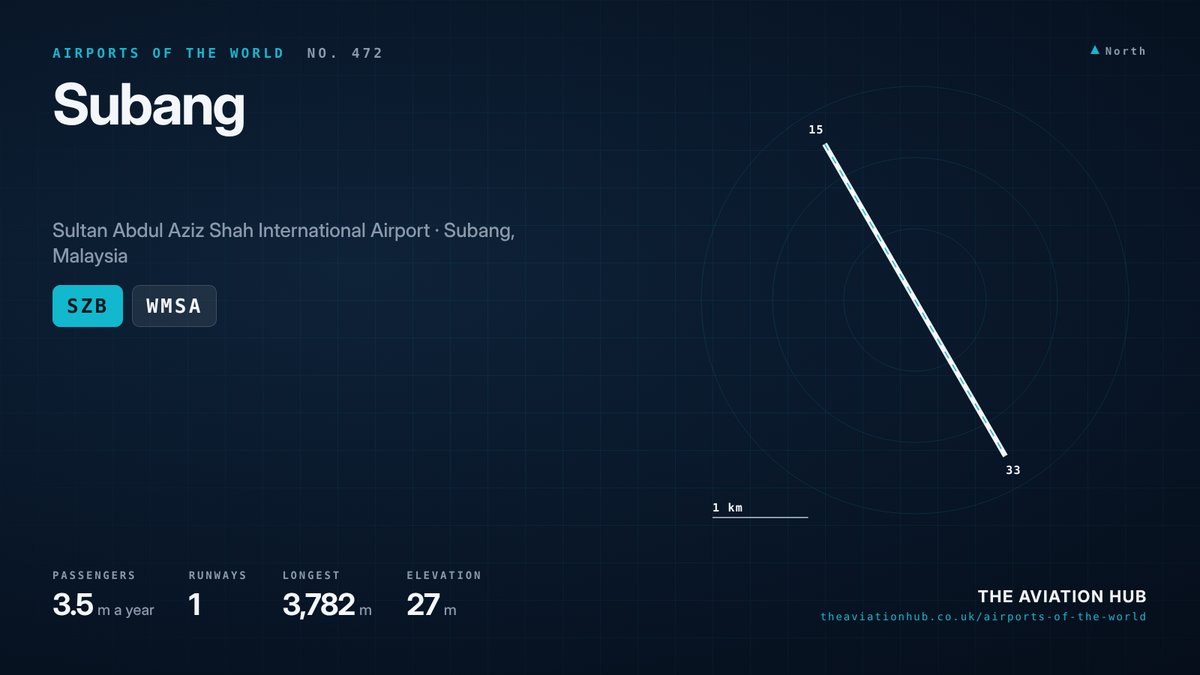
The codes are SZB for IATA and WMSA for ICAO. The airport lies in Subang, Selangor, about 11 miles (18 km) west of central Kuala Lumpur. Elevation is 27 metres (90 feet). There is one runway and one active passenger terminal, the SkyPark Terminal, also known as Terminal 3.
Traffic reached 1,859,173 passengers in 2025, with about 26,900 aircraft movements and 14,700 tonnes of cargo. Firefly uses Subang Airport as its hub, Berjaya Air treats it as a focus city and Batik Air Malaysia runs a growing operation. Malaysia Airports Holdings operates the site, officially named Sultan Abdul Aziz Shah Airport. Schedules are on the airport’s official website.
A Short History of Subang
Construction began in 1961 on a 535 hectare site, and the airport opened on 30 August 1965 at a cost of about RM52 million. It replaced the cramped Sungai Besi airfield and became Malaysia’s main international gateway. Its original runway, 3,500 metres long, was the longest in South East Asia at the time.
The first terminal had a floating concrete shell roof and a circular ramp, inspired by the penguin pool at London Zoo. Renovations in the 1980s removed much of that design, and an upgraded terminal with aerobridges opened in 1983. Traffic peaked at 15.8 million passengers in 1997, the last full year before KLIA opened.
In March 1996 Subang Airport was renamed after Sultan Abdul Aziz Shah of Selangor, who also served as Malaysia’s 11th king. After 1998 it became a base for turboprops, general aviation and maintenance. Jets returned only on 1 August 2024, after a gap of 22 years, under a government plan to revive the airport.
Runways at Subang Airport
There is a single asphalt runway, 15/33, measuring 3,782 metres (12,408 feet) long and 45 metres wide. It was extended from its original 3,500 metres between 1989 and 1990. That length is far more than today’s narrow body jets and ATR turboprops need, and it leaves room for wide body aircraft when required.
The runway runs roughly north west to south east, with dense housing close to both ends. Afternoon thunderstorms are the main hazard. The airport has a difficult accident record. Japan Airlines Flight 715, a Douglas DC-8, crashed on approach in 1977, killing 34. Flying Tiger Line Flight 066, a Boeing 747 freighter, struck a hillside in 1989 with the loss of all four crew.
In 1983 a Malaysian Airline System Airbus A300 landed short without fatalities. More recently, a Beechcraft Premier I crashed near the airport on 17 August 2023, killing ten people.
Terminals and Airlines
All scheduled flights use the SkyPark Terminal, which was rebuilt after a RM300 million revamp announced in 2007 and a RM40 million facelift in 2009. Terminal 1, the old international building, was demolished in 2003. Terminal 2 is earmarked for business aviation hangars.
Firefly, mostly with ATR 72 turboprops, flies to Penang, Langkawi, Kota Bharu, Kuala Terengganu, Alor Setar, Johor Bahru and Singapore Seletar. Batik Air Malaysia serves Penang, Kota Kinabalu, Kuching, Langkawi, Bangkok, Jakarta and Singapore. Berjaya Air flies to Thai and Vietnamese islands including Koh Samui and Phu Quoc. HK Express links Subang Airport with Hong Kong, Scoot flies to Singapore and TransNusa to Jakarta.
Routes and Destinations
Singapore and Penang are the backbone routes, each served by three airlines. Singapore is reached through both Changi and the smaller Seletar airport, which suits business travellers on both sides. Penang, Langkawi and Kota Bharu draw domestic tourists and families.
The return of jets has broadened the network. Batik Air Malaysia added routes to Borneo, Bangkok and Jakarta, and HK Express started direct flights to Hong Kong. Batik adds Denpasar on Bali from 2 December 2026. Berjaya Air’s resort routes to Hua Hin, Koh Samui and Phu Quoc fill a niche few airports offer.
Traffic is spread fairly evenly through the year, with peaks around Hari Raya, Chinese New Year and school holidays. Cargo is modest at around 15,000 tonnes.
Getting to and from Subang Airport
Rapid KL bus 772 links the terminal with Pasar Seni in central Kuala Lumpur, stopping at Ara Damansara and Asia Jaya stations on the LRT Kelana Jaya Line. Changing to the LRT at Ara Damansara is the cheapest sensible option for the city. Bus T804 runs to Kwasa Sentral on the MRT Kajang Line.
The Skypark Link rail service opened in May 2018 but was suspended on 15 February 2023 because of low ridership. Taxis and ride hailing reach central Kuala Lumpur in 30 to 45 minutes, traffic permitting. A shuttle bus runs to both KLIA terminals in about an hour, which helps connecting passengers.
Spotting and Photography
Subang Airport is popular with local spotters because of its variety. Alongside airliners, the field hosts business jets, maintenance visitors, government aircraft and helicopters. Roads around the perimeter and the residential areas near the runway ends give views of approaches.
Expect Firefly ATR 72s, Batik Air Malaysia Boeing 737s, HK Express Airbus A320neos and Scoot A320s, plus Berjaya Air turboprops on resort routes. Military and police aircraft also use the field, so avoid photographing them. Respect residents, stay off private land and follow instructions from police and security.
What Comes Next
The Subang Airport Regeneration Plan, approved in 2023, sets out a RM1.3 billion first phase. It targets five million passengers within four to five years and eight million by 2030, and aims to restore the Skypark Link rail service. The wider Asia Aerospace City project would add aerospace industry and maintenance facilities.
Noise and road congestion in the surrounding suburbs will limit how far growth can go. Even so, Subang looks set to become a busy city airport again, complementing rather than competing with KLIA. See how it compares with KLIA and Penang on our Airports of the World map.
Continue to follow The Aviation Hub for more analysis and insight.
Advertise with us Your brand, in front of an aviation audience Home page and in-article placements, sold directly, one advertiser per slot. From £250 a year. See the rates

