
Kingsford Smith Airport sits at Mascot on the northern shore of Botany Bay, about 5 miles (8 km) south of central Sydney. Sydney Airport is the busiest in Australia and the main international gateway to the country, handling around 42.5 million passengers in 2025. Two parallel runways stretch into the bay on reclaimed land, a third crosses them, and a night curfew and an hourly movement cap shape every schedule. Qantas calls it home, and the view of the city skyline from the approach is as good as any in the world.
Sydney Airport at a Glance
The IATA code is SYD and the ICAO code is YSSY. The field lies just 6 metres (21 feet) above sea level between the Cooks River and Botany Bay, with the suburbs of Mascot, Tempe and Kurnell on three sides and the water on the fourth. Three asphalt runways serve three terminals, the international Terminal 1 on the northwestern side and the domestic Terminals 2 and 3 on the northeastern side. Sydney Airport Corporation operates it under a long lease from the Commonwealth, owned since 2022 by a consortium of Australian superannuation funds and infrastructure investors.
Qantas and its regional arm QantasLink run their main hub here, Virgin Australia treats it as a hub and Jetstar as an operating base, and Rex also keeps aircraft at Sydney Airport. Around 25.4 million of the 2025 passengers flew domestically and 17.2 million internationally, with international traffic growing faster. Airlines serve roughly 46 domestic and 43 international destinations. Flight details and parking rates are on the airport’s official website.
How Sydney’s Airport Came to Be
Nigel Love, a former wartime pilot, leased paddocks at Mascot in 1919 for a private aerodrome, and the field opened officially in January 1920. The Commonwealth government bought the land soon afterwards and the first regular services began in 1924. In 1936 the airport was renamed after Sir Charles Kingsford Smith, the aviator who had made the first transpacific flight eight years earlier, and the name stuck.
Reclamation of Botany Bay in the 1960s produced the long north south runway and the modern international terminal, which opened in 1970 with the arrival of the Boeing 747. The main runway was extended in the late 1970s so it could serve as an emergency landing site for the NASA Space Shuttle, a role it kept until 1986. The parallel runway opened in 1994 after furious opposition from residents under the flight path, and the curfew followed in 1995.
The Commonwealth sold the airport operator to a Macquarie led group for AUD 5.4 billion in 2002. Accidents have been few. An Ansett ANA Viscount crashed into Botany Bay in 1961 and an Advance Airlines flight hit the sea wall in 1980, with 15 and 13 deaths respectively.
Runways at Sydney Airport
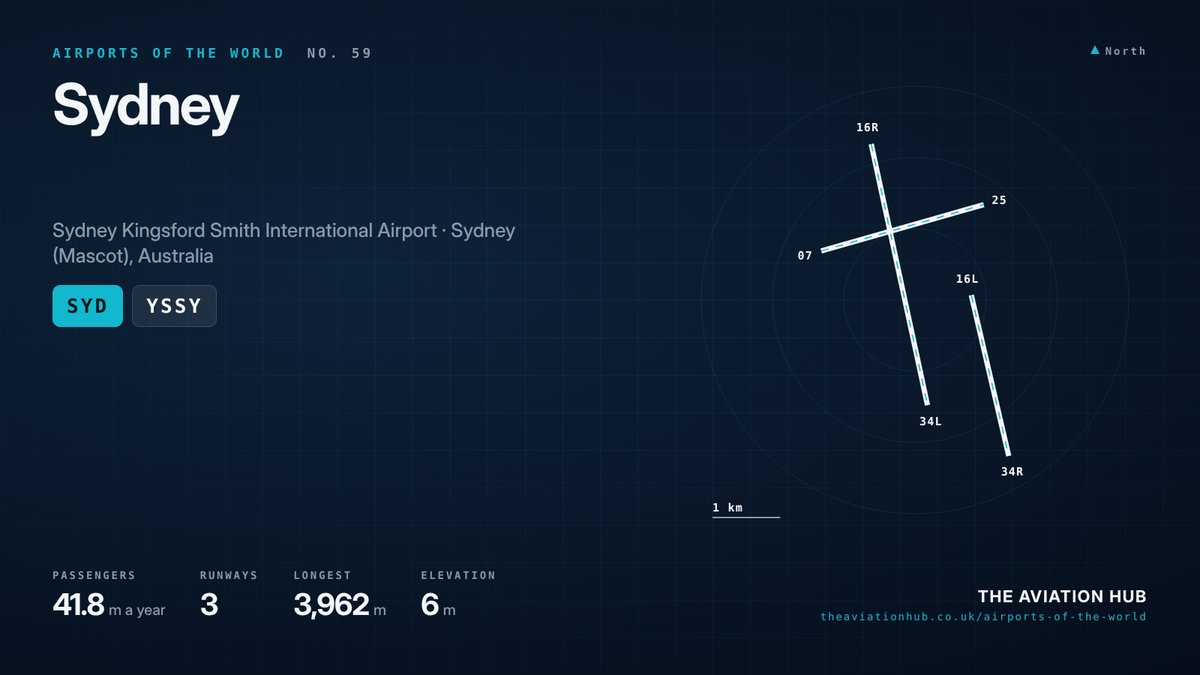
Runway 16R/34L is the main runway at 3,962 metres (12,999 feet) by 45 metres, the longest operational runway in Australia, and handles the heaviest long haul departures. Its parallel partner, Runway 16L/34R, measures 2,438 metres (7,999 feet) and takes mainly domestic flights and arrivals. Runway 07/25 crosses them from east to west at 2,530 metres (8,300 feet) and is used mostly by lighter aircraft, though it can accept any type. All three are asphalt.
The parallel pair run north to south with their southern ends on reclaimed land in the bay. When the wind is from the north, arrivals on 34L and 34R come in over the water with the city skyline ahead, while departures climb out over Mascot. Southerly winds reverse the pattern and send arrivals over the suburbs, which the noise sharing system tries to limit.
A curfew bans take offs and landings between 23:00 and 06:00, with a small number of shoulder movements allowed and fines of up to AUD 550,000 for breaches. A cap of 80 movements an hour also applies, so a single thunderstorm or strong wind on 07/25 can cause delays that ripple through the whole Australian network.
Terminals and Airlines
Terminal 1 handles every international flight at Sydney Airport. Pier B serves Qantas and its oneworld partners, including British Airways, Cathay Pacific, Japan Airlines, Qatar Airways and American, plus SkyTeam carriers such as Delta and Korean Air. Pier C serves Virgin Australia and its partners alongside Star Alliance members United, Singapore Airlines, ANA, Air New Zealand and Air Canada. Emirates, Etihad, LATAM and the Chinese carriers also use the building.
Terminal 2, once the Ansett domestic terminal, serves Jetstar, Virgin Australia, Rex and the regional carrier Link Airways. Terminal 3 belongs to Qantas and QantasLink, with the airline’s Chairman’s Lounge and Business Lounges inside. The domestic terminals sit a short walk apart, but Terminal 1 is on the far side of the runways and reached by the T Bus shuttle or the train.
Qantas and Virgin Australia between them carry the vast majority of domestic passengers. The Qantas First Lounge in Terminal 1, designed by Marc Newson, is among the most photographed airline lounges in the world.
Routes and Destinations
Melbourne is the busiest route by a wide margin and one of the heaviest air corridors on the planet, with departures every few minutes on Qantas, Virgin Australia and Jetstar. Brisbane and the Gold Coast follow, then Adelaide, Perth, Canberra and Cairns. Perth, at about 2,040 miles (3,290 km), is the longest domestic sector.
Singapore, Auckland and Hong Kong led the international table in 2025, with Los Angeles, Tokyo, Dubai, Doha and Bali close behind. Qantas flies Boeing 787-9s and Airbus A380s to Los Angeles, Dallas Fort Worth, London via Singapore and Johannesburg. The Dallas nonstop, at roughly 8,580 miles (13,800 km), is one of the longest routes from Sydney Airport, edged only by United’s seasonal Houston service. Qantas plans to fly nonstop to London and New York with Airbus A350-1000s under Project Sunrise.
Seasonal peaks follow the Australian summer and the Christmas holidays in December and January, with a second surge in the northern summer as European and American visitors arrive. Cargo is significant, with freighters from Qantas, Singapore Airlines and the big integrators using the dedicated apron.
Getting to and from Sydney Airport
The T8 Airport and South Line runs through the Airport Link tunnel with stations at both the International and Domestic terminals. Trains reach Central in about 13 minutes and run roughly every 10 minutes. A station access fee of around AUD 17 (roughly £9) is added to the fare because the stations are privately operated, which makes the total about AUD 20 to the city. Walking to Mascot or Wolli Creek station avoids the surcharge and is the cheapest sensible option.
Bus route 350 links the terminals with Bondi Junction and route 420 runs to Burwood. By road, the M1 Southern Cross Drive and the M5 feed the airport, and the Sydney Gateway motorway link completed in 2024 cut journey times from the west. Taxis to the central business district cost AUD 50 to 65 (around £26 to £34) and take 20 to 40 minutes. Ride share pickups are in designated zones, and multi storey car parks serve all terminals.
Spotting and Photography
Sydney Airport is one of the great spotting locations. The Shep’s Mound viewing area on Ross Smith Avenue, beside the 16R threshold, gives close views of departures on the main runway and the domestic apron. Across the bay, the beaches and headlands at Kyeemagh and the foreshore at Brighton Le Sands offer unobstructed shots of arrivals on 34L and 34R with the water in the foreground.
The car parks and observation deck at Terminal 1 overlook the international apron, and hotels along O’Riordan Street have rooms facing the field. Morning light favours the eastern side of the runways and afternoon the western side, with winter offering the clearest air. Shep’s Mound is an official spot with no restrictions, but elsewhere stay off airport roads, keep clear of the perimeter fence and respect the residents of Mascot and Kurnell.
What Comes Next
The Master Plan 2039 forecasts around 50 per cent more passengers by the end of the next decade, with international numbers roughly doubling, all within the existing runways and curfew. That means larger aircraft, more efficient terminals and a gradual merging of the domestic buildings. Western Sydney International Airport at Badgerys Creek, where construction began in 2018 and passenger flights start in late 2026, has no curfew and will take some of the pressure.
Sydney Airport will remain the country’s main gateway, but for the first time in a century it will have a rival in its own city. See how it compares on our Airports of the World map.
Continue to follow The Aviation Hub for more analysis and insight.
Advertise with us Your brand, in front of an aviation audience Home page and in-article placements, sold directly, one advertiser per slot. From £250 a year. See the rates

