
Taipei Songshan Airport is the city airport of Taiwan’s capital, set in Songshan District about 4 miles (6 km) from Taipei Main Station. Once the island’s main international gateway, it now concentrates on domestic flights to the outlying islands and short city pair routes to Tokyo Haneda, Seoul Gimpo and Shanghai Hongqiao. Its single runway also serves an air force base. The Wenhu metro line stops at the door, so passengers can be downtown in 20 minutes.
Taipei Songshan Airport at a Glance
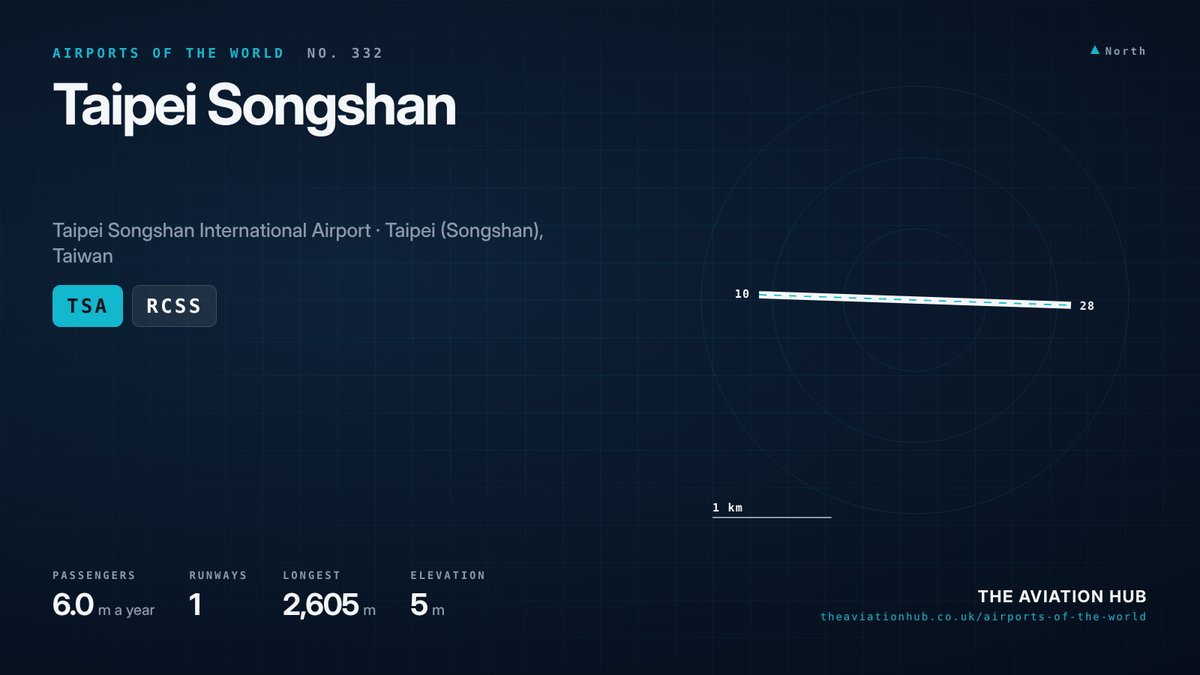
The airport uses the IATA code TSA and the ICAO code RCSS. It covers 182 hectares (450 acres) at an elevation of 5 m (18 ft), squeezed between the Keelung River to the north and dense city blocks to the south. One runway, two passenger terminals and an international cargo operation make up the civil side. The Civil Aeronautics Administration runs the airport, while Songshan Air Force Base occupies part of the site.
Taipei Songshan Airport handled around 5.4 million passengers in its latest reported year, below the 6.2 million of 2018 and far short of the 15.3 million peak of 1997. China Airlines, EVA Air, Mandarin Airlines and UNI Air are the main Taiwanese operators. Japan Airlines and ANA fly the Haneda route, and Korean airlines serve Gimpo. Flight times and terminal information are on the airport’s official website.
A Short History of Songshan
The airfield opened on 28 March 1936 under Japanese rule as Taihoku Airfield, also known as Matsuyama Airfield. During the war with China it was a Japanese military base, and in 1937 bombers flew from here against the mainland. The Republic of China Air Force took it over in 1946 and renamed it Songshan Airport. Shared military and civil use began on 16 April 1950.
For decades Songshan was Taiwan’s main international airport. Traffic outgrew the cramped city site, and the new Taoyuan International Airport opened on 26 February 1979. Passengers at Songshan fell from 6.2 million in 1978 to 2.9 million the next year. Domestic flying then boomed, and the airport peaked at more than 15.3 million passengers in 1997.
Taiwan’s high speed railway, opened in 2007, wiped out the busiest domestic routes. Taichung and Chiayi flights stopped in mid 2007, and Kaohsiung and Tainan services ended in 2008. Songshan reinvented itself. Shanghai Hongqiao flights began on 14 June 2010 and Tokyo Haneda followed in October 2010, turning it into a city centre business airport. Terminal 2 reopened for domestic flights on 29 March 2011.
Runways at Taipei Songshan Airport
A single runway serves Taipei Songshan Airport. Runway 10/28 is 2,605 m (8,547 ft) long and 60 m wide with an asphalt surface, running east to west along the Keelung River. That length suits the Airbus A321neo and Boeing 737-800, plus the Airbus A330 and Boeing 767 types that have worked the Haneda and Hongqiao routes. Plans called for jet bridges to be cut from eight to six to fit wider aircraft.
The approaches are dramatic. Aircraft landing on runway 10 come in low over the city, while runway 28 arrivals descend past the hills of Neihu to the east. Mountains ring the basin, and in 1999 procedures were changed to keep aircraft clear of Taipei 101, then under construction. On 4 February 2015 TransAsia Airways Flight 235, an ATR 72-600, suffered an engine problem after take off. The crew shut down the wrong engine, and the aircraft clipped a taxi and crashed into the Keelung River, killing 43 of the 58 aboard.
Terminals and Airlines
Terminal 1 at Taipei Songshan Airport handles international flights, and the refurbished Terminal 2 handles domestic services. Both are compact and quick to use, with short walks from kerb to gate and fast immigration on most days. A new international cargo terminal adds freight capacity on the same site.
China Airlines and EVA Air fly the international city pair routes, alongside Japan Airlines and ANA on Haneda. Chinese carriers such as China Eastern, Shanghai Airlines and Air China fly to mainland cities. Domestic flying belongs mainly to Mandarin Airlines and UNI Air, whose ATR 72 turboprops link Taipei with the outlying islands and the east coast. Business jets and government flights add variety.
Routes and Destinations
Kinmen is the busiest domestic route, carrying more than 1.2 million travellers in 2018. Penghu, Matsu, Hualien and Taitung follow, all places where the train is slow or impossible. These island routes run many times a day and fill quickly at weekends and holidays. Taipei Songshan Airport is the natural base for them, since most passengers start or end their journeys in the capital.
The international network is built on city centre pairs. Tokyo Haneda, Seoul Gimpo and Shanghai Hongqiao link downtown with downtown, ideal for business travellers. Other mainland Chinese cities appear when cross strait politics allow. Haneda, roughly 1,300 miles (2,100 km) away, is the flagship route. Cargo reached about 47,000 tonnes in 2018.
Getting to and from Taipei Songshan Airport
The Taipei Metro makes access simple. Songshan Airport station on the driverless Wenhu line sits beside Terminal 1, with trains every few minutes. Zhongxiao Fuxing, for the Bannan line and the eastern business district, is around ten minutes away. Taipei Main Station takes about 25 minutes with one change. It is the cheapest sensible option at a fare of well under £1.
Taxis wait outside both terminals and reach Xinyi or Taipei Main Station in around 15 to 20 minutes outside rush hour. City buses serve the airport from Dunhua North Road and Minquan East Road. The Fuxing North Road underpass, 677 m long, carries traffic beneath the runway. Parking is available but limited. For long haul flights, the Taoyuan Airport MRT from Taipei Main Station reaches Taoyuan in around 40 minutes.
Spotting and Photography
Taipei Songshan Airport is a favourite with local spotters because the city wraps so tightly around it. Binjiang Street, beside the western part of the field, is the classic spot, with arrivals passing low over the road. Riverside parks along the Keelung River give open views of the runway and departures. The terminal also has a rooftop observation deck.
Wind decides the runway direction, so check forecasts before setting out. Positions on the south side, including the terminal deck, have the sun behind them for most of the day. Summer humidity can produce heavy haze, while clear winter days give the sharpest results. The Air Force side is sensitive, so avoid photographing military aircraft, stay on public land and follow police instructions at once.
What Comes Next
Songshan’s future has been debated for two decades. Politicians have proposed closing it and redeveloping the land, while others want it as a city centre international airport. The current approach keeps it open for domestic and regional city routes, with Taoyuan as the long haul hub. Runway upgrades and terminal refurbishments have kept the facilities current.
Taipei Songshan Airport looks set to remain a niche but valuable link, carrying island traffic and premium business routes from a site no new airport could match for convenience. Further mainland China routes depend on cross strait politics. See how it compares with other Asian city airports on the Airports of the World map.
Continue to follow The Aviation Hub for more analysis and insight.
Advertise with us Your brand, in front of an aviation audience Home page and in-article placements, sold directly, one advertiser per slot. From £250 a year. See the rates

