
Taiwan Taoyuan International Airport is the main international gateway to Taiwan, located in Dayuan District of Taoyuan City about 25 miles (40 km) west of central Taipei. It handled roughly 47.8 million passengers in 2025, up more than six per cent on the previous year. Taipei Taoyuan Airport is the main hub for China Airlines, EVA Air and the newer Starlux, and the Hong Kong route alone carries close to five million passengers a year. A long delayed Terminal 3 is nearing completion and will reshape the field.
Taipei Taoyuan Airport at a Glance
The airport uses the IATA code TPE and the ICAO code RCTP. It lies at 32 metres (106 feet) above sea level on the coastal plain of the Taiwan Strait, with the sea a short distance to the northwest. Two parallel runways and two operating terminals handle the traffic, with a third terminal under construction. The Taoyuan International Airport Corporation, wholly owned by the government, operates the field.
Traffic in 2025 reached about 47.8 million passengers on roughly 262,000 aircraft movements. EVA Air was the largest carrier by passengers, ahead of China Airlines, and Starlux has grown quickly since its 2020 launch. Cathay Pacific treats the airport as a focus city, and Scoot, Tigerair Taiwan, Thai Lion Air and Thai VietJet maintain operating bases. Flight information and transport details are on the airport’s official website.
From Chiang Kai Shek to Taoyuan
Taipei’s original airport at Songshan, inside the city, was overwhelmed by the 1970s. The government included a new international airport among its Ten Major Construction Projects, and the field opened on 26 February 1979 as Chiang Kai Shek International Airport. Terminal 1, with its distinctive curved roof inspired by Dulles in Washington, dates from that opening.
Terminal 2 opened in 2000 and gained its north concourse in 2005, by which time the airport had become a significant Asian hub. In September 2006 the Chen Shui Bian administration renamed it Taiwan Taoyuan International Airport, a decision the opposition Kuomintang contested and which remains politically sensitive. Terminal 1 was extensively rebuilt in 2012 to a design by Norihiko Dan.
Two accidents mark the airport’s history. China Airlines Flight 676, an Airbus A300, crashed on approach in February 1998 with 202 deaths including six on the ground. In October 2000 Singapore Airlines Flight 006, a Boeing 747-400, took off from a closed runway in a typhoon, struck construction equipment and killed 83 people. Both led to major changes in approach procedures and runway signage at Taipei Taoyuan Airport.
Runways at Taipei Taoyuan Airport
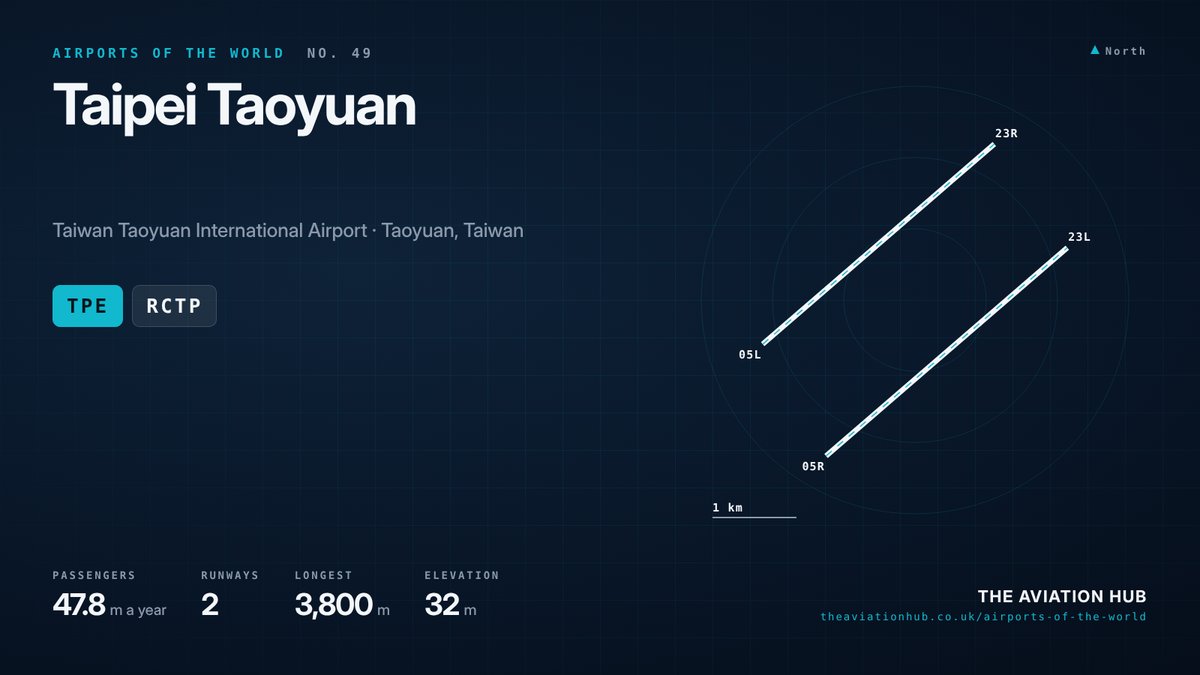
Two parallel runways run northeast to southwest. Runway 05L/23R measures 3,660 metres (12,008 feet) by 60 metres and Runway 05R/23L is 3,800 metres (12,467 feet) by 60 metres. Both offer precision instrument approaches.
Northeasterly monsoon winds dominate from autumn to spring, so arrivals typically approach from the southwest onto the 05s. Summer brings southwesterly flow and operations on the 23s, along with typhoons that can shut the airport for a day or more. The airport’s exposed position makes crosswinds a frequent challenge.
A third runway is planned to the north as part of the wider Taoyuan Aerotropolis scheme, with completion expected around 2030. It will lift capacity well beyond the current pair and allow Taipei Taoyuan Airport to handle the traffic Terminal 3 is designed to attract.
Terminals and Airlines
Terminal 1 has 18 gates split between Concourse A and Concourse B. China Airlines uses Concourse A for much of its regional flying, and Cathay Pacific operates mainly from Concourse B. Starlux and low cost carriers such as Scoot, Tigerair Taiwan, Peach and AirAsia also use Terminal 1. The 2012 rebuild modernised the ageing terminal.
Terminal 2 is the larger building at Taipei Taoyuan Airport and houses the long haul operations of the home carriers. China Airlines uses Concourse D and EVA Air uses Concourse C, so SkyTeam and Star Alliance each have their own wing. Japan Airlines, United, Delta and KLM also use Terminal 2. A Skytrain links the two terminals airside and landside.
Terminal 3, designed by Rogers Stirk Harbour and Partners and built by a Samsung C&T led consortium, is opening in phases and will have capacity for 45 million passengers. The allocation of airlines to the new building is still under discussion. A planned Terminal 4 has been shelved.
Routes and Destinations
Hong Kong is by far the busiest route, with around 4.9 million passengers in 2025 on a sector of under two hours. Tokyo, split between Narita and Haneda, comes second, with Osaka Kansai third. Bangkok, Seoul Incheon, Singapore, Manila, Okinawa’s Naha and Shanghai Pudong complete the top tier. Cross strait flights to mainland China have recovered only partially since 2020.
Long haul flying from Taipei Taoyuan Airport is extensive for an island of 23 million people. EVA Air and China Airlines serve Los Angeles, San Francisco, New York, Seattle, Vancouver, London Heathrow, Paris, Amsterdam, Frankfurt, Vienna, Sydney and Brisbane. Starlux has added Los Angeles, San Francisco, Seattle and Ontario in California. The longest sector is EVA Air’s service to Houston, with New York close behind.
Cargo is a major business. China Airlines and EVA Air both operate large freighter fleets, and the airport handles a significant share of Asia’s semiconductor exports. The cargo aprons see Boeing 747-8F and 777F activity around the clock.
Getting to and from Taipei Taoyuan Airport
The Taoyuan Airport MRT opened in 2017 and serves both terminals. Express trains reach Taipei Main Station in about 38 minutes and commuter trains take around 45 minutes, with departures every 15 minutes. A single fare is NT$150 (around £3.70), which makes the MRT the cheapest sensible option for most travellers. The line also connects to Taiwan High Speed Rail at Taoyuan station for onward travel south.
Coaches run from both terminals to Taipei, Taichung, Hsinchu and other cities, with journey times of 50 to 70 minutes to central Taipei. National Highway 2 links the airport to the main north to south motorway. Taxis operate 24 hours and cost roughly NT$1,200 to 1,400 (around £30 to £35) to central Taipei. Multi storey car parks serve each terminal.
Spotting and Photography
Terminal 2’s observation deck, open to the public on the upper level, is one of the better airside viewpoints in Asia and overlooks the main aprons and the airfield. The Novotel beside Taipei Taoyuan Airport offers rooms facing the runways. Outside the perimeter, the roads and fields near the 05 thresholds to the southwest are popular in winter northeasterly flow.
For 23 operations, roads near the northeastern end of the field give good approach shots. Light is best in the morning from the south side and in the late afternoon from the north. Taiwanese police are generally relaxed about photography, but stay off private farmland, keep clear of fences and avoid pointing lenses at military aircraft. The payoff is a rich mix of 747 freighters, A350s and the colourful Starlux fleet.
What Comes Next
Terminal 3 is the big one. Repeatedly delayed by design changes and the pandemic, its north concourse is now in use and the main building should follow in phases through 2026 and 2027. Once complete, the airport will have capacity for more than 80 million passengers. The third runway and the Aerotropolis development will add industrial and logistics zones around the field in the 2030s.
Geopolitics is the obvious uncertainty, but the commercial picture is bright. Starlux is adding Airbus A350s, EVA Air has Airbus A350-1000s on order, and Taiwan’s semiconductor trade keeps the freighters full. Taipei Taoyuan Airport is set to climb the Asian rankings once the new terminal opens. Track its progress on our Airports of the World map.
Continue to follow The Aviation Hub for more analysis and insight.
Advertise with us Your brand, in front of an aviation audience Home page and in-article placements, sold directly, one advertiser per slot. From £250 a year. See the rates

