
Taiyuan Airport Guide: Shanxi’s Growing Coal Country Gateway
Taiyuan Airport serves the capital of Shanxi with two 3,600 m runways and a huge Terminal 3 on the way. Runways, airlines, routes and access explained.
 By The Aviation Hub
6 min read
Updated October 20, 2026
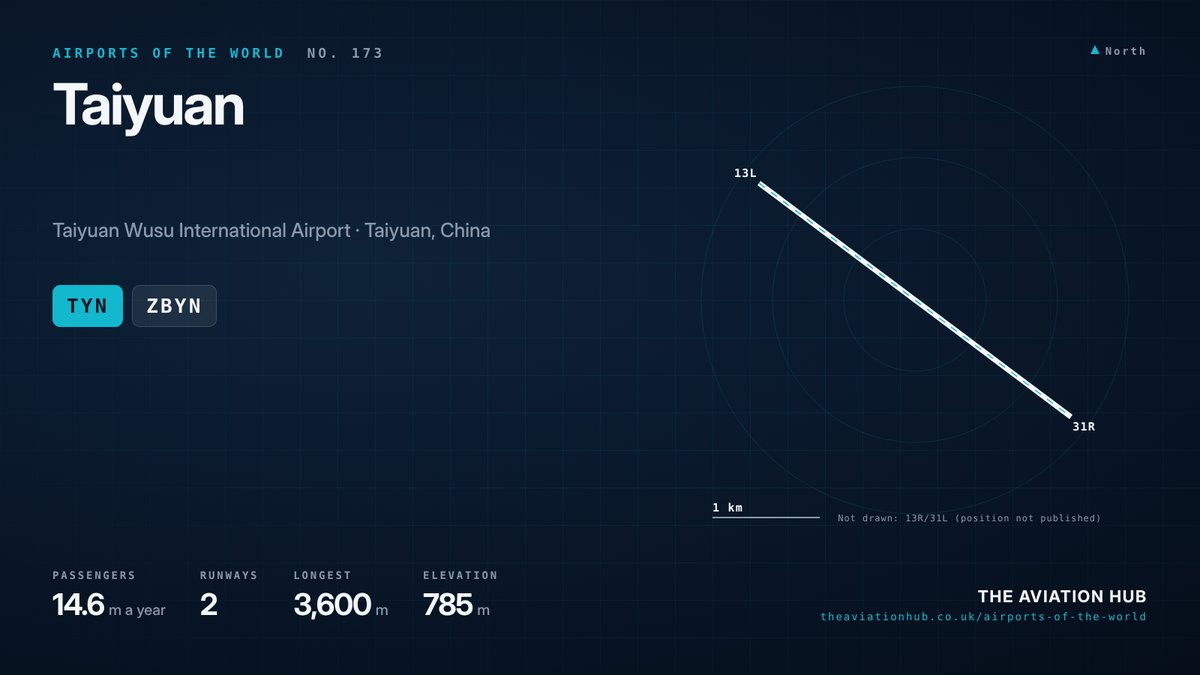
Taiyuan Airport, formally Taiyuan Wusu International Airport, serves the capital of Shanxi province in northern China from a site about 9 miles (15 km) southeast of the city centre in Xiaodian district. It handled roughly 14.6 million passengers in 2025, which places it in the second tier of Chinese airports behind the coastal giants. The field is in the middle of its largest expansion since civil flying began here in 1971, with a second runway now open and a vast new terminal under construction.
Taiyuan Airport at a Glance
The codes are TYN and ZBYN. The airport sits 785 m (2,575 ft) above sea level on the floor of the Taiyuan basin, with the Taihang mountains to the east and the Fen river to the west. It has two parallel concrete runways, two passenger terminals in use and a third taking shape beside them. In 2025 it recorded around 14.57 million passengers, about 107,000 aircraft movements and roughly 76,000 tonnes of cargo.
China Eastern Airlines and Hainan Airlines both treat the city as a focus point, and the low cost carrier West Air keeps a base here. Air China, China Southern, Shandong Airlines, Lucky Air and Spring Airlines add most of the remaining frequencies. Shanxi Airport Group, a provincial company, manages the field alongside the smaller airports at Datong, Yuncheng and Changzhi. Terminal maps and transfer times appear on the airport’s official website.
From Military Field to Civil Airport
The airfield takes its name from Wusu village beside the site. Construction started in June 1939 under the Japanese occupation and the field opened that November as a joint military and civil base. American bombers raided it in August 1944 and destroyed 13 Japanese aircraft on the ground. The field was repaired and reopened in 1946, passed to the Civil Aviation Administration of China in November 1969 and formally became a civil airport on 1 July 1971.
Growth at Taiyuan Airport was slow until the 1990s, when the runway was lengthened and a new terminal built to support Shanxi’s coal and heavy industry economy. The airport gained its international title on 13 November 2007 and Terminal 2 opened on 1 September 2008, shortly after the Beijing Olympics. The older Terminal 1 was rebuilt and reopened on 1 January 2014, giving the field two working buildings.
The airport played the diversion role again from March 2020, when international arrivals bound for Beijing were routed to a ring of cities including Taiyuan during the pandemic. In September 2021 the National Development and Reform Commission approved the Phase III expansion, and work started at the end of that year.
Runways at Taiyuan Airport
Two parallel concrete runways run northwest to southeast, each 3,600 m (11,811 ft) long and 45 m wide. Runway 13L/31R is the original strip, extended over the years to its present length. Runway 13R/31L is the new second runway built under Phase III, and it entered service on 25 December 2025. The original runway then closed for complete renovation, so for a period Taiyuan Airport is again operating on a single strip, this time the new one.
When both are available the pair will allow segregated parallel operations, with one runway for arrivals and the other for departures, and later independent operations once the full taxiway system is finished. The 3,600 m length and the high elevation go together. At nearly 800 m above sea level and with hot summers, aircraft need more runway than at sea level, and the airport was planned for Boeing 787s and Airbus A330s on long international sectors.
The wind decides between the 13 and 31 directions, and approaches to 13 come in from the northwest across the southern suburbs of the city. Winter brings cold, dry and often still conditions, and low visibility from haze and fog can disrupt mornings in December and January.
Terminals and Airlines
Terminal 2 is the main building at Taiyuan Airport, a long glass fronted hall opened in 2008, and it handles the bulk of domestic trunk flights. China Eastern, which has the largest network, operates from here, along with the international flights. Terminal 1, the rebuilt 1990s building, takes a share of the remaining domestic traffic.
The alliances are present through their Chinese members, with Air China for Star Alliance, China Eastern for SkyTeam and Hainan Airlines outside the groups. Lounges are run by the airport and by China Eastern, and the premium product is basic by the standards of Beijing or Shanghai. Everything changes with Terminal 3, a 400,000 square metre building that will dwarf both existing terminals.
Routes and Destinations
The network from Taiyuan Airport is overwhelmingly domestic. Shanghai, split between Pudong and Hongqiao, and Guangzhou and Shenzhen are the busiest city pairs, each served by several airlines through the day. Beijing Capital is close enough to be fought over by the high speed railway, which covers the distance in under three hours, so air frequencies are lower than the size of the cities would suggest. Chengdu, Chongqing, Kunming, Hangzhou, Xi’an, Haikou and Sanya fill the rest of the top table.
International flying is thin but recovering. Hong Kong, Bangkok and Kuala Lumpur have been the core overseas routes, with seasonal charters to Southeast Asian beach resorts. Kuala Lumpur, at roughly 2,500 miles (4,000 km), is about the longest sector flown. Summer holiday and the Spring Festival produce the usual Chinese peaks, when extra sections to Sanya and Haikou appear. Cargo is dominated by domestic belly freight.
Getting to and from Taiyuan Airport
Taiyuan Metro Line 1, which opened at the end of 2024, runs from the terminal through the heart of the city along Yingze Street, making it the cheapest sensible option at a few yuan. Taiyuan South railway station, the high speed hub with trains to Beijing, Xi’an and Shijiazhuang, is about 5 miles (8 km) away and a short taxi or metro ride from the airport.
Airport buses connect the terminals with the main railway station and the city centre hotels for around 16 yuan (£1.70), taking 30 to 40 minutes. A taxi to the centre takes about 25 minutes and costs roughly 40 to 50 yuan (£5). The Taiyuan Wusu Airport Expressway links the site to the city ring road and to the G5 and G20 national expressways. Parking is plentiful and cheap, and a new 130,000 square metre car park is part of the Phase III works.
Spotting and Photography
Taiyuan Airport is not a spotting destination and there are no official viewing facilities. The terminal windows at Terminal 2 give decent views of the apron and the arriving aircraft taxiing in, and the departure lounges face the runways. Outside the fence, the Phase III works have reshaped the perimeter, so check access locally before setting out.
The traffic is a mix of Airbus A320neo family jets, Boeing 737-800s and 737 MAX 8s, with the occasional wide body on the busiest trunk routes at peak times. Afternoon light works best for arrivals on the 13 runways. Chinese airports treat photography near the perimeter with suspicion, so stay well back from fences, do not fly drones and move on politely if asked by police or security.
Expansion Plans
Phase III is the whole story. Besides the second runway, the project adds Terminal 3, a 50,000 square metre ground transport centre, an apron with 127 stands and the car park, all designed for 40 million passengers a year. The terminal is expected to open before the end of the decade and will take over most scheduled flights, with the older buildings kept for low cost and regional use. Work on renovating the original runway runs in parallel.
Taiyuan Airport is building far ahead of demand, in the Chinese way, and the next few years will show whether the airlines fill the space. Compare it with Xi’an, Zhengzhou and the rest of China on the Airports of the World map.
Continue to follow The Aviation Hub for more analysis and insight.
Advertise with us Your brand, in front of an aviation audience Home page and in-article placements, sold directly, one advertiser per slot. From £250 a year. See the rates

