
Tampa Airport Guide: The Field That Invented the Airside
Tampa Airport pioneered the landside and airside terminal and the driverless people mover. Read about its three runways, airlines, routes and the new Airside D.
 By The Aviation Hub
6 min read
Updated October 20, 2026
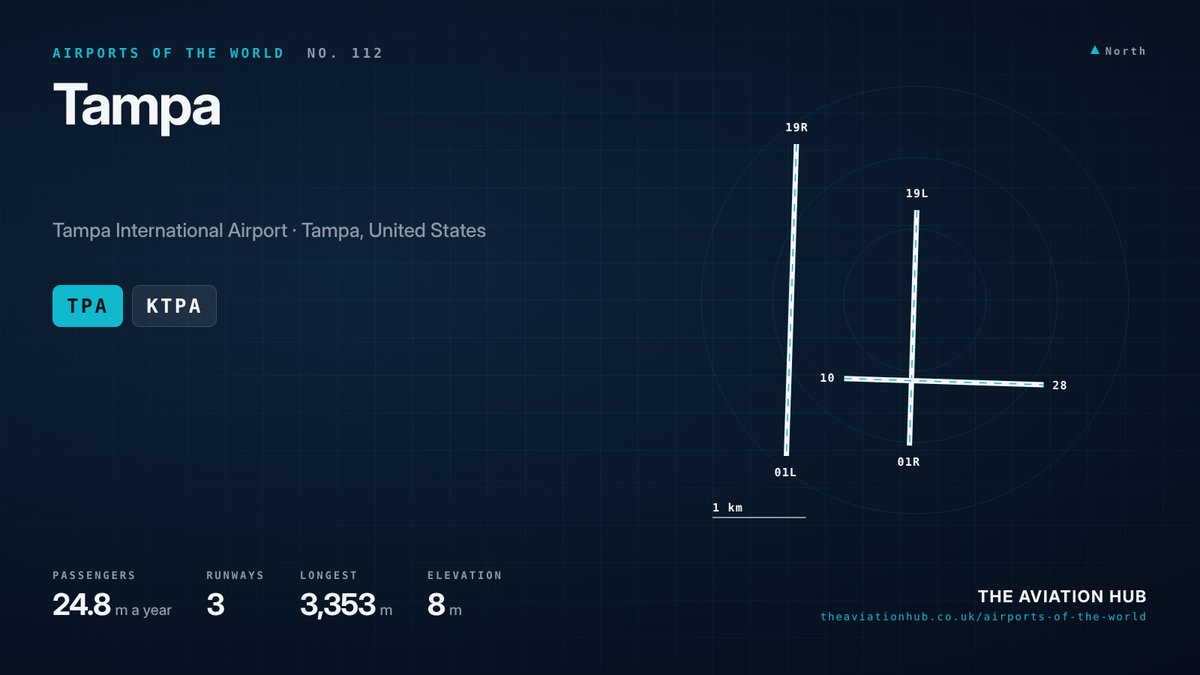
Tampa International Airport serves the west coast of Florida and the fast growing Tampa Bay region, home to more than three million people. It opened in 1928 as Drew Field and in 1971 unveiled a terminal design that changed airport architecture everywhere, with a central landside building linked by automated trains to separate airside satellites. Tampa Airport handled around 24.8 million passengers in 2025 and is regularly rated among the best airports in North America by its passengers. A new Airside D is under construction to carry it towards 35 million.
Tampa Airport at a Glance
The codes are TPA and KTPA. The airport sits about 6 miles (10 km) west of downtown Tampa, beside Old Tampa Bay, at an elevation of 8 m (26 ft). Three runways serve a single landside terminal and four active airsides, lettered A, C, E and F, with 59 gates in total. A SkyConnect train links the terminal to a rental car centre and economy parking.
In 2025 Tampa Airport handled around 24.8 million passengers, roughly level with the year before. Southwest is the largest carrier with about a quarter of the market, followed by Delta, American, United and Frontier. Breeze Airways and Frontier both base aircraft here. The Hillsborough County Aviation Authority owns and runs the field. Flight status, parking and the SkyConnect timetable are on the airport’s official website.
How Tampa’s Airport Came to Be
Tampa Bay has a claim on the very beginning of airline history. On 1 January 1914 Tony Jannus flew a Benoist flying boat from St Petersburg across the bay to Tampa, the first scheduled commercial flight using a heavier than air machine. The city’s airport came later. Drew Field opened on 22 February 1928 on land previously owned by the developer John H. Drew, 6 miles west of downtown.
The Army Air Forces took the field over during the Second World War and expanded it enormously, before handing it back to the city after the war. Trans Canada Airlines began international flights in 1950 and the airport was renamed Tampa International that year. A 1952 terminal served through the propeller era and the first jets.
The turning point came on 15 April 1971, when the Landside/Airside terminal opened. It separated ticketing and baggage from boarding and connected them with driverless people movers, the first fully automated system at any airport. Colour coded red and blue signage, another innovation, told passengers which side of the terminal to use. The 1972 control tower was the tallest in the United States at the time. The concept was copied around the world and remains the template for the airport today.
Runways at Tampa Airport
Tampa Airport has three runways. The two parallel runways run roughly north to south. Runway 19R/01L is the longest at 3,353 m (11,002 ft), with a concrete surface, and it handles the heaviest departures including the transatlantic flights. Runway 19L/01R is 2,530 m (8,300 ft) long with an asphalt surface. The crosswind runway 10/28 is 2,133 m (6,999 ft) long. All three are 46 m wide.
The parallel runways were renumbered in January 2011 because of the slow shift in magnetic variation, which is why the identifiers run 19 and 01 rather than the older 18 and 36. Northerly operations on 01L and 01R bring arrivals in over Old Tampa Bay and the Gandy Bridge. Southerly flow sends arrivals over the suburbs of Carrollwood and Town ‘n’ Country. Afternoon thunderstorms from June to September are the main operational headache, often closing the field for an hour at a time.
Terminals and Airlines
The landside terminal holds check in, baggage claim, shops and the main hall, with each airside reached by its own pair of shuttle trains. Airside A, with 16 gates, serves JetBlue, United, Breeze and Sun Country. Airside C, also 16 gates, is home to Southwest along with Alaska and Avelo. Airside E, with 13 gates, hosts Delta, Air Canada and Frontier.
Airside F, with 14 gates, is the international pier and holds the customs and immigration facility. American is the largest tenant, joined by Virgin Atlantic to London Heathrow and British Airways, which switches its London flights from Gatwick to Heathrow from 25 October 2026. Edelweiss, Discover, Aeromexico, Avianca, Copa, Cayman Airways, Porter and WestJet complete the roster. Airsides B and D were demolished years ago, and the new Airside D will rise on the site of the latter. Lounges include the Delta Sky Club and the Admirals Club.
Routes and Destinations
Tampa Airport serves around 100 nonstop destinations across North America, the Caribbean, South America and Europe. Atlanta was the busiest route in the year to May 2026 with about 992,000 passengers, far ahead of Charlotte with about 479,000 and Denver with about 478,000. Chicago O’Hare and Dallas Fort Worth come next, and New York, Washington, Boston, Philadelphia and Baltimore are also busy, reflecting the stream of visitors and retirees from the northeast.
Toronto is the busiest international route with around 252,000 passengers in the year to May 2026, followed by Panama City and Frankfurt. London Heathrow and London Gatwick come next, with Virgin Atlantic and British Airways both serving the city. Mexico City, Amsterdam, Cancun, Havana, Zurich and the Cayman Islands fill out the foreign schedule. Traffic peaks between January and April, when the snowbirds and spring break crowds arrive, and dips in the humid late summer. Cargo is modest, with UPS and FedEx the main operators.
Getting to and from Tampa Airport
Tampa has no rail link, and the region’s public transport is thin. The cheapest sensible option is the Hillsborough Area Regional Transit bus, which serves a stop beside the rental car centre along with Pinellas Suncoast Transit routes to St Petersburg. Passengers take the free SkyConnect train from the main terminal to reach it. Fares are a few dollars and journeys into downtown take around 30 to 40 minutes.
Most people drive or take a taxi. The airport connects to Interstate 275 and the Veterans Expressway, with downtown around 15 minutes away and St Petersburg about 30 minutes across the Howard Frankland Bridge. A taxi or ride hailing trip to downtown costs around USD 25 to 30 (about £19 to £23). Short term and long term garages sit beside the terminal, and the rental car centre has space for 5,300 vehicles.
Spotting and Photography
Tampa Airport is an easy and pleasant spotting location. The top levels of the terminal garages give views across the airsides and both parallel runways, and the airside satellites themselves have large windows close to the aircraft. The British Airways, Virgin Atlantic and Discover wide bodies on Airside F are the highlights.
Outside the fence, the best known spot is Cypress Point Park on Old Tampa Bay, south of the field, which catches arrivals on 01L over the water. North of the field, a dead end off West Hillsborough Avenue gives views of arrivals on 19R. Morning light suits the eastern side of the field and afternoon light the west. Police are used to spotters but will move anyone parked on the hard shoulder, so use the parks and public lots.
What Comes Next
Airside D is the big project. Ground was broken in December 2024 in the northwest corner of the field, and the 16 gate pier will handle both domestic and international flights when it opens around 2028. Delta was named anchor tenant in February 2025 and will operate one of two lounges. The authority says the expansion supports growth to 35 million passengers a year by 2037.
The original Innovia people mover cars are being replaced, and land south of the rental car centre is reserved for a future light or commuter rail station if the region ever builds one. The verdict is that Tampa Airport has managed its growth more gracefully than most American fields and has a clear plan for the next decade. Compare it with Florida’s other gateways on the Airports of the World map.
Continue to follow The Aviation Hub for more analysis and insight.
Advertise with us Your brand, in front of an aviation audience Home page and in-article placements, sold directly, one advertiser per slot. From £250 a year. See the rates

