
Tehran Mehrabad Airport Guide: Iran’s Domestic Powerhouse
Tehran Mehrabad Airport is the busiest airport in Iran and a domestic hub for more than 20 airlines. Read about its runways, terminals, history and metro link.
 By The Aviation Hub
7 min read
Updated October 20, 2026
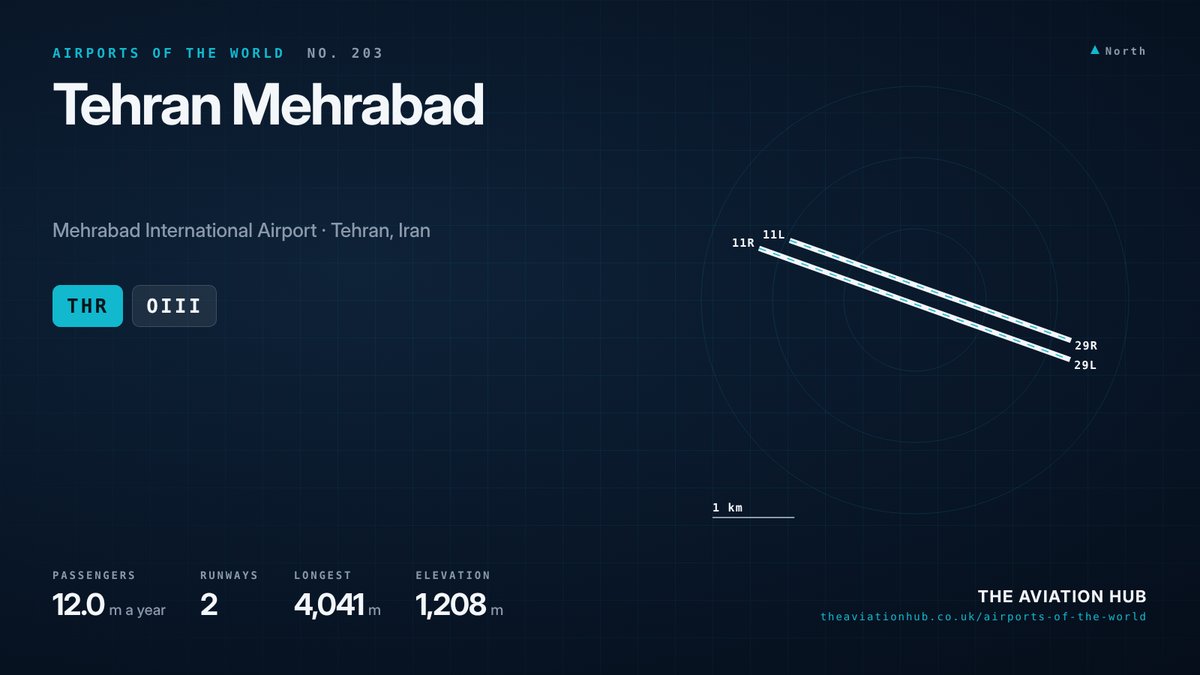
Mehrabad International Airport sits inside the western suburbs of Tehran, one of the few capital city airports still surrounded by housing on three sides. It has not seen a scheduled international flight since 2008, yet it remains the busiest airport in Iran by passengers and movements. Tehran Mehrabad Airport is the domestic hub for Iran Air, Mahan Air and a crowd of smaller carriers, and it handles around 12 million passengers a year. Its two long runways, its 1950s terminal and its turbulent history make it one of the most interesting fields in the Middle East.
Tehran Mehrabad Airport at a Glance
The codes are THR and OIII. The field lies about 6 miles (10 km) west of central Tehran beside the Azadi Tower, which is the first landmark most arriving passengers see. Elevation is 3,962 ft (1,208 m), high enough to affect take off performance on hot summer afternoons. The Alborz mountains rise sharply to the north and shape every approach.
Tehran Mehrabad Airport has two parallel runways and three passenger terminals in use, numbered 1, 2 and 4, plus the Terminal 6 arrivals hall. Traffic peaked at roughly 17.5 million passengers in 2017 before sanctions and the pandemic cut it back. The most recent full year reported around 12.3 million. Iran Air is the largest operator, and the state owned Iran Airports Company runs the site. Flight information appears on the airport’s official website.
How Mehrabad Came to Be
The site began as an army base for the first armoured units of the Imperial Iranian Army in the 1930s. Flying started in 1938 when the Iranian aviation club moved its light aircraft there, and the airfield grew through the Second World War under Allied occupation. Terminal 1 at Tehran Mehrabad Airport opened in 1955 and still stands as a registered national monument.
Terminal 2 arrived in 1977 at the height of the oil boom, when Pan Am, Lufthansa and British Airways all served Tehran. The revolution changed everything in February 1979. The military briefly seized the airport to block Ayatollah Khomeini’s return, then stood aside as his chartered Air France Boeing 747 landed to a crowd of millions. Iraqi aircraft bombed the field in September 1980 on the first day of the war between the two countries.
Terminal 4 opened in 2007. International flights moved in stages to the new Imam Khomeini International Airport south of the city, which opened in 2004. Mehrabad became a purely domestic field once the transfer ended in 2008. A 2019 plan to shift domestic flights to Imam Khomeini as well collapsed after public protests, and the old airport carried on.
Runways at Tehran Mehrabad Airport
Runway 11R/29L is the longer of the pair at 4,041 m (13,258 ft) and 60 m wide, with an asphalt surface. Runway 11L/29R runs beside it at 3,989 m (13,087 ft) and 45 m wide. Both are long because the field sits more than a kilometre above sea level, where thin air stretches take off runs, and because the Iranian Air Force shares the site with heavy transports.
The prevailing westerly wind puts most operations on the 29 runways, with arrivals crossing the city from the east just south of Azadi Square. Easterly operations on 11L and 11R bring arrivals in over the western suburbs and send departures out over the city. The two strips sit close together, so Tehran Mehrabad Airport runs them as a dependent pair rather than as fully independent parallels.
Those runways have seen too many accidents. A collision in 1993 between an Iran Air Tours Tupolev Tu-154 and an Air Force Sukhoi Su-24 killed 133 people. A C-130 crashed into a block of flats after take off in 2005, killing 106. Sepahan Airlines Flight 5915, an Antonov An-140, fell into a residential street after an engine failure in August 2014.
Terminals and Airlines
Terminal 1 is the 1955 original and now houses the smaller carriers, including Kish Air, Zagros Airlines, Varesh Airlines and Chabahar Airlines. Terminal 2 next door is the busiest building and the home of Iran Air, Iran Airtour, Qeshm Air, Karun Airlines, ATA Airlines and Meraj Airlines. The two share a single landside forecourt and a metro station.
Terminal 4 stands further west and belongs to Mahan Air, the largest private airline in Iran, alongside Iran Aseman Airlines, Caspian Airlines, Taban Air, Saha Airlines, Sepehran, Yazd Airways and Pouya Air. Terminal 6 opened in 2012 as a dedicated arrivals hall for Terminal 4 flights. A former Terminal 3 for Hajj pilgrims and a Terminal 5 cargo building both lost their roles when Imam Khomeini opened.
The fleet mix is unlike anywhere else. Sanctions have kept Iranian airlines flying elderly Airbus A300s, A310s, Boeing 747s, McDonnell Douglas MD-80s and Fokker 100s long after they vanished elsewhere. Mahan Air operates Airbus A340s, and Iran Air flies a handful of Airbus A320 family jets and ATR 72-600s delivered under the 2016 nuclear deal.
Routes and Destinations
Tehran Mehrabad Airport links the capital with around 60 destinations across Iran on more than 20 airlines. The busiest routes run to Mashhad, the pilgrimage city in the north east, and to Shiraz, Isfahan, Tabriz, Ahvaz and Bandar Abbas. Kish Island and Qeshm Island draw heavy leisure traffic in winter. Dozens of smaller cities, from Bojnord to Jask to Yasuj, rely on the field for their only air link.
There are no scheduled international routes, although the occasional charter or state flight still uses the field. The longest regular sectors reach Chabahar and Saravan near the Pakistan border, around 860 to 890 miles (1,390 to 1,430 km) to the south east. Traffic surges around Nowruz in late March and during the summer holidays. Cargo volumes once topped 120,000 tonnes a year but have fallen with the move of freight to Imam Khomeini.
Getting to and from Tehran Mehrabad Airport
Line 4 of the Tehran Metro serves the field with two stations, Mehrabad Airport Terminals 1 and 2 and Mehrabad Airport Terminals 4 and 6. Trains run towards Azadi Square and on through the city centre, with a journey of around 25 minutes to Ferdowsi. The fare is a few thousand rials, which is the cheapest way in by a wide margin.
The Makhsus Karaj Expressway and the Tehran Karaj motorway pass the northern boundary, and the Western Bus Terminal stands beside Azadi Tower within walking distance of Terminals 1 and 2. Taxis use a fixed rate system from ranks outside each terminal, and Snapp, the local ride hailing app, is cheaper still. Driving to the city centre takes 20 minutes at quiet times and well over an hour in rush hour.
Spotting and Photography
Tehran Mehrabad Airport is a tempting target for enthusiasts because of its vintage fleet, but it demands care. Photography of airports and military sites is sensitive in Iran, and the Air Force areas of the field are strictly off limits. The departure lounges of Terminals 2 and 4 look out over the aprons and give the safest views of the A300s, MD-80s and Fokkers.
Arrivals on the 29 runways pass low just south of Azadi Square, where the Azadi Tower makes a famous backdrop in the late afternoon light. For most of the day the sun sits to the south of the runways. In winter, snow on the Alborz adds a dramatic skyline behind aircraft on short final.
Keep cameras away from the perimeter fence, avoid long lenses in public streets and respect any police request. The reward is a fleet that no other airport in the world can offer.
What Comes Next
A seventh terminal with twenty gates was announced in 2015 but never started, and the plan has drifted. The real question is whether Mehrabad survives at all. Planners have argued for decades that a city centre airport with two long runways should give way to housing and parkland, with all flights moved to Imam Khomeini. Public opposition and the convenience of the metro link have kept it open.
The war of June 2025 and the Israeli strikes of 2026 damaged the military side of the field and closed it for periods, and recovery depends on politics as much as on aviation. Airline growth is capped by sanctions and the age of the fleet.
Tehran Mehrabad Airport will stay the domestic heart of Iranian aviation for as long as the government allows it. Compare it with Imam Khomeini and the rest of the region on the Airports of the World map.
Continue to follow The Aviation Hub for more analysis and insight.
Advertise with us Your brand, in front of an aviation audience Home page and in-article placements, sold directly, one advertiser per slot. From £250 a year. See the rates

