
Tel Aviv Airport Guide: Inside Ben Gurion’s Fortress Hub
Tel Aviv Airport, officially Ben Gurion International, is Israel's main gateway. Runways, terminals, El Al routes, rail access and spotting explained.
 By The Aviation Hub
6 min read
Updated October 20, 2026
Ben Gurion International Airport is Israel’s principal gateway and one of the most heavily guarded civil airfields in the world. It lies on flat farmland between the towns of Lod and Or Yehuda, south east of the city it serves. Most travellers simply call it Tel Aviv Airport, and it handled close to 25 million passengers at its 2019 peak. For El Al and a growing crowd of foreign carriers it is the single point of entry to a country with no useful land borders for aviation.
Tel Aviv Airport at a Glance
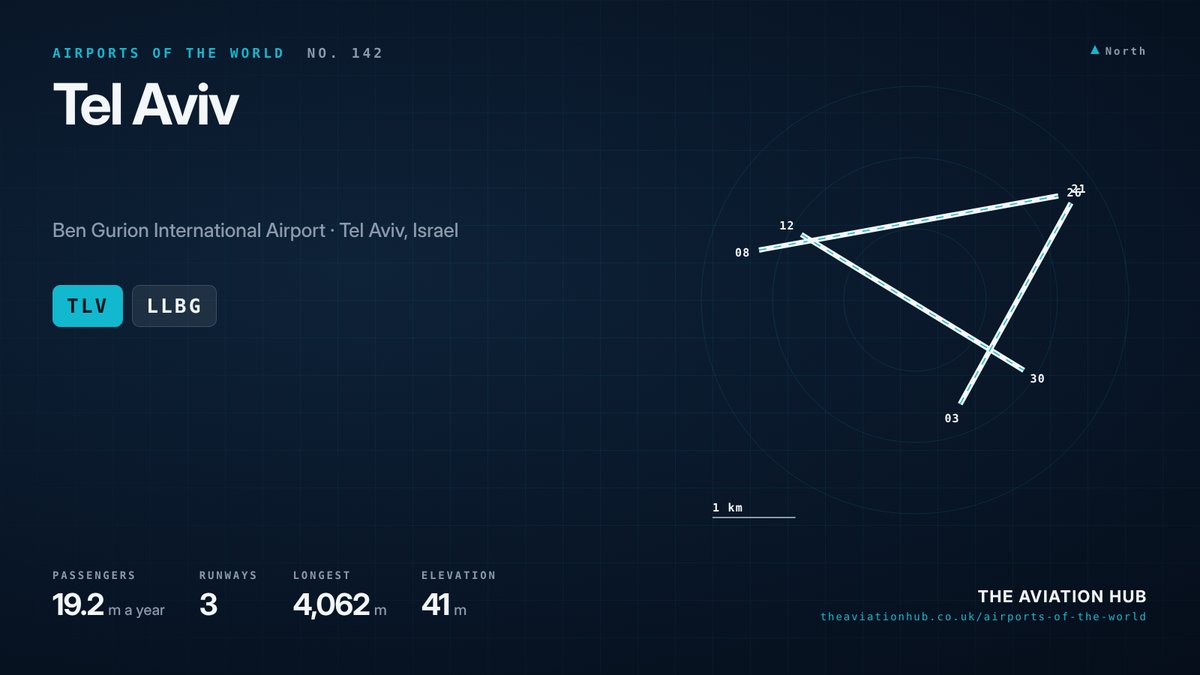
The IATA code is TLV and the ICAO code is LLBG. The field sits about 12 miles (19 km) south east of central Tel Aviv and some 28 miles (45 km) from Jerusalem, at an elevation of just 41 m (135 ft). There are three runways and two working passenger terminals. Terminal 3 handles almost all scheduled international flights, while Terminal 1 takes domestic, low cost and charter traffic.
Tel Aviv Airport handled roughly 19.2 million passengers in 2025 across around 141,000 aircraft movements, well below the record of about 24.8 million set in 2019. Regional conflict has cut foreign airline capacity repeatedly since late 2023. El Al is the dominant home carrier, with Israir, Arkia and Sundor also based here. The Israel Airports Authority, a state body, owns and runs the site, and publishes flight and security information on the airport’s official website.
How Tel Aviv’s Airport Came to Be
The British built an airstrip here in 1934, during the Mandate period, beside the Templer colony of Wilhelma. The first scheduled passenger service came on 3 August 1935, a route from Cairo through Lydda to Nicosia. The Royal Air Force expanded the field during the Second World War, and it passed to the new state of Israel in 1948 as Lod Airport.
The name changed in 1973 to honour David Ben Gurion, Israel’s first prime minister, who died that year. The 1970s also brought the airport’s darkest moments. In May 1972 Israeli commandos stormed a hijacked Sabena Boeing 707 on the apron, and three weeks later gunmen killed 24 people in the terminal in the Lod Airport massacre. Those events shaped the layered security regime that still defines the passenger experience today.
The modern era began with Terminal 3, which opened in 2004 and replaced the cramped old Terminal 1 as the international gateway. Concourse E followed in 2018. Terminal 2, a small domestic building, was demolished once domestic flights moved into Terminal 1. Runway extensions completed in 2014 gave the airfield the capacity it needed for the traffic boom of the late 2010s.
Runways at Tel Aviv Airport
Tel Aviv Airport has three asphalt runways arranged in an open V pattern. The longest is 08/26 at 4,062 m (13,327 ft), known locally as the quiet runway because take offs from it disturb fewer homes. It is the main departure runway. Runway 12/30 is 3,112 m (10,209 ft) long and sits closest to the terminals, so it takes most landings.
The third runway, 03/21, is the short one at 2,772 m (9,094 ft) but is unusually wide at 60 m. The 2014 extension works allowed arrivals on one runway and departures on another at the same time, which lifted hourly capacity considerably. Approaches to runway 12 bring aircraft in low over the coastal plain, and the final turn gives passengers a good look at the Tel Aviv skyline on clear days.
Terminals and Airlines
Terminal 3 is the main event at Tel Aviv Airport. It has 40 gates across four concourses, including the large Concourse E added in 2018, and a landmark central rotunda with a fountain. El Al operates its hub here with the King David Lounge. Star Alliance carriers share a dedicated check in area, and most European flag carriers, United, Delta and American use Terminal 3 when they are flying. Etihad began six daily flights to Abu Dhabi on 15 June 2026, making Tel Aviv its most frequent route.
Terminal 1 reopened in 2007, was opened to all low cost carriers in 2015 and now handles low cost and charter airlines and the domestic flights to Eilat. It is a cheaper building to use, which is why the low cost airlines prefer it, though passengers must still clear the same security screening. A free shuttle bus links the two terminals, which are a short distance apart.
Routes and Destinations
Greece, the United States and the United Arab Emirates have been the top countries by passenger numbers in recent years. Athens is a key short haul route, served by El Al, Aegean and several low cost carriers. New York JFK and Newark are the busiest long haul routes, with El Al running multiple daily Boeing 787-9 flights. The Abu Dhabi link grew fast after the Abraham Accords, carrying roughly 100,000 passengers in the first quarter of 2026 alone.
El Al’s longest regular service is Los Angeles, and Melbourne and Tokyo are among the routes it has announced in recent years. Summer is the peak season as Israelis head for the Greek islands and Cyprus, while winter traffic is lighter. Cargo is modest but important for perishables, electronics and pharmaceuticals, with a dedicated freight area.
Getting to and from Tel Aviv Airport
The railway is the cheapest and fastest way to reach Tel Aviv Airport. Israel Railways has a station beneath Terminal 3, with trains to Tel Aviv Savidor in about 18 minutes and to Jerusalem Navon in around 25 minutes on the high speed line. A single ticket to the city costs under NIS 20 (about £4). Trains do not run from Friday afternoon until Saturday evening, or on Jewish holidays, so check the Shabbat timetable before relying on it.
Buses fill the gap. Afikim route 485 runs to Jerusalem around the clock, and shared taxis known as monit sherut depart when full. Regular taxis wait outside arrivals, with the run to central Tel Aviv taking 25 to 40 minutes and costing roughly NIS 150 to 200 (about £32 to £43). The airport sits beside Highways 1 and 40, and there are thousands of parking spaces across short stay, long stay and covered car parks.
Spotting and Photography
Photography around the perimeter of Tel Aviv Airport is restricted, and security staff take an interest in anyone with a long lens near the fence. The practical choice is to shoot from inside Terminal 3, where the large windows of the departure concourses look out across the apron and the taxiways. The gate areas give views of the El Al fleet, including the 787s and the remaining Boeing 777-200ERs.
Most arrivals land on runway 12 after crossing the coast and southern Tel Aviv, and most departures use runway 26 towards the sea. Do not photograph military aircraft, security installations or the many foreign air force tankers that have been parked on the field since early 2026. Be polite, keep passports to hand and expect questions, as the rules here are stricter than at most airports.
What Comes Next
A NIS 9 billion (about £1.9 billion) expansion plan announced in 2017 covers a larger Terminal 1, a bigger Terminal 3, a new Concourse A, a domestic terminal and relocated cargo facilities. A new motorway interchange began construction in late 2021. Progress has been slowed by the pandemic and by war, with the airport closed entirely for eleven days in June 2025 and hit by a Houthi missile in May 2025 and an Iranian missile in March 2026.
Tel Aviv Airport will recover its 2019 highs only when foreign carriers feel safe enough to return in numbers. The infrastructure is ready for far more passengers; the geopolitics is not. See how it compares with other gateways on our Airports of the World map.
Continue to follow The Aviation Hub for more analysis and insight.
Advertise with us Your brand, in front of an aviation audience Home page and in-article placements, sold directly, one advertiser per slot. From £250 a year. See the rates

