
Tenerife North Airport Guide: Los Rodeos After the Fog
Tenerife North Airport, the old Los Rodeos, now handles over seven million passengers a year. Read about its runway, history, Binter routes and buses.
 By The Aviation Hub
6 min read
Updated October 20, 2026
Tenerife North Airport, officially Tenerife North Ciudad de La Laguna, is the island’s original airport and the gateway for inter island flights and mainland Spain. It sits on a high plateau above Santa Cruz, at La Laguna, and is still widely known by its old name, Los Rodeos. A record of more than 7.1 million passengers used it in 2025. For most aviation readers, though, it will always be the site of the deadliest accident in aviation history.
Tenerife North Airport at a Glance
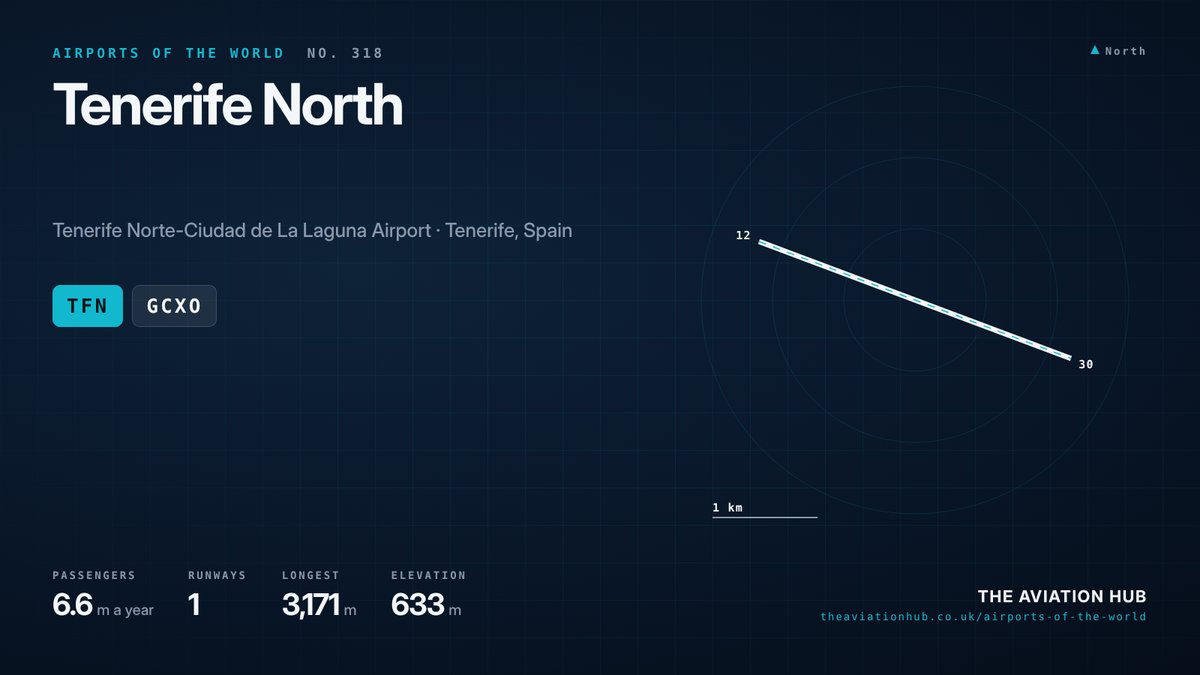
The IATA code is TFN and the ICAO code is GCXO. The terminal lies in San Cristobal de La Laguna, about 7 miles (11 km) from Santa Cruz de Tenerife. Elevation is 2,076 feet (633 m), high enough to sit inside the cloud layer that the trade winds push against the island. There is one runway and one terminal. Aena, the Spanish state airport operator, runs the site.
Tenerife North Airport handled 7,174,977 passengers in 2025, well above the 6.12 million recorded in 2023. Together with Tenerife South, it gave the island more than 21 million passengers that year. Binter Canarias is the dominant airline, linking the airport with every other Canary island and a growing list of mainland and international cities. Flight information is on the airport’s official website.
How Los Rodeos Came to Be
The Los Rodeos plain was first used for an unofficial Deutsche Luft Hansa flight from Berlin by an Arado V I, before any proper airport existed. In May 1930, C.L.A.S.S.A. opened the first air link between mainland Spain and the Canaries with a Ford Trimotor from Getafe. Operations resumed on 23 January 1941 with an Iberia Dragon Rapide from Gran Canaria.
By 1946 the airport had hangars, a terminal and an 800 m paved runway, and opened officially to national and international traffic. The runway reached 2,400 m in 1953, when lighting allowed night flights, and 3,000 m by 1964 for the Douglas DC-8. In 1971 it was strengthened and fitted with an instrument landing system ahead of Boeing 747 operations.
Then came 27 March 1977. In thick fog, KLM Flight 4805 began its takeoff roll and struck Pan Am Flight 1736, which was still taxiing on the runway. Both Boeing 747s had diverted from Gran Canaria after a bomb there. The collision killed 583 people, and 61 aboard the Pan Am jet survived. Tenerife South opened in November 1978, and international flights left Los Rodeos until a new terminal opened in 2002.
Runways at Tenerife North Airport
Tenerife North Airport has a single asphalt runway, 12/30, measuring 3,171 m (10,404 ft) by 45 m. Its length reflects the jet age ambitions of the 1960s and 1970s, when DC-8s and 747s were expected. Today the runway mostly handles ATR 72 turboprops, Embraer E195-E2s and Airbus A320 and Boeing 737 family jets.
Weather is the defining factor. At 633 m, the plateau often fills with cloud and fog, and visibility can collapse within minutes. The trade winds and the cloud base decide which runway direction is in use. The terrain is unforgiving too: in 1972 Spantax Flight 275 crashed on takeoff, and in 1980 Dan Air Flight 1008, a Boeing 727, flew into high ground near the airport, killing all 146 people aboard. Modern instrument systems and procedures have transformed safety since then.
Terminals and Airlines
The terminal that opened in 2002 is a four storey building with 12 gates, a car park and direct motorway access ramps. A dedicated inter island area followed in 2005, separating short hops to La Palma and El Hierro from flights to the mainland. The layout is compact, and most passengers walk only a short distance from check in to the gate.
Binter Canarias is the backbone, flying ATR 72-600s on inter island routes and Embraer E195-E2s to mainland Spain and international points. Its network now reaches Madrid, Funchal and Ponta Delgada. Iberia Express, Air Europa and Vueling connect Tenerife North Airport with Madrid, Barcelona and other Spanish cities, and TUI fly Deutschland links it with Dusseldorf and Frankfurt. Canaryfly fills in inter island gaps.
Routes and Destinations
Madrid is the busiest route from Tenerife North Airport, with about 1.41 million passengers in 2023. Gran Canaria followed with about 900,000, as Binter runs a shuttle style service between the two island capitals throughout the day. La Palma and Barcelona come next, ahead of Lanzarote, Fuerteventura and Seville. Business travellers, government staff and residents make up much of the demand, so traffic is steadier year round than at the resort airport in the south.
Long haul flying has come and gone. Air Europa flew Airbus A330s to Miami in 2009 and 2010, and Santa Barbara Airlines moved its Caracas service here in 2003, running it until 2014. Plus Ultra took up the Caracas route in 2018, and at about 3,490 miles (5,620 km) it is the longest flight, reflecting the deep family ties between the Canaries and Venezuela. Cargo is modest, at about 12,900 tonnes in 2025.
Getting to and from Tenerife North Airport
TITSA buses serve the terminal on routes 20, 30, 103 and 343, connecting with Santa Cruz, La Laguna, Puerto de la Cruz and other parts of the island. Fares are cheap, especially with a Ten+ travel card, and the ride to Santa Cruz takes around 20 to 30 minutes. Buses are the cheapest sensible option for anyone without a car.
The Tenerife tram ends in La Laguna, a short bus or taxi ride from the terminal, so it is useful for reaching central Santa Cruz without traffic. By road, the airport sits beside the TF-5 motorway. A taxi to Santa Cruz takes about 15 minutes and costs roughly €20 to €25 (£17 to £22). Car hire desks fill the arrivals hall, and parking is next to the terminal.
Spotting and Photography
The plateau around Tenerife North Airport offers open views across fields and low hills, with the volcanic ridge of Anaga to the east and Teide sometimes visible above the cloud. Roads near both ends of the runway give approach shots, and the elevation means aircraft often appear out of the mist with little warning. Clear mornings bring the best light and the sharpest views.
The Mesa Mota hill in La Laguna holds the international memorial to the 1977 disaster, a spiral staircase sculpture opened on the 30th anniversary in 2007. It is a place for reflection, not a spotting position. The traffic is mostly Binter, with mainland jets in between. Stay on public roads, park responsibly in narrow streets and keep away from the airport fence.
What Comes Next
Tenerife North Airport is busier than ever, and the terminal that opened in 2002 is showing its age. Aena’s investment programme for the Canary Islands includes improvements here, while the island’s wider debate centres on capacity at Tenerife South and on tourism limits. The runway itself has plenty of capacity, so growth depends on the terminal and on airline demand.
Binter’s expansion is the main growth story, adding mainland and international routes with its Embraer jets. Fog will always make the airport less predictable than the south. The verdict: a busy, practical city airport for residents and business travellers, with a history that makes it unlike any other. Compare it with Tenerife South on our Airports of the World map.
Continue to follow The Aviation Hub for more analysis and insight.
Advertise with us Your brand, in front of an aviation audience Home page and in-article placements, sold directly, one advertiser per slot. From £250 a year. See the rates

