
Inflight fires are rising fast. We examine whether a lithium battery ban in the cabin would improve safety, or simply move the risk into the hold.
On 21 August 2026, an American Airlines Airbus A321 was roughly thirty minutes from Dallas Fort Worth when a passenger’s laptop began to smoke. Moments later it was burning in the aisle.
Cabin crew had it inside a thermal containment bag within about five minutes, the flight crew declared an emergency, and flight 2398 landed safely with 133 people aboard.
One passenger was treated for burns at the gate.
That is the version of this story the industry has grown used to. What the lithium battery is doing in the cabin.
Training works, containment bags work, the aircraft lands.
Yet airlines and regulators have spent the past two years tearing up their rulebooks anyway, and the reason is straightforward.
The distance between a contained laptop fire and a destroyed aircraft is far shorter than the injury statistics imply.
Which brings us to the question that resurfaces every time footage of flames in an overhead bin goes round the internet.
Should airlines simply ban lithium batteries from the cabin?
The Incidents That Changed the Conversation On A Lithium Battery Ban
The case that made everyone sit up regarding a lithium battery incident happened on the ground.
On 28 January 2025 an Air Busan Airbus A321 was preparing to leave Gimhae for Hong Kong when fire broke out in a rear overhead bin.
All 176 occupants escaped down the slides. The aircraft did not survive.
South Korea’s National Forensic Service later traced the blaze to an insulation breakdown inside a power bank stowed above row 30, and specifically ruled out the aircraft’s own wiring and lighting.
Nine months later the same failure happened in the air.
Air China flight CA139, an A321 running Hangzhou to Incheon, diverted to Shanghai Pudong on 18 October 2025 after a battery in a passenger’s bag ignited in an overhead locker.
Video showed flames climbing out of the compartment while crew fought them with extinguishers.
Nobody was hurt.
Australia had its own version that July, when a power bank caught fire in an overhead locker on Virgin Australia flight VA1528 during the descent into Hobart.
Crew put it out before landing. One passenger was assessed for smoke inhalation.
The pattern has carried into 2026.
An Alaska Airlines service from Wichita to Seattle turned back on 22 February after a passenger’s portable charger caught fire.
Then came the American Airlines laptop in August.
Four aircraft, four continents, one failure mode with the lithium battery.
The Numbers Are Climbing, and So Is the Reporting

The FAA has tracked these lithium battery events since 2006 and the trend is not subtle.
The agency logged 97 verified incidents involving smoke, fire or extreme heat in 2025, up from 89 the year before, and by late April 2026 its running total since 2006 had passed 717.
Nearly four in ten of those involved portable battery packs.
UK figures point the same way.
The Civil Aviation Authority now calls lithium battery fire the number one safety risk to aircraft.
Reports of passenger devices overheating or malfunctioning rose from 123 in 2024 to 206 in 2025.
Detections of lithium devices powered by a battery wrongly packed into hold bags climbed 91 percent over the same period, from 316 to 643.
The regulator reckons the average passenger now boards with four lithium powered items.
A caveat belongs here. Part of that rise reflects better reporting rather than more fires.
Crews recognise lithium battery fires faster than they did five years ago, and every diversion now generates a paperwork trail.
Even allowing for that, the underlying device count is going one way.
Why the Cabin Is Exactly Where Regulators Want Them
Here is the awkward truth for anyone calling for a cabin ban on the lithium battery.
Every serious safety authority has already reached the opposite conclusion.
Spare lithium batteries and power banks are forbidden from checked baggage worldwide, and that prohibition exists precisely because the hold is the worse option.
The FAA’s position is that a battery fire in the cabin can be dealt with by crew and passengers.
Nobody can do anything about one in the hold.
Halon suppression in a lower deck compartment knocks down flame.
It does not stop thermal runaway, which is a self sustaining reaction that keeps generating its own heat regardless of what is sprayed at it.
The FAA points to large volumes of water as the effective response.
There is no water in the hold, and there is nobody down there to notice in the first place.
That is why the CAA spent its summer campaign telling passengers to bring batteries into the cabin rather than keep them out.
An easyJet flight from Hurghada diverted to Rome in May 2026 for no reason other than a passenger mentioning in the cruise that their power bank was in a checked bag.
The crew treated that as an emergency, because it was one.
The Case for a Lithium Battery Ban Is Not Frivolous
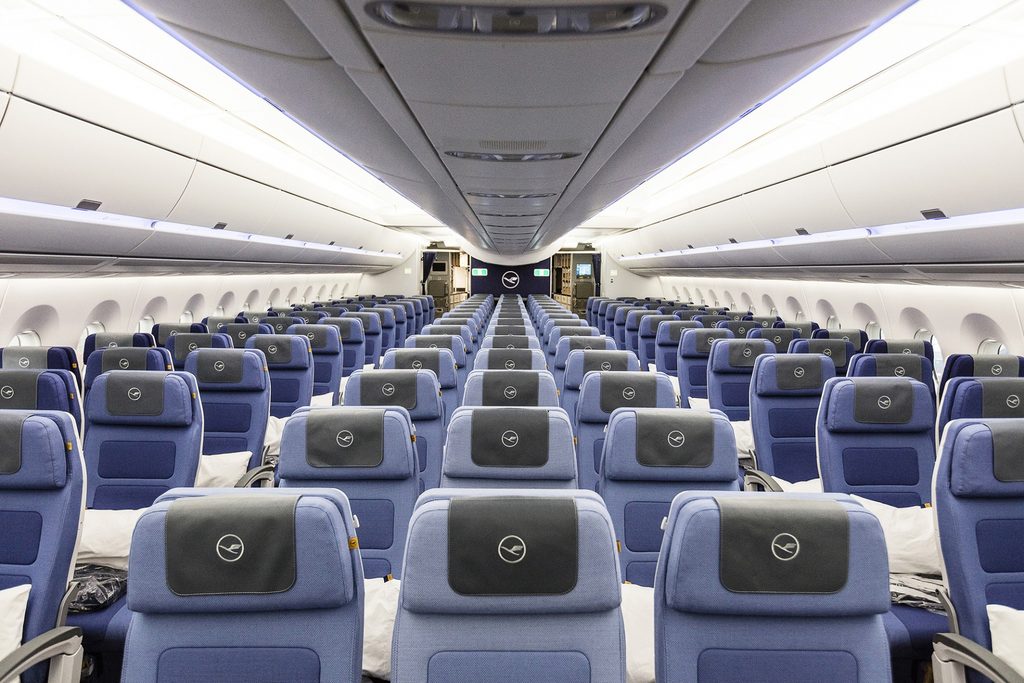
Air Busan remains the strongest argument the ban camp has on the lithium battery.
One consumer power bank, stowed out of sight in a locker, wrote off an A321 in minutes.
Had that fire started at top of climb rather than at the gate, the outcome does not bear thinking about.
No amount of crew training changes the arithmetic of a fire in a sealed tube at cruise.
There is also an enforcement problem nobody has solved. Airlines cannot see inside a passenger’s bag.
They cannot verify that a power bank bought through an online marketplace was ever tested to UN 38.3, and substandard cells are freely available.
Rules that rely on passengers declaring their own dangerous goods are rules that rely on trust.
Crews are absorbing the consequences.
Two events a week in the UK alone means cabin crew now function as a fire response team for a hazard the passenger brought aboard.
What a Ban Would Actually Mean
Then reality intrudes.
A cabin ban on the lithium battery is a ban on phones, laptops, tablets, cameras, headphones, watches, hearing aids, insulin pumps and glucose monitors.
It also bans the electronic flight bags on the flight deck and the crew’s own equipment.
The industry has tested a partial version of this before.
In 2017 the United States and the United Kingdom barred large electronics from the cabin on certain routes, and EASA warned almost immediately that pushing devices into the hold traded one risk for a worse one. The policy lasted months.
Move the batteries below deck and the hazard does not disappear.
It concentrates, unsupervised, in the one compartment nobody can reach.
The Industry Picked Containment Over Prohibition
Which is the route ICAO has taken. An addendum to the Technical Instructions took effect on 27 March 2026 and, for the first time, treats power banks as a category separate from spare batteries.
Passengers are capped at two, they must travel in cabin baggage, they must be individually protected against short circuit, they must not be recharged on board, and they should not be used to charge other devices in flight.
IATA folds the same provisions into the 68th edition of its Dangerous Goods Regulations from 1 January 2027.
Several carriers moved faster. Emirates cut passengers to a single power bank and banned its use in flight from October 2025.
The Lufthansa Group banned use from January 2026. Southwest went to one unit per passenger in April 2026.
United now keeps power banks out of overhead bins entirely, which is the direct lesson of Air Busan and CA139.
That last measure is the interesting one.
It does not remove a single battery from the cabin. It just makes sure somebody is looking at them.
The Gap Nobody Is Closing

All of this manages the lithium battery once it is aboard.
None of it touches how the battery was made.
UL Standards and Engagement found thermal runaway events in air cargo up around 40 percent since 2021 and pinned the cause on battery quality, shipper behaviour and uneven regulatory oversight rather than anything airlines control.
Aviation is being asked to absorb a consumer product safety failure at 35,000 feet.
Market surveillance of imported cells, enforcement against non compliant sellers and mandatory capacity labelling would do more for cabin safety than any further line in an airline’s conditions of carriage.
Where This Leaves Us Regarding The Lithium Battery Ban
A total ban on the lithium battery in the cabin is the wrong answer to a real problem.
It would strip passengers of the devices modern travel is built around, and it would take the one hazard crews can actually fight and hide it where they cannot.
The right answer is duller.
Fewer power banks per passenger, no charging at altitude, nothing stowed where it cannot be seen, better crew equipment, and sustained pressure on the people making and selling the cells.
Most of that is already in force or lands on 1 January 2027.
The measure worth watching is the overhead bin.
Air Busan, Air China and Virgin Australia all started the same way, inside a closed locker, out of sight. If one further restriction goes industry wide, it will be that one.
Continue to follow The Aviation Hub for more analysis and insight!