
Thessaloniki Airport Guide: Northern Greece’s Seaside Gateway
Thessaloniki Airport handled almost eight million passengers in 2025. Explore its sea runway, terminals, Aegean and Ryanair bases, routes and bus links.
 By The Aviation Hub
6 min read
Updated October 20, 2026
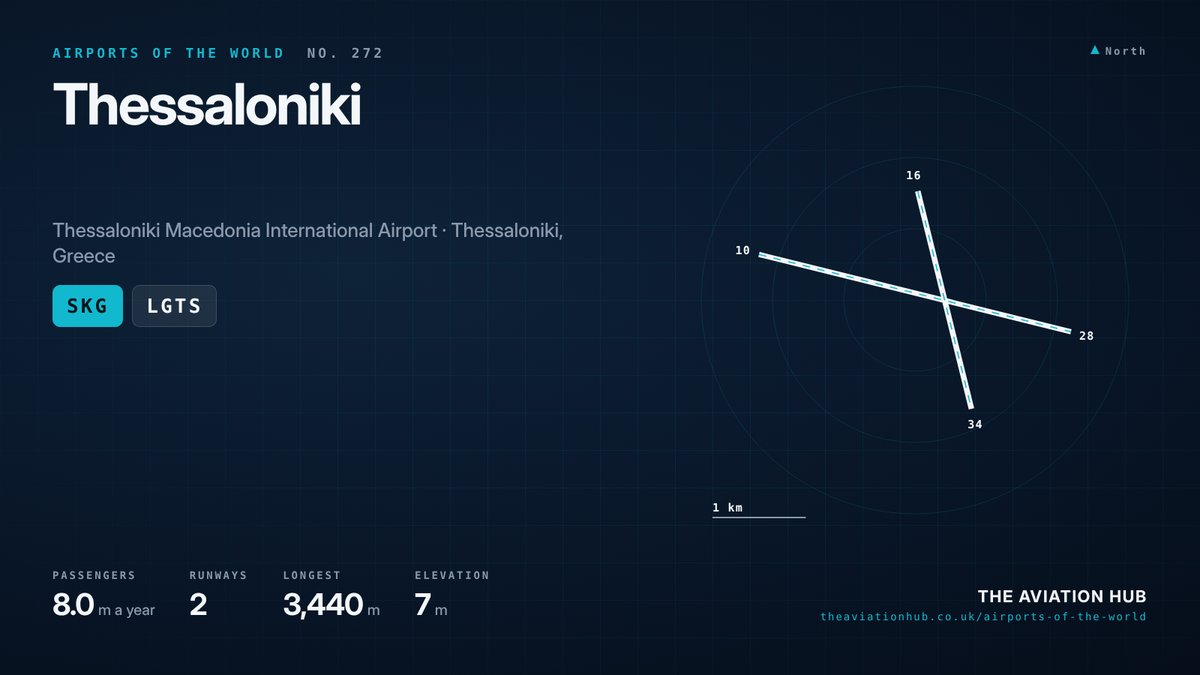
Thessaloniki Airport sits on the shore of the Thermaic Gulf at Mikra, south east of Greece’s second city. It is the main gateway to northern Greece, serving the city itself, the beaches of Chalkidiki and much of the Balkans beyond. Traffic reached almost eight million passengers in 2025, the third highest total in the country after Athens and Heraklion. A runway pushed out into the sea and a new terminal have transformed the field in recent years.
Thessaloniki Airport at a Glance
The codes are SKG for IATA and LGTS for ICAO. The airport lies roughly 8 miles (13 km) south east of the city centre, at an elevation of just 7 metres (22 feet). There are two runways and two terminal buildings, T1 and T2, joined into one complex. Its full official name is Thessaloniki Airport Makedonia, adopted in 1993.
The airport handled about 7.98 million passengers in 2025, up more than eight per cent, along with some 61,000 aircraft movements. Aegean Airlines, Olympic Air and Sky Express all treat the field as a hub, and Ryanair operates a base. The Greek state still owns the site, but Fraport Greece, a joint venture of Fraport AG and the Copelouzos Group, has run Thessaloniki Airport under a 40 year concession since April 2017. Flight information is on the airport’s official website.
A Short History of Mikra
Aircraft first used the flat ground at Mikra during the First World War, when Allied squadrons flew from here on the Macedonian front. Work on a proper civil airport began in 1938 but stopped when war returned. The field finally opened to civilian traffic in 1948, and for decades it was known simply as Mikra Airport.
The airport grew with Greek tourism and the city’s role as a trading hub for the Balkans. The 1978 Thessaloniki earthquake damaged the control tower, which was later demolished and replaced. In 1993 the field took the name Makedonia, a choice that carried political weight during the dispute with Greece’s northern neighbour over that name.
The biggest project took more than two decades. The plan to lengthen runway 10/28 dates from 1997 and works began in 2005. They were completed in March 2019 at an estimated cost of €179 million, and the extended runway entered service on 11 September 2020. Fraport then delivered the new T2 in February 2021, three months ahead of schedule.
Runways at Thessaloniki Airport
Thessaloniki Airport has two asphalt runways. The main runway, 10/28, measures 3,440 metres (11,286 feet) long and 50 metres wide, after an extension of 1,000 metres built out into the sea. It has an instrument landing system and comfortably handles wide body charters and long haul diversions. The secondary runway, 16/34, is 2,424 metres (7,953 feet) long and 60 metres wide.
Before the extension, the shorter runways at Thessaloniki Airport and the water beyond them left little margin. In August 1997 an Olympic Airways crew had to steer off the runway to avoid running into the sea, and the aircraft was written off. In 2013 an AMC Airlines Boeing 737-800 overran runway 16 by about 110 metres, without injuries. The longer 10/28 now gives jets a far bigger safety buffer.
Weather and terrain still matter. High ground rises close to the field from the north round to the south, which complicates the approach to runway 34. In December 1997 an Aerosvit Yakovlev Yak-42 strayed while approaching and crashed in the Pierian range across the gulf, killing all 70 on board. Winter fog can also disrupt operations.
Terminals and Airlines
T1 is the original three storey building at Thessaloniki Airport and now handles gates 13 to 24. Gates 13 and 14 serve domestic and Schengen flights, 15 to 18 can handle any type, and 19 to 24 serve non Schengen routes such as the UK, Turkey and Israel. T2, opened in 2021, adds 28 check in counters and gates 1 to 12 for domestic and Schengen services.
Aegean Airlines and its regional arm Olympic Air form the largest group, flying to Athens, the islands and a broad European network. Aegean is a Star Alliance member, so it connects with Lufthansa and other partners. Sky Express adds domestic and regional routes. Ryanair, easyJet, Wizz Air and Eurowings carry much of the international traffic, while Jet2.com and TUI bring British holidaymakers in summer. Ryanair has trimmed its based fleet for winter 2026.
Routes and Destinations
Athens is the backbone. The Athens to Thessaloniki route carried about 1.8 million passengers in 2016, enough to rank among the ten busiest in the European Union. Aegean, Olympic and Sky Express also link the city with Crete, Rhodes and other islands, which keeps domestic traffic strong all year.
Internationally, Germany is the largest single market after domestic flights, reflecting the large Greek community there. The UK and Cyprus follow. Summer brings a sharp peak as tourists head for Chalkidiki and the beaches of northern Greece, with seasonal links across Europe. Some travellers from North Macedonia, Bulgaria and Serbia also use Thessaloniki Airport for its wider choice of low cost flights. Cargo is modest.
Getting to and from Thessaloniki Airport
Bus is the cheapest sensible option. OASTH route 01X runs through the city centre to the main KTEL coach station, and its night version 01N keeps the service going around the clock. The journey to the centre takes 30 to 45 minutes depending on traffic. Shuttle 02X links the terminal with Nea Elvetia on Metro Line 1, and a separate shuttle of about ten minutes reaches Mikra, the terminus of Line 2.
By road the airport connects with the EO16 towards Chalkidiki and the city’s inner ring road, which in turn reaches the A1 and A2 motorways. A taxi to the centre takes around 20 to 30 minutes and typically costs €25 to €35 (roughly £21 to £30). There are about 2,285 parking spaces and a full range of car hire desks. An overground metro extension to the terminal has been proposed but not built.
Spotting and Photography
The seafront setting is the attraction. The main runway now juts into the Thermaic Gulf, so arrivals from the water pass low over the sea. A go kart track off the road towards Epanomi gives views of arrivals on runway 28, while fields and a hill towards Kardia village sit under the approach to runway 34, used when northerly winds blow. On clear days Mount Olympus can appear on the far horizon, giving Thessaloniki Airport a memorable backdrop.
Summer afternoons bring the busiest mix, with Aegean Airbus A320neos, Ryanair Boeing 737s, Sky Express turboprops and charter jets from across Europe. Low winter sun from the south can make for dramatic shots over the water. Greek authorities are sensitive about photography near airports and military areas, so stay on public ground, avoid the fence and comply immediately if police ask questions.
What Comes Next
With the runway extended and T2 open, the main capacity work is done. Fraport expected passenger traffic to rise by nearly half by 2026, and traffic grew by eight per cent in 2025. The next step would be a direct rail connection, either an overground Line 2 extension or improved shuttles from Mikra.
The concession runs until 2057, giving Fraport a long horizon to keep investing. Thessaloniki Airport looks set to pass eight million passengers soon and strengthen its role as the gateway to northern Greece and the southern Balkans. Compare it with Athens and the islands on our Airports of the World map.
Continue to follow The Aviation Hub for more analysis and insight.
Advertise with us Your brand, in front of an aviation audience Home page and in-article placements, sold directly, one advertiser per slot. From £250 a year. See the rates

