
Tianjin Airport Guide: Beijing’s Port City Neighbour
Tianjin Airport at Binhai serves China's northern port city with two runways, a metro link and an Airbus assembly line. Runways, routes and access explained.
 By The Aviation Hub
7 min read
Updated October 20, 2026
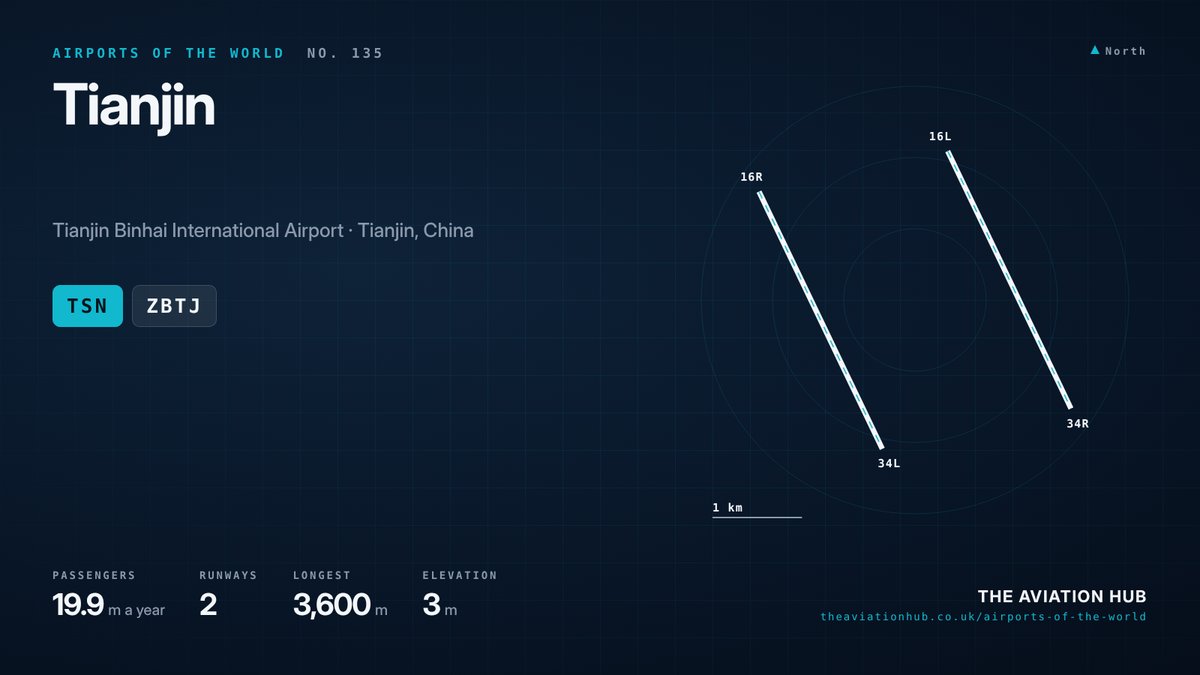
Tianjin Binhai International Airport lies about 8 miles (13 km) east of the centre of Tianjin, the port city of northern China that sits an hour from Beijing by high speed rail. It is the main airport of one of China’s four municipalities under direct central control and the 26th busiest in the country. Tianjin Airport handled just under 20 million passengers in 2025, a figure held down by the pull of the two Beijing airports but supported by a strong cargo business and the Airbus assembly plant beside the field. Two parallel runways and two terminals serve a network led by Tianjin Airlines and Okay Airways.
Tianjin Airport at a Glance
The codes are TSN and ZBTJ. The field sits at just 3 m (10 ft) above sea level on the flat alluvial plain between the city and the Bohai Sea, in Dongli district. It has two runways, 16R/34L and 16L/34R, and two terminals, the 2006 building now known as Terminal 1 and the much larger Terminal 2 that opened on 28 August 2014.
Tianjin Binhai International Airport Company, a subsidiary of Capital Airports Holding, operates Tianjin Airport. Tianjin Airlines and Okay Airways are headquartered on the field, and Air China and Xiamen Airlines treat it as a focus city. Traffic in 2025 was about 19.9 million passengers, down 1 per cent on the year before, with around 147,000 aircraft movements and roughly 133,000 tonnes of cargo. Transport and parking information is on the airport’s official website.
How Tianjin’s Airport Came to Be
The airfield at Zhangguizhuang dates from November 1939, when the Japanese occupation built it as a military base. It reopened in 1950 as Tianjin Zhangguizhuang Airport and later took the Binhai name, which ties the airport to the Binhai New Area economic zone being developed along the coast.
For decades Tianjin lived in Beijing’s shadow, with the capital’s airport only 75 miles (120 km) away. Its distinctive role grew from cargo and industry. A new passenger terminal opened in 2006 and the second runway was completed in May 2009. In 2008 Airbus opened its first final assembly line outside Europe beside the airport, where A320 family aircraft are built for Chinese customers, later joined by an A330 completion and delivery centre.
Terminal 2 and the Line 2 metro station opened together on 28 August 2014, lifting the airport into the modern era. Okay Airways, China’s first private airline, chose Tianjin as its home in 2005, and Tianjin Airlines grew from Grand China Express into a large regional operator based here.
Runways at Tianjin Airport
The main runway, 16R/34L, is 3,600 m (11,811 ft) long and 60 m wide, surfaced in concrete. The parallel runway, 16L/34R, completed in 2009, is 3,200 m (10,499 ft) long and 45 m wide, also concrete. The two lie far enough apart for simultaneous operations, and the airport typically uses one for arrivals and the other for departures during peaks.
The airport is rated 4E rather than 4F, which makes it the only one of China’s four municipal airports without the top classification. In practice Boeing 777s and Airbus A330s use it routinely, and the Airbus plant delivers A320neo family jets and A330s from the field, so new airframes on their first flights are a regular sight.
Northerly winds dominate in winter, bringing arrivals in from the south on the 34 runways, while summer sea breezes often favour the 16 direction with approaches from the north. Fog and winter smog are the chief hazards, and the busy airspace of the capital region adds to the workload.
Terminals and Airlines
Terminal 2 is the main building, a long curved hall with separate departure and arrival levels and a basement transport centre with the metro station, transfer hall and car parks. Dozens of jet bridges serve the two buildings. Terminal 1 now handles a smaller share of the domestic traffic, and the two are linked by a walkway and shuttle.
Tianjin Airlines flies Airbus A320 family jets and Embraer E190 and E195 regional aircraft across China and to a handful of Asian cities, and it has operated A330s on longer routes. Okay Airways fields Boeing 737-800s and 737 MAX 8s. Air China, Xiamen Airlines, China Eastern, China Southern, Hainan Airlines, Spring Airlines and Juneyao all operate substantial schedules at Tianjin Airport.
International service comes from Korean Air and Asiana to Seoul, Japan Airlines to Nagoya, the Chinese carriers to Tokyo and Osaka, and Scoot, Thai Lion Air, EVA Air and Vietnamese carriers to Singapore, Bangkok, Taipei and Nha Trang. Cargo airlines are prominent, with Lufthansa Cargo, ANA Cargo, Korean Air Cargo and the Chinese freight carriers using the dedicated cargo apron.
Routes and Destinations
The busiest routes are the trunk links to Shanghai, Guangzhou, Shenzhen, Chengdu, Chongqing, Hangzhou, Xi’an and Kunming. Routes to the north east, including Harbin, Shenyang and Dalian, are strong because Tianjin is the gateway between the industrial north and the rest of the country. Beijing itself is not served by air, the high speed train covering the distance in 30 minutes.
Internationally the airport serves Seoul, Tokyo Narita and Haneda, Osaka, Nagoya, Bangkok, Singapore, Taipei and Hong Kong. Hainan Airlines launched a Vancouver service in 2018, the first intercontinental passenger route, but withdrew it in January 2019. Tianjin Airlines now flies to London Heathrow and Sydney. Cargo is where Tianjin Airport punches above its weight, with around 133,000 tonnes in 2025 and a long history among the top cargo gateways in China.
Traffic peaks at Chinese New Year and the October holiday, with summer strong on the Korean and Japanese routes.
Getting to and from Tianjin Airport
Tianjin Metro Line 2 runs from the station beneath Terminal 2 to the city centre and Tianjin railway station in around 30 to 40 minutes for a fare of about ¥3 to ¥4, the cheapest sensible option by a wide margin. At Tianjin station the intercity high speed line reaches Beijing South in around 30 minutes, which makes the airport a practical alternative gateway for the capital.
Airport buses run to the city centre, Tianjin West station and the Binhai New Area, and long distance coaches serve Beijing and cities across Hebei. By road the airport sits beside the Jinbin expressway and the outer ring road. A taxi to the centre costs around ¥50 to ¥70 (roughly £5 to £8) and takes 25 to 40 minutes. Underground and surface parking is plentiful at Terminal 2.
Spotting and Photography
Tianjin Airport is a rewarding stop for enthusiasts because of the Airbus plant. Brand new A320neo family aircraft in airline liveries conduct test flights from the field, and A330s arrive from Toulouse for cabin completion and leave in the colours of Chinese carriers. Views from inside Terminal 2 take in the main apron and the runways beyond, and the gate windows are the safest place to work.
Outside, the roads south of the 34 thresholds near Dongli give views of arrivals in northerly winds, with afternoon light from the west. The cargo apron hosts freighters from Lufthansa Cargo, Korean Air Cargo and the Chinese cargo airlines, often at night.
Photography near Chinese airport fences draws police attention quickly, and the Airbus plant and military areas are off limits. Stay on public roads, keep your passport with you and avoid pointing cameras at anything other than aircraft.
What Comes Next
The airport is expanding in three phases under a plan that would take the terminal area beyond 500,000 square metres and lift capacity to 40 million passengers a year, with the site growing from 25 to 80 square kilometres. More terminal space and airfield capacity feature in the long term layout, and the cargo zone is being enlarged to serve the Tianjin free trade area and the port.
The constraints are competition and airspace. Beijing Daxing opened in 2019 within reach of many Tianjin passengers, and the crowded skies of the capital region limit how many extra slots Tianjin can add. The airport’s answer is cargo, regional connectivity and the lure of cheaper fares than Beijing.
Tianjin Airport will grow as an industrial and freight gateway with the Airbus plant as its calling card, rather than as a rival to Beijing. See how it sits among China’s airports on the Airports of the World map.
Continue to follow The Aviation Hub for more analysis and insight.
Advertise with us Your brand, in front of an aviation audience Home page and in-article placements, sold directly, one advertiser per slot. From £250 a year. See the rates

