
Tijuana Airport Guide: Cross Border Xpress and Beyond
Tijuana Airport sits on the US border, with a bridge that lets San Diego travellers walk straight in. Explore its runway, airlines, routes and access.
 By The Aviation Hub
6 min read
Updated October 20, 2026
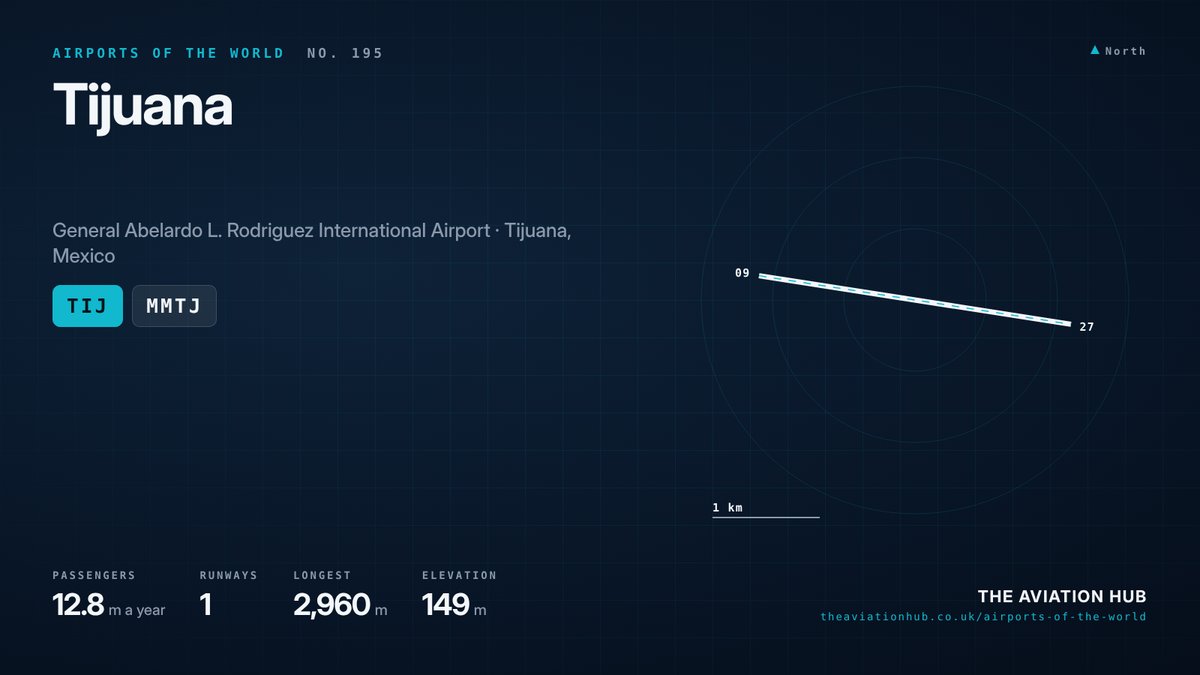
Tijuana Airport, officially General Abelardo L. Rodriguez International Airport, sits hard against the border between Mexico and the United States. It serves Tijuana and the wider San Diego region, and a footbridge lets passengers walk across the frontier straight into the terminal. Around 12.65 million people used it in 2025. That makes it one of the busiest airports in Mexico, and a vital domestic link for millions of Californians with Mexican roots.
Tijuana Airport at a Glance
The IATA code is TIJ and the ICAO code is MMTJ. The airport lies in the Otay Mesa district, roughly 3 miles (5 km) northeast of downtown Tijuana. Elevation is 149 metres (489 feet). There is one active runway and one passenger terminal with two concourses, plus a separate processing building for the cross border bridge.
Tijuana Airport handled about 12.65 million passengers in 2025, up 0.8 per cent on 2024. The record year remains 2023, with 13.18 million. Volaris runs its hub here and is the largest operator, while Viva has used the airport as a focus city since 2015. Grupo Aeroportuario del Pacifico, known as GAP, has operated it since 1999. Flight information is on the airport’s official website.
How Tijuana’s Airport Came to Be
Tijuana’s first airport stood on land now crossed by Agua Caliente Boulevard. Its replacement opened on 1 May 1951 as the Aeropuerto Federal de Tijuana, on the mesa east of the city. In 1965 it passed to the state airports body, ASA. The name honours General Abelardo L. Rodriguez, a former governor of Baja California who served as President of Mexico from 1932 to 1934.
The original runway, 10/28, created an awkward problem. It ran so close to the border that departing aircraft strayed into American airspace soon after take off. After Operation Intercept in 1969 raised border tensions, pressure grew to stop the incursions. In 1970 a new 2,500 metre runway, 09/27, opened about 300 metres south of the border along with a larger terminal, and the old terminal became a Mexican Air Force base known as the Aeropuerto Viejo.
Privatisation under the 1995 Airports Law brought Tijuana into the GAP group in 1999. Concourse extensions and renovations followed under GAP. The biggest change came on 9 December 2015, when the Cross Border Xpress opened.
Runways at Tijuana Airport
Tijuana Airport has one active runway, 09/27, which is 2,960 metres (9,711 feet) long and 44 metres wide. It handles everything from Airbus A320neo jets to the Boeing 787 used on the Beijing service. A second runway, 10/28, measured 2,000 metres (6,561 feet) but is now closed.
Prevailing westerly winds off the Pacific favour runway 27 for much of the time, so arrivals usually come in from the east, switching to the west when Santa Ana winds blow. Cerro San Isidro and the hills to the east make the approach more demanding than the flat coastal airports nearby. The border shapes the airspace on every flight. Brown Field Municipal Airport sits only a short distance away on the American side, and controllers in both countries coordinate closely.
The single runway is not the main constraint. Terminal space, stands and border processing have been the pinch points, which is why investment has focused on buildings rather than concrete.
Terminals and Airlines
The terminal at Tijuana Airport has two concourses. Concourse A is domestic, with nine gates, five of them with jet bridges. Concourse B handles domestic and international flights through eight gates, five of them with jet bridges. A New Transit Processing Building opened in 2022 to handle passengers arriving over the Cross Border Xpress bridge.
The Cross Border Xpress, or CBX, links Tijuana Airport with a 4,200 square metre terminal on American soil in southern San Diego. A 120 metre (390 feet) bridge crosses the border, and passengers clear customs at either end. Designed by the late Ricardo Legorreta, it cost about US$120 million and now carries roughly a third of all passengers. Volaris, Viva, Aeromexico and the revived state owned Mexicana fly domestic routes, while Hainan Airlines and American Eagle add international services.
Routes and Destinations
Mexico City is the busiest route, with 982,170 passengers in 2025. Guadalajara followed closely with 909,402, then Culiacan, Leon Bajio and Monterrey. Puerto Vallarta, Morelia, San Jose del Cabo and Mexico City’s newer Felipe Angeles airport also feature strongly. Volaris alone serves around 35 domestic destinations.
Cancun is the longest domestic nonstop route in Mexico, a flight of more than four hours across the country. Hainan Airlines flies to Beijing, the only passenger link between the San Diego and Tijuana area and China. Since 2024 China Southern has used the airport as a refuelling stop on its Shenzhen to Mexico City service, though passengers cannot board there. Demand peaks around Christmas, Easter and the summer holidays, when families visit relatives across Mexico.
Getting to and from Tijuana Airport
For travellers in California, the CBX is the obvious route into Tijuana Airport. Park or get dropped off at the San Diego building, buy a bridge ticket, walk across and check in. Mexicoach runs coaches from the CBX to San Diego and Los Angeles. In 2025 about 4 million passengers used the bridge.
On the Mexican side, city buses link the terminal with downtown Tijuana, Zona Rio and Otay for MX$14 to MX$16, which is the cheapest sensible option. Autobuses ABC runs coaches to Ensenada and Mexicali. Public taxis can drop off but not pick up, so arriving passengers use authorised airport taxis at higher fares. Hire cars and parking are available, and the drive downtown takes 15 to 30 minutes.
Spotting and Photography
Spotting here comes with a frontier attached. Higher ground in the neighbourhoods south of the field gives views across the runway, with Volaris and Viva A320neo jets dominating the traffic. The Hainan 787 and the China Southern stopover are the prizes. Inside the terminal, gates in both concourses overlook the apron.
Light favours positions on the south side for most of the day, since the sun stays in the southern sky. The border fence runs along the northern edge of the airfield, and both countries patrol it closely. Never photograph border infrastructure, military areas or the Air Force base, and move on if asked by police or soldiers. Respect local rules at all times.
What Comes Next
GAP has spent heavily on the terminal and the CBX link, and further expansion of check in, security and stand capacity is part of its development plans. Officials said the 2022 processing building was meant to support long haul routes to Asia and South America. Growth has flattened since the 2023 peak, so new routes will matter more than new buildings.
The CBX model remains the airport’s real advantage, turning San Diego into a catchment area for Mexican domestic flights. Tijuana Airport is heading for steady growth as a binational gateway rather than a purely Mexican one. Compare it with its neighbours on the Airports of the World map.
Continue to follow The Aviation Hub for more analysis and insight.
Advertise with us Your brand, in front of an aviation audience Home page and in-article placements, sold directly, one advertiser per slot. From £250 a year. See the rates

