
Tirana Airport Guide: Albania’s Fast Growing Gateway
Tirana Airport carried a record 11.6 million passengers in 2025. Discover its history, runway, airlines, busiest routes, transport links and future plans.
 By The Aviation Hub
6 min read
Updated October 20, 2026
Tirana International Airport Nene Tereza, known to most Albanians simply as Rinas, is the front door to one of Europe’s fastest growing tourist destinations. Tirana Airport handled a record 11.6 million passengers in 2025, more than ten times its traffic of the early 2000s. It is currently the only airport in Albania with scheduled passenger flights, so it serves the whole country, from the capital to the beaches of the riviera. Wizz Air and Ryanair have turned it into a low cost battleground.
Tirana Airport at a Glance
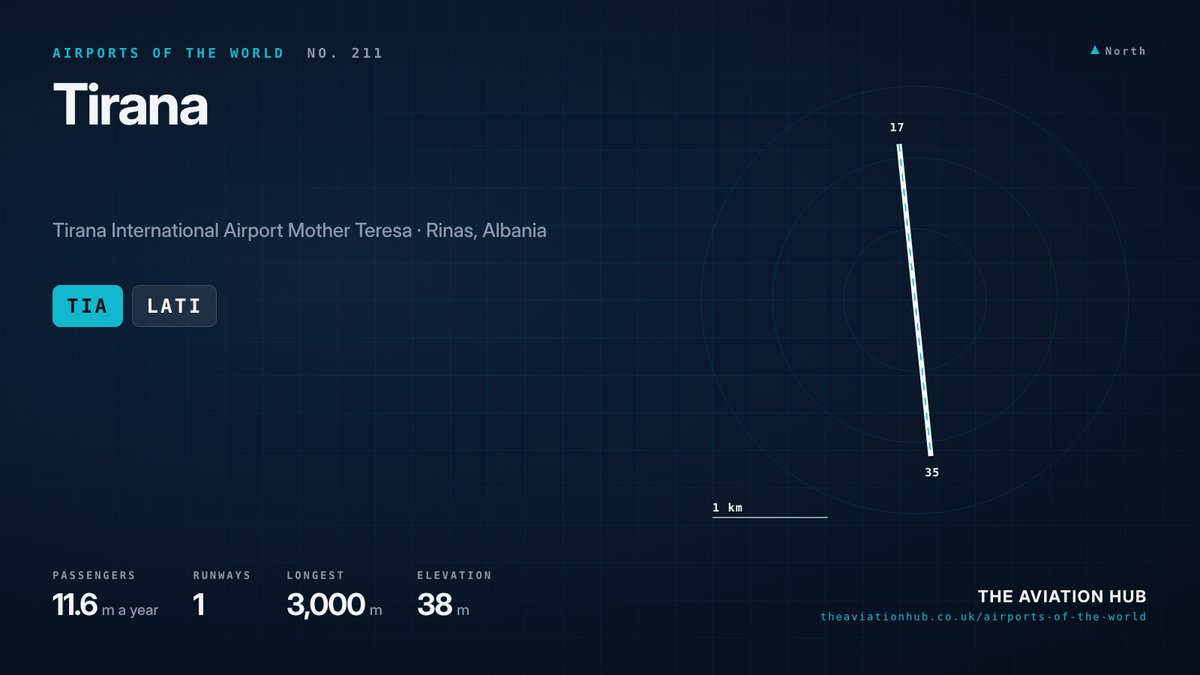
The IATA code is TIA and the ICAO code is LATI. The airport sits on the plain at Rinas, about 7 miles (11 km) north west of central Tirana as the crow flies and roughly 11 miles (17 km) by road. Elevation is 126 ft (38 m). There is one runway and one passenger terminal.
Traffic reached about 11.6 million passengers in 2025, after passing 10 million for the first time in 2024. Wizz Air carried around 54 per cent of passengers and Ryanair about 22 per cent, and both keep aircraft based here. The flag carrier Air Albania flew from the field until it stopped operating at the end of 2025. Tirana International Airport SHPK operates it under a long term concession. Timetables and parking details are on the airport’s official website.
A Short History of Rinas
Commercial flying reached Tirana in 1926, when the German airline Adria Aero Lloyd began domestic services. The current site at Rinas was built between 1955 and 1957. Under the communist regime that followed, Albania sealed itself off, and only a handful of foreign airlines kept a thin link with the outside world.
The airport opened up after the fall of communism in the early 1990s. It took the name of Mother Teresa, the Albanian Catholic nun and missionary who died in 1997. In 2005 a consortium led by the German group Hochtief won a concession to rebuild and run the airport, and a new passenger terminal opened in 2007.
Ownership has changed hands since. China Everbright became sole owner of the operator in 2017, and the Albanian Kastrati Group took control in 2020. The original deal gave Rinas a monopoly on international flights, which was later relaxed to let other airports in the country develop.
Runways at Tirana Airport
Runway 17/35 is the only strip, asphalt surfaced, 3,000 m (9,843 ft) long and 45 m wide. That length suits the Airbus A321neo and Boeing 737 MAX fleets that dominate the schedule, and it handles occasional wide body charters without trouble.
The runway runs roughly north to south across the Rinas plain, with hills rising to the east and the Adriatic coast roughly 12 miles (20 km) to the west. Wind decides which end is in use. Arrivals on Runway 17 come in from the north over open farmland, while those on Runway 35 cross the low ground to the south.
With one runway and a single terminal, Tirana Airport is now feeling summer peaks. Stand capacity, not runway length, is the main limit. Morning and evening waves of based aircraft leave the apron crowded, and turnaround times are tight on peak weekends.
Terminals and Airlines
All flights use the terminal opened in 2007, which has been extended since to cope with demand. Arrivals and departures share one building, with Schengen and non Schengen passengers all passing through passport control because Albania sits outside the Schengen area.
Wizz Air is the dominant airline at Tirana Airport, with a large base of Airbus A321neos serving Italy, Germany, the United Kingdom and Central Europe. Ryanair is the second largest operator, focused on Italy and the UK. Air Albania, set up in 2018 with Turkish Airlines as a partner, flew Airbus narrow bodies to Istanbul and Italy before it stopped operating at the end of 2025.
Turkish Airlines, Pegasus, Lufthansa, Austrian Airlines, ITA Airways, Aegean Airlines and Eurowings are among the other regular carriers. Seasonal charters add capacity from Poland, Scandinavia and the Czech Republic in summer.
Routes and Destinations
Italy is the largest country market by a distance, reflecting the large Albanian diaspora there. Milan was the busiest destination from Tirana Airport in 2025, with about 1.02 million passengers across its airports. London came second at around 933,000, and Rome was third with roughly 588,000.
Germany is the second biggest country market, followed by the United Kingdom. Bologna, Bergamo, Pisa, Venice and Bari feed the Italian network, while Istanbul provides onward connections across Asia. Diaspora traffic peaks around Christmas and in high summer, when families return home.
Tourism has added a new layer of demand. Visitors heading for Durres, Saranda and the Albanian riviera now use Rinas in large numbers, and new routes keep arriving. A Luxair service is due from spring 2027.
Getting to and from Tirana Airport
The airport connects to the main Tirana to Durres highway via the SH60 road. A taxi to central Tirana takes around 20 to 25 minutes outside rush hour and costs roughly 2,500 lek (about £22). Fares are fixed for the main city zones, so agree the price before setting off.
The cheapest sensible option is the airport bus. It runs around the clock, roughly every hour, between the terminal and central Tirana for a few hundred lek. Car rental desks fill the arrivals hall, and many visitors drive straight to the coast. Durres is about 40 minutes away by road.
A new electrified railway linking Tirana, Durres and Tirana Airport is under construction, with a dedicated station at the terminal. Opening is planned for early 2027.
Spotting and Photography
Tirana Airport offers a lively mix for enthusiasts. Wizz Air and Ryanair dominate, but Pegasus, Turkish Airlines and a stream of summer charters add colour. The hills to the east frame departures well on clear mornings.
Roads and farm tracks around the perimeter give views of both approaches, though there are no formal viewing areas. The terminal’s departure lounge has windows over the apron. Light is best in the morning from the eastern side and in the afternoon from the west.
Behave sensibly near the fence, do not stop on access roads and respect any instruction from the police. The airport has suffered two high profile armed robberies, in 2016 and 2019, so security staff are alert to anyone loitering.
What Comes Next
The rail link is the most important project, giving the airport its first fixed transport connection. Further terminal and apron work is needed to keep pace with the low cost airlines, which continue to announce routes.
Competition is coming. A new airport at Vlore in the south is being developed to serve the coast, and others may follow. The terms of the concession, which dates from 2005, will shape the next phase of investment.
Tirana Airport is heading for further growth as Albania’s tourism boom matures, with space rather than demand as the real constraint. Compare it with other Balkan gateways on the Airports of the World map.
Continue to follow The Aviation Hub for more analysis and insight.
Advertise with us Your brand, in front of an aviation audience Home page and in-article placements, sold directly, one advertiser per slot. From £250 a year. See the rates

