
Toronto Pearson Airport Guide: Canada’s Five Runway Hub
Toronto Pearson Airport is Canada's busiest airfield and Air Canada's global hub, with five runways and two terminals. Routes, UP Express access and spotting.
 By The Aviation Hub
7 min read
Updated October 20, 2026
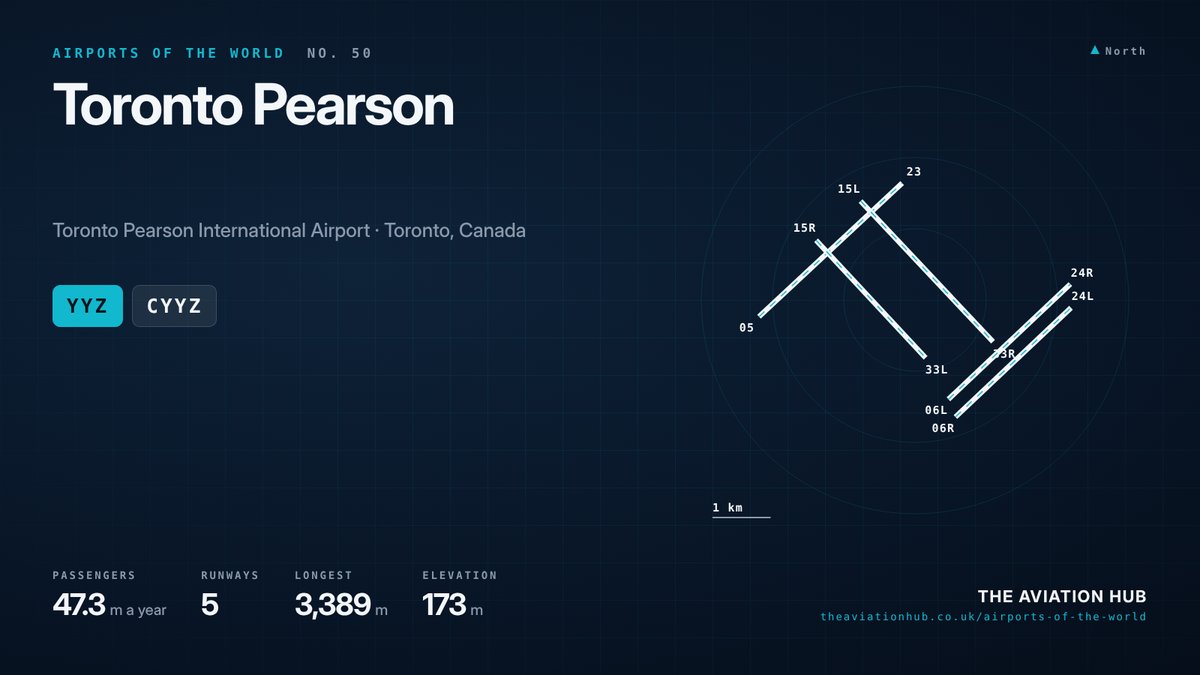
Toronto Pearson International Airport is the largest and busiest airport in Canada, lying in Mississauga about 12 miles (20 km) northwest of downtown Toronto. It handled roughly 47.3 million passengers in 2025 and serves more than 180 destinations on six continents with over 50 airlines. Toronto Pearson Airport is the primary global hub of Air Canada and an important base for WestJet and Porter Airlines. Five runways and two large terminals give it a scale that no other Canadian field approaches.
Toronto Pearson Airport at a Glance
The IATA code is YYZ, inherited from the telegraph code of the old Malton railway station, and the ICAO code is CYYZ. The airport sits at 173 metres (569 feet) above sea level on the gently rolling farmland west of Toronto, now entirely surrounded by suburbs and industrial estates. Five runways in two alignments serve Terminals 1 and 3, which are linked by the free Terminal Link people mover.
Passenger traffic in 2025 reached about 47.3 million, a modest rise on 2024. Air Canada and its Rouge and Express subsidiaries carry well over half the passengers. WestJet and Porter both treat the airport as a hub, Air Transat uses it as a focus city and Flair Airlines operates a base. The Greater Toronto Airports Authority, a not for profit corporation, operates the field within Transport Canada’s National Airports System. Parking and transit updates are on the airport’s official website.
From Malton Airport to Pearson
The federal government agreed in 1937 to support two airports for Toronto, one on the waterfront and one inland. The inland site at Elmbank near the village of Malton opened in 1938, with the first scheduled passenger flight arriving in 1939. Trans Canada Air Lines made Malton its eastern operating base, and wartime production of Avro Lancasters at the adjacent Victory Aircraft plant brought the field national importance.
The Aeroquay, a circular terminal with a central parking garage, opened in 1964 and became an icon of Canadian modernism. Terminal 2 followed in 1972 and Terminal 3 in 1991. The airport was renamed Lester B. Pearson International Airport on 2 January 1984 after the former prime minister and 1957 Nobel Peace Prize laureate.
The GTAA took over from Transport Canada in 1996 and launched a redevelopment that replaced the Aeroquay and Terminal 2 with the present Terminal 1, opened in stages from 2004. On 2 August 2005 Air France Flight 358, an Airbus A340-300, overran Runway 24L in a thunderstorm and came to rest in the Etobicoke Creek ravine beside Highway 401. All 309 people aboard survived, which earned the event the nickname the Toronto miracle.
Runways at Toronto Pearson Airport
Five runways serve the field. Three run roughly east to west. Runway 05/23 is the longest at 3,389 metres (11,120 feet) on asphalt and concrete. Runway 06L/24R measures 2,956 metres (9,697 feet) and Runway 06R/24L is 2,743 metres (9,000 feet), both asphalt. The two north to south runways are Runway 15L/33R at 3,368 metres (11,050 feet) and Runway 15R/33L at 2,770 metres (9,088 feet), again asphalt. All five are 61 metres wide.
The east to west runways carry the bulk of the traffic. Westerly winds prevail, so the 23 and 24 runways are the standard configuration, with arrivals on 23 and 24R and departures on 24L. Easterly flow puts operations on the 05 and 06 runways. The north to south pair come into play in strong crosswinds and at night to spread noise.
Toronto Pearson Airport operates under a night flight restriction programme that limits movements between midnight and 06:30. Winter brings heavy snow, and the airport runs one of the largest de icing facilities in the world, a central pad that can treat a dozen aircraft at once. Lake effect fog from Lake Ontario occasionally disrupts morning operations.
Terminals and Airlines
Terminal 1 is a vast building with piers D, E and F. It houses Air Canada and all its subsidiaries, the Star Alliance carriers including United, Lufthansa, Austrian, Swiss, Turkish and Air China, plus Royal Air Maroc and non aligned airlines such as Emirates, Etihad and Air North. Air Canada’s Maple Leaf lounges and the Signature Suite for premium passengers sit in this terminal.
Terminal 3 at Toronto Pearson Airport handles almost everyone else. WestJet, Porter, Air Transat and Flair fly from here alongside the SkyTeam carriers Delta, Air France, KLM and Korean Air and the oneworld carriers American, British Airways, Cathay Pacific, Qatar Airways and Iberia. The building opened in 1991 as the privately developed Trillium Terminal and has been expanded several times since.
Both terminals contain United States Customs and Border Protection preclearance facilities, so passengers to American cities clear immigration before departure and arrive as domestic travellers. The Terminal Link train connects the two buildings with the Viscount station and long stay car parks in a few minutes.
Routes and Destinations
Domestically, Vancouver, Montreal, Calgary and Ottawa are the heaviest routes, with Air Canada and WestJet competing hour by hour. Transborder flying to the United States is enormous, with New York LaGuardia, Chicago O’Hare, Newark, Boston and Los Angeles among dozens of American cities served daily. Toronto Pearson Airport is one of the biggest sources of United States bound passengers anywhere outside the country.
Internationally, London Heathrow leads, followed by Cancun, Punta Cana, Frankfurt and Paris. Air Canada’s long haul network reaches Tokyo, Seoul, Hong Kong, Shanghai, Delhi, Mumbai, Dubai, Tel Aviv, Sao Paulo and Sydney. The longest sectors run to Sydney and Manila. Winter sun routes to the Caribbean and Mexico swell the schedule from December to April, while Europe dominates the summer.
Cargo throughput exceeds 400,000 tonnes a year. FedEx, UPS, Cargojet and several foreign freighter operators use the Infield cargo area between the runways.
Getting to and from Toronto Pearson Airport
The UP Express train runs from Terminal 1 to Union Station downtown in about 28 minutes, roughly every 15 minutes, for around CAD 12.35 (approximately £7). It is the quickest and most reliable option. The TTC 900 Airport Express bus connects to Kipling subway station and routes 52, 352 and 952 serve Lawrence West station. A standard TTC fare of about CAD 3.35 makes the bus and subway combination the cheapest sensible option, taking around an hour.
GO Transit routes 40 and 94 link the airport with the wider region. Highways 427 and 409 feed directly into the terminal roads, with Highway 401 close by. A taxi or ride share to downtown costs around CAD 60 to 75 (roughly £35 to £43) and takes 30 to 50 minutes depending on the notoriously congested 401. Multi level garages sit in front of both terminals, with cheaper long stay lots served by the Terminal Link.
Spotting and Photography
Toronto Pearson Airport is a friendly place for spotters. The Terminal 1 parking garage roof and the Terminal Link viewing points give wide apron views. Outside the fence, the car park and footpath area beside Airport Road and Derry Road on the northeast corner overlooks the 24R and 24L thresholds in the usual westerly flow. The Carlingview Drive strip near the 23 approach and the Sheraton Gateway hotel, built inside Terminal 3, are also popular.
Easterly operations bring arrivals over Mississauga onto the 05 and 06 runways, best viewed from the Renforth Drive area. Morning light favours the east side, afternoon the west. Peel Regional Police are used to enthusiasts but will check identification, so stay on public ground, avoid blocking traffic and keep away from fence lines. Expect Air Canada 787s and 777s, Emirates A380s and a steady Cargojet 767 parade.
What Comes Next
The GTAA is investing heavily in Terminal 1 piers and baggage systems under its LIFT programme, with new pier capacity and expanded check in halls planned for the late 2020s. A Pearson transit hub opposite Terminal 3 will gather the UP Express, GO buses and a westward extension of the Eglinton Crosstown light rail line, scheduled for around 2030 to 2031. A link to the Finch West line is also under study.
A sixth runway is not on the near term agenda, and night restrictions cap growth in movements, so the future lies in larger aircraft and better connections. Air Canada’s order book of Boeing 787-10s and Airbus A321XLRs points that way. Toronto Pearson Airport will remain Canada’s dominant gateway for decades. Our Airports of the World map shows how it compares with the other North American giants.
Continue to follow The Aviation Hub for more analysis and insight.
Advertise with us Your brand, in front of an aviation audience Home page and in-article placements, sold directly, one advertiser per slot. From £250 a year. See the rates

